
ANGLE PLC (AIM:AGL, OTCQX:ANPCY) Chief Executive Andrew Newland talked with Proactive about the company’s recent breakthrough in dual ctDNA and CTC DNA analysis on the Illumina platform. The six-month project overcame technical hurdles to achieve an end-to-end solution using Illumina’s specialist lung cancer DNA kit, demonstrating its potential impact in a 27-patient study.
Newland highlighted that ANGLE’s Parsortix system identified actionable DNA variants in circulating tumour cells (CTCs) that were not present in ctDNA samples. This advancement underscores the importance of analyzing intact cancer cells rather than focusing solely on fragmented DNA. He also noted that Illumina has allocated its upcoming European Association of Cancer Research conference webinar to ANGLE’s findings, marking the start of a co-marketing initiative.
On the relevance of artificial intelligence (AI), Newland explained how it is used in analyzing proteins on cells and molecular signatures, emphasising that the best possible sample, like Parsortix-based ones, is key to maximizing the impact of AI and sequencing in liquid biopsies.
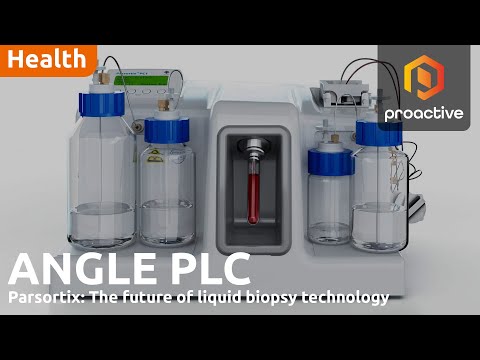
Proactive: I'm joined by ANGLE PLC Chief Executive Andrew Newland. Andrew, very good to speak with you. You've announced successful results for your dual ctDNA and CTC DNA workflow on the Illumina platform for the first time. Can you tell us about the new data and its significance?
Andrew Newland: Yes, well, we're really happy. We've been working for some time now to see if we can get an Illumina end-to-end solution in place. It’s taken us over six months to resolve a number of technical issues, but we’re delighted that we’ve done that.
This differs from the work we previously presented, which was using a third-party DNA kit on the Illumina sequencing. This is Illumina’s end-to-end DNA kit—a specialist lung cancer kit—and Illumina sequencing. What we’re pleased about is that we’ve got some very strong data for lung cancer. Specifically, in a 27-patient study, we identified actionable DNA variants in circulating tumour cells (CTCs) for 100% of eight patients diagnosed with cancer but not yet treated. These variants were not present in the ctDNA samples.
For treated patients, whether still undergoing treatment or between treatments, we found actionable clinical variants in CTC DNA for 90% of cases. These variants were not present in ctDNA either. This adds to the evidence of the importance of analyzing circulating tumour cells. The difference here is that it was achieved using a specialist lung cancer panel with an end-to-end Illumina solution.
Proactive: And what's the significance of this for ANGLE?
Andrew Newland: Obviously, we’re building evidence for DNA dual analysis. We think it’s incontrovertible that getting intact cancer cells provides additional information beyond ctDNA, which is derived from fragments of dead cells. This is another step toward demonstrating that.
The major significance for ANGLE is the end-to-end Illumina solution. Illumina is excited about this too. They’ve allocated their entire webinar for the European Association of Cancer Research conference on February 6th to ANGLE’s presentation of these results. This marks the start of a new co-marketing program between Illumina and ANGLE.
Illumina has 23,000 sequencing systems in the market, sold to 9,500 customers. All these customers could benefit from buying a Parsortix system to recover samples and extend their analysis from ctDNA to both ctDNA and circulating tumour cells. That’s why we’re very happy about this development.
Proactive: Andrew, there’s been intense interest in AI this week. While I have you, is there any relevance of AI and the recent news to liquid biopsy?
Andrew Newland: Oh, that’s an interesting one. Yes, there’s been a lot of news about AI. Artificial intelligence has relevance in liquid biopsy, and we’re already using it in a couple of areas. For example, we use it in image analysis when looking at proteins on cells under a microscope, to efficiently codify cells.
We’re also beginning to use it in molecular signatures, especially in ctDNA analysis. ctDNA produces fragmented data, and AI helps to make sense of it. In computing, we’ve seen Moore’s Law in action, where systems become smaller, faster, and cheaper. Sequencing and AI are following a similar path, with costs dropping as efficiency improves.
However, AI and sequencing companies will increasingly need high-quality content to differentiate themselves. That’s where ANGLE’s Parsortix system comes in. A good sample is critical to achieving meaningful results. It’s the old saying: garbage in, garbage out. The industry will eventually recognize the need to adopt Parsortix-based samples to obtain intact, living cancer cells rather than byproducts of the disease or the immune system. We believe this trend is playing toward ANGLE’s strengths.
Proactive: Andrew, congratulations again on today’s news. Thank you very much for speaking with us.