
Livium Ltd is increasing its strategic focus on scaling its battery recycling division, Envirostream, due to the potential of increased recycling volumes and cashflows over the years ahead.
Livium, previously Lithium Australia, has undertaken a review of the business to explore options to reduce costs — it expects the restructure and cost reductions to save an estimated A$1.5 million annually.
The revised strategy has an enhanced focus on strategic partnering initiatives to support ongoing growth and development of its technologies.
Right-sizing organisation
"We have advanced our strategy to inflection points, with the next phases of growth for each division requiring strategic partners to underpin their growth and development,” Livium CEO and managing director Simon Linge said.
“With a focus on strategic growth partners, we have reviewed our resourcing and made the decision to restructure our organisation and reduce costs.
“Livium remains committed to delivering returns for shareholders. Whilst organisational changes may impact our ability to react to opportunities, right-sizing the organisation assists in resetting the company's cost base to become sustainable over this critical period."
Envirostream battery recycling
Livium’s revenue-generating battery recycling division is Australia’s largest recycler of lithium-ion batteries, drawing on its technical expertise to provide value-added services and has strong commercial relationships.
The company has placed strategic focus on battery recycling, through Envirostream, due to the potential of increased recycling volumes over the coming years.
Envirostream made significant strides over the past year. It not only increased its volumes of electric vehicle (EV) and energy storage system (ESS) batteries but also secured exclusive customer arrangements, positioning the company as a key player in lithium-ion battery recycling nationally.
With consumer demand and regulatory pressures driving growth, LIT anticipates even greater volumes in the future.
Envirostream is focusing strategically on expanding its operations to meet growing demand. This includes potential investments in operational efficiency and capacity expansion, supported by discussions with advisors to explore various partnership and funding opportunities.
Envirostream successfully increased volumes of EV and ESS in 2024, with most of the volume being received under exclusive customer arrangements.
Over the year, Envirostream collected 736,000 tonnes of large format batteries and it is estimated that there are five times these volumes available today, which are increasingly expected to be recycled due to consumer demand and government regulation.
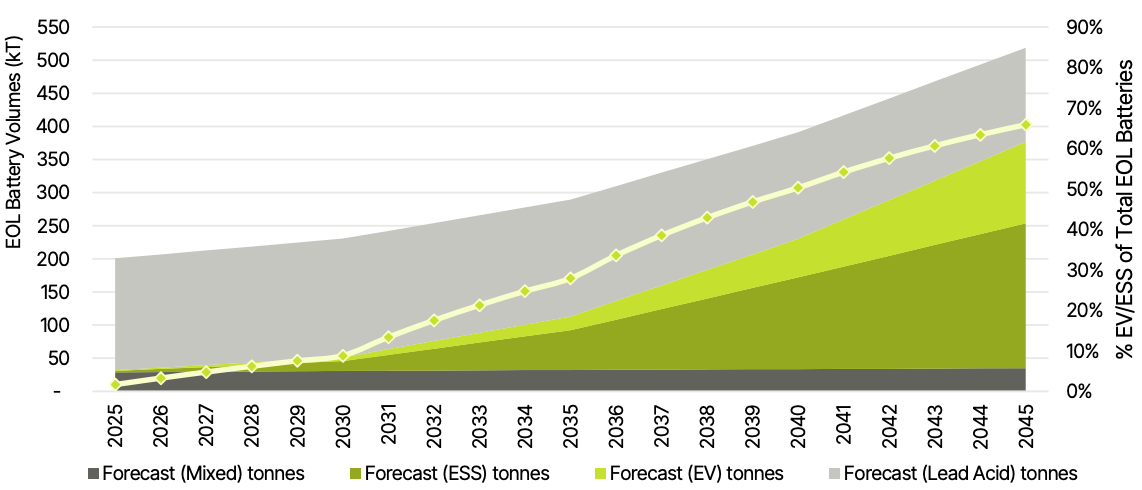
In its Battery Market Analysis, B-cycle shows how EV and ESS batteries are expected to dominate.
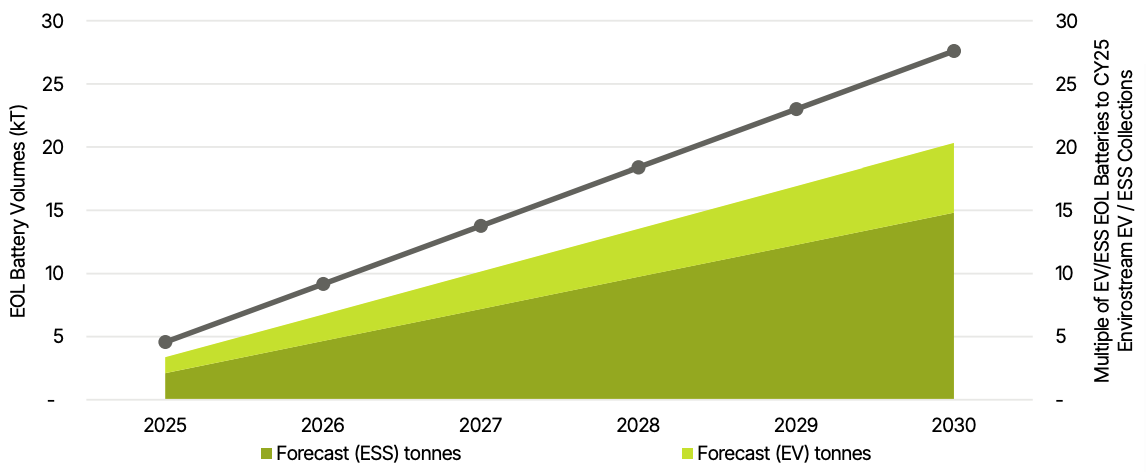
Focusing only on EV/ESS for the balance of the decade demonstrates the near-term opportunity for Envirostream collections growth relative to current performance.
Near term commercialisation
Livium is also “well advanced” on the near-term commercialisation pathways of its other technologies — battery materials and lithium chemicals:
Battery materials - Defined pathway for development of an Australian lithium ferro phosphate (LFP) demonstration plant with funding to be secured directly into VSPC from strategic partners.
Lithium chemicals - Complete joint development agreement (JDA) activities with MinRes, including assessment of alternate commercialisation pathways and selection of the preferred lithium product.
Cost restructure
The company says that its focus on strategic partnering requires a different resourcing structure. Consequently, LIvium decided to restructure, resulting in the targeted reduction of 25% of roles across the organisation.
Livium estimates that severance payments and other associated costs of this organisational review will be absorbed, and the benefit of reduced personnel costs seen by the end of the 2025 financial year.
Other cost-reduction activities are also being implemented, including the use of third-party support. Total estimated annual cost savings from the restructure are expected to be at least A$1.5 million.
What’s ahead?
Livium outlined the following activities as key to delivering value in the near term:
Battery recycling - Continued safe operations, growing end-of-life volumes and seeking partners to scale operations in line with the expected waste outlook and to expand into related services.
For Envirostream, the near-term outlook is positive, enabling increases of volumes collected and processed and providing an opportunity to expand service offerings in line with market requirements.
Battery materials - Secure funding for an Australian LFP demonstration plant from government and private strategic partners, who will invest directly into Very Small Particle Company (VSPC).
Lithium chemicals - Complete JDA activities with MinRes, including assessment of alternate commercialisation pathways and selection of the preferred lithium product
Corporate - Complete implementation of organisation restructure and other cost-saving initiatives.
To accommodate expectations of market growth, Livium intends to explore deploying growth capital to improve operating efficiencies and expand capacity.
The company has appointed advisors to coordinate discussions around partnership and growth funding options, which includes strategic partners and other financiers.