
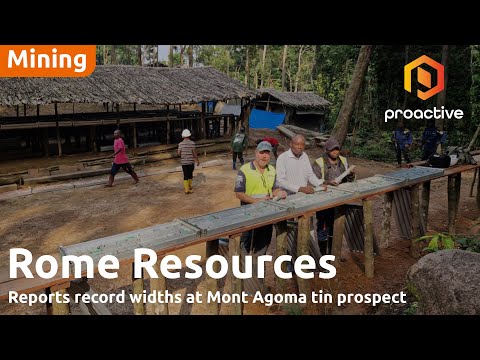
Rome Resources CEO Paul Barrett discusses the latest lab results from drilling the Mont Agoma tin prospect in the DRC.
Paul Barrett: I think the most interesting thing about them is that both of those two holes that we had the assays done for have produced or shown very wide tin zones, one at 30 meters, one at almost 40 meters. So these are very wide zones in the grand scheme of things.
What it does tell us is that where those holes were drilled is still in the transition zone between the copper-tin mineralization and the pure tin mineralization, which is deeper, which I think is really quite key to what we're going to do next.
So, because we see a wide tin zone of 30 to 40 meters, that’s much wider than the Alphamin zone that they're mining to the south, which is the highest-grade tin mine in the world. And it's a very, very profitable operation.
We believe that when we go down deeper into the system (this 40m-wide zone) it clearly can accept and is very accommodating of tin mineralization and will get better and better developed as you go down.
Not in terms of the overall thickness, but in terms of the amount of tin within that zone.
And that's in a way the Holy Grail, which is why we're now looking at continuing our drilling program deeper into that zone.
Proactive: In the RNS you draw a comparison between the mineralization at Mont Agoma and that of San Rafael in Peru, which is another tin-copper deposit.
Paul Barrett: Yes, it's a very common situation where you have a granite that includes some tin fluid.
When it's cooling, the tin fluids drop out at a high temperature so as the hydrothermal fluids come up they're usually at a deeper horizon.
And then the copper and the zinc, still in solution, come out at the lower temperature higher up.
So that gives you that zone in between—tin at the bottom, copper-tin in the middle, and just copper at the top. And that's exactly what San Rafael is.
Proactive: You are going deeper to examine this. So take us through the next steps of the drill program.
Paul Barrett: At Mont Agoma we've got three rigs active at the moment. They will be continuing drilling. We have a number of pads lined up offset slightly to the northeast.
When they're drilled, they come in under the existing intercepts. So we're looking to drill deeper under the intercepts to test that model.
Because we're in a very good position in terms of having the strategic investor come in just before Christmas, we are pretty healthily cashed up at the moment.
So we can continue this drilling program for the next two or three months to get this next phase of Mont Agoma holes drilled and then take stock.
On the other hand, we've got Kalayi, which is almost complete in terms of the drilling. We're getting the results in as we speak.
That’s something we will announce again quite shortly and then look to go straight to assess that for the resource numbers.
Mont Agoma—we’ve got to wait for these deeper holes. So it’ll be another month or two.