
Helium and natural gas company, D3 Energy Ltd (ASX:D3E, OTCQB:DNRGF), has confirmed significant helium and gas potential in South Africa as demand for the commodites outstrips supply.
The company is determined to unlock the resource potential of its flagship ER315 asset, in South Africa’s Free State Province. D3E was granted its 100% owned flagship methane and helium exploration asset in August, not long after the company’s IPO in May.
With world-class helium concentrations ranging between 5-9% and significant discovered natural gas resources, D3 Energy is positioned to address growing global helium demand while securing South Africa’s energy security and supporting energy transition efforts.
“We believe our asset is becoming a globally significant helium project at a time where supply is struggling and will struggle to meet both current and predicted demand,” D3E chair Greg Columbus said.
He added that the company is also, “developing into an important provider of natural gas in South Africa, helping address energy deliverability challenges and supporting the country’s sustainable energy transition, and importantly, deliver value to shareholders.”
Helium: a critical resource for the 21st century
As a critical resource that plays a vital role in various high-tech industries and cutting-edge applications, the price of helium is set to soar in coming years with a supply shortage looming.
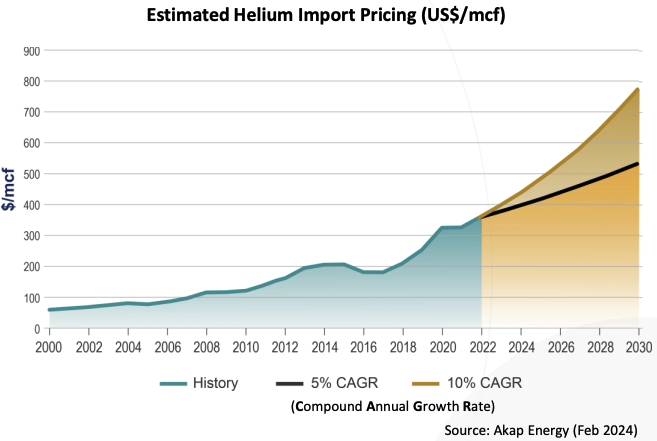
Helium prices is already at record highs levels, having gained 18% per annum over the past five years — a trend that is predicted to continue to increase.
Looking ahead, demand is predicted to remain high and to continue to grow. A finite resource, helium underpins diverse industries due to its unique thermal conductivity, inertness, and cryogenic properties.
There is no way of manufacturing helium artificially and most of the world’s reserves have been derived as a byproduct of the extraction of natural hydrocarbon gas.
One of its most significant uses is in the manufacturing of semiconductors. It is also essential for the cooling of nuclear reactors, and in the context of the global energy transition, helium-cooled reactors are emerging as a key technology for safe and efficient nuclear power generation.
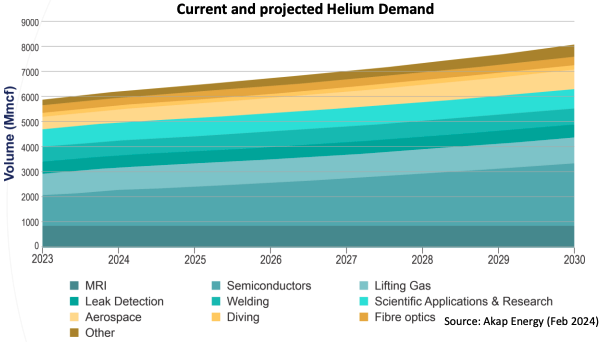
Irreplaceable in certain applications, current helium demand growth for helium is around 5-6% annually — double the expected supply growth. The total market demand for helium is tipped to grow from 6-billion-cubic-feet (BCF) to just over 8-BCF by 2030.
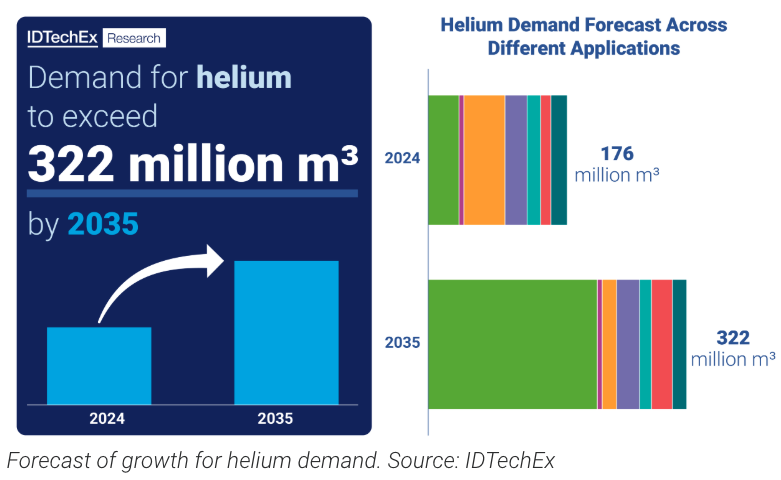
According to independent market intelligence group, IDTechEx, by 2035 demand for helium is expected to nearly double.
Helium supply is anticipated to expand in response to increasing demand, yet geopolitical risks may disrupt stability as a significant amount of production is from Qatar and Russia.
New medium and long-term supply largely comes as a by-product of planned oil and gas mega-projects, which are high cost and often delayed and can be subject to geopolitical influences.
As such, a prolonged tightening in the helium market is expected amid lower than expected global output and potential supply deferments — especially if the large projects in Qatar and Russia are delayed.
Prospective for methane
The opportunity in helium is clear, but the market fundamentals of D3E’s other production product, methane, also remain robust.
South Africa continues to experience significant energy shortages and the country appreciates the importance of natural gas to solve its current issues, and to play a part in the energy transition. The country currently imports gas via pipeline from the Pande and Temane fields in Mozambique with significant and growing shortfalls announced from 2024.
D3 Energy is ideally placed to not only meet this shortfall but to help South Africa transition more broadly to a more balanced, cleaner and lower emissions energy market.
Developing a globally significant helium project
Since listing, D3 Energy has delineated a significant contingent resource and prospective resource for both helium and natural gas at the ER315 project, which spans four permit areas totalling 442,750 acres and is adjacent to existing producer Renergen.
The company notes that converting just an initial percentage of its sizeable 2C contingent helium resource into reserves would translate into “enormous value”.
D3E began testing at ER315 in August — successfully flowing gas at legacy gold exploration borehole, RBD03, that was drilled within the area of ER315 back in 1983. D3E then delivered further positive results from other boreholes across the project.
Results from initial drilling confirmed world class helium concentrations averaging over 4% and as high as 9%.
Recent drilling also confirmed material gas (helium and methane) production from new borehole RBD10 of 191mscfd and existing legacy gold exploration borehole RBD03 of 147msfd.
There are 9 boreholes currently flowing with 3 wells at measurable rates. The company says that Bloemskraal boreholes have potentially been flowing gas at these rates since the early to mid 1980s.
These results support a production right (PR) application to expedite a pathway to development.
NOVO Energy — a South African gas retailer and major D3 shareholder — with the pair working towards initial offtake agreements.
NOVO, which is an integrated energy and technology company and licensed gas trader, is focused on procurement and development of methane rich gas sources; the establishment and ownership of gas infrastructure (CNG/LNG/pipelines); and the provision of turnkey customer solutions (industrial, NGV, power generation and feedstock).
Through a methodical technical approach, D3 Energy continues to deliver strong drilling and production testing results as it advances its projects, providing investors exposure to two critical commodities driving innovation worldwide and energy security.
The company says its asset is becoming a globally significant helium project at a time where supply is struggling and will struggle to meet both current and predicted demand, as well as developing into an important provider of natural gas in South Africa — helping address energy deliverability challenges and supporting the country’s sustainable energy transition.