
Olympio Metals Ltd (ASX:OLY, OTC:COPGF) has started preparing for a Fixed Loop Electromagnetic (FLEM) survey at the Chevrier high-grade copper Prospect within the Dufay Project in Quebec, Canada, as it seeks to identify conductive sulphide concentrations on the path to first drilling in late January 2025.
Chevrier contains showings of chalcopyrite-rich quartz veining mined previously, including an extensive historical adit, and is within 1,300 metres of the Cadillac-Lake Larder Fault Zone, known as the Cadillac Break.
The prospect, which includes the Chevrier workings, was mined briefly in the late 1920s and contains chalcopyrite-rich quartz veins with rock chip sampling values up to 6.78% copper.
Survey preparations
Line cutting for the FLEM survey started this week with the survey expected to be carried out in early January by TMC Geophysics, the same company that previously completed a ground IP survey within the Dufay Project area.
The EM survey method can identify conductive sulphide concentrations at depths of greater than 200 metres and modelling of anomalous responses can define drill targets.
Guiding drill locations
Olympio’s managing director Sean Delaney said: “The effort to construct an adit at Chevrier in the 1920s attests to the grade of this copper-rich prospect, and yet it remains quite unexplored.
"The planned EM survey will be the first detailed geophysical survey, ground or airborne, to cover the area and will help guide the drill hole locations.”
Olympio said the Cadillac Break terrane bounding structure was associated with world-class endowments of VMS and orogenic gold and copper mineralisation.
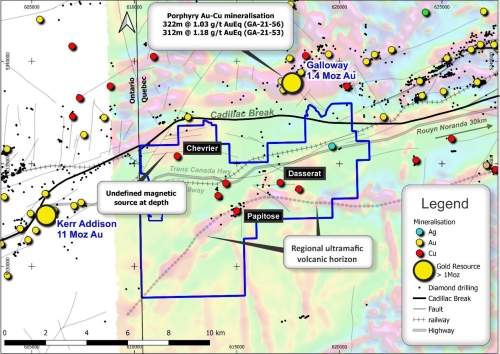
Dufay Project, showing regional mineralisation context on Cadillac Break (1VD regional magnetics backdrop).
Dufay Project is 35 kilometres west of the Rouyn-Noranda mining centre and copper smelter in southwest Québec.
Near Cadillac Break
"The Dufay Project is ideally located to the immediate south of the Cadillac Break, and we have an exciting few months ahead as we prepare to drill a number of copper and gold targets at the project,” Delaney added.
Mineralisation at Chevrier consists of quartz-pyrite-chalcopyrite veining and breccia with common pods and stringers of chalcopyrite-rich sulphides, hosted in shale.
Select zones of mineralisation show intense potassic feldspar alteration, which may be suggestive of remobilisation of earlier potassic alteration associated with alkaline porphyry intrusives.
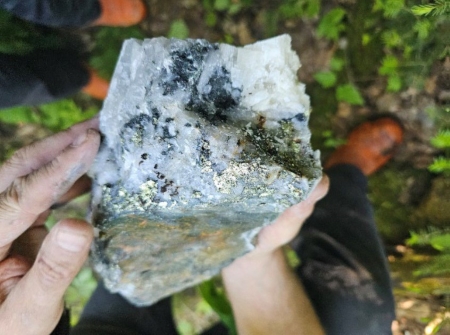
Quartz-tourmaline vein with pyrite and chalcopyrite aggregations, Chevrier prospect.
Available records, which cover the past 50 years, indicate there have never been any geochemical or geophysical surveys over the prospect and the prospect has never been drilled.
The evidence of discrete sulphide-rich zones suggests that EM would be a suitable survey method to highlight potential sulphide concentrations at depth.
The survey has been designed by TMC Geophysics to optimise the response for a moderately northwest dipping body.
Drilling to follow
Any anomalous responses will be converted to plate models by Olympio geophysical consultants Planetary Geophysics, with the drill plan modified accordingly.
Rouyn-Noranda-based drilling contractors will be engaged to complete the diamond drilling in late January.
Drill hole permitting is pending and the drilling program will be managed by experienced Val D’Or-based consultants Explo-logik.
Four holes are planned at Chevrier, however, additional holes may be drilled from permitted collar locations pending EM survey completion and interpretation.