
Maximus Resources Ltd (ASX:MXR, OTC:MXRRF) has received final assay results from a first phase RC drill program at its 100%-owned 8500N Paleochannel, near Kambalda in Western Australia, which show shallow high-grade gold mineralisation continues in the northern zone of the paleochannel.
Results from the final 56 holes of the program — consisting of 102 reverse circulation (RC) holes for 3,186 metres of drilling — have been received and include shallow high-grade gold up to 56.5 g/t.
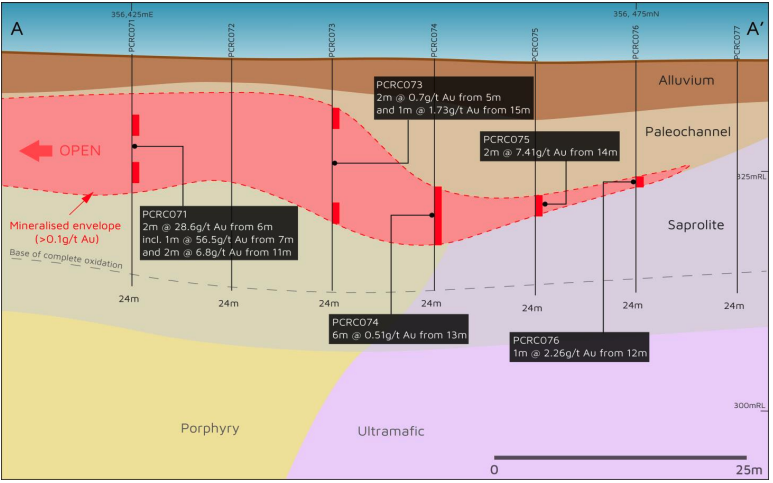
Cross-section of 8500N Paleochannel.
The completed drill program was designed to infill and extend mineralisation across the strike of the paleochannel, which has now been delineated over a 450-metre strike length.
It was designed to verify legacy drilling and improve the geological confidence of the shallow mineralisation while testing for potential extension of the mineralisation along strike and the underlying primary mineralisation.
Highly encouraging
Maximus managing director Tim Wither said, "The complete assay results from the 8500N paleochannel drilling have been highly encouraging, confirming the shallow high-grade nature of the paleochannel and have shown some easy wins with extension to the known mineralisation, along strike and directly below the paleochannel.
“The shallow paleochannel mineralisation sits 5 to 20 metres below the surface, with a strike length of approximately 450 metres.
“Drilling has also uncovered paleochannel gravel zones up to 7 metres thick, compared to legacy results, significantly enhancing the economic prospects for the 8500N paleochannel project.
“This drill program has been a necessary step for Maximus’ verifying legacy results and has provided valuable information revealing clear visual markers of the paleochannel gravels to aid in efficient ore extraction.”
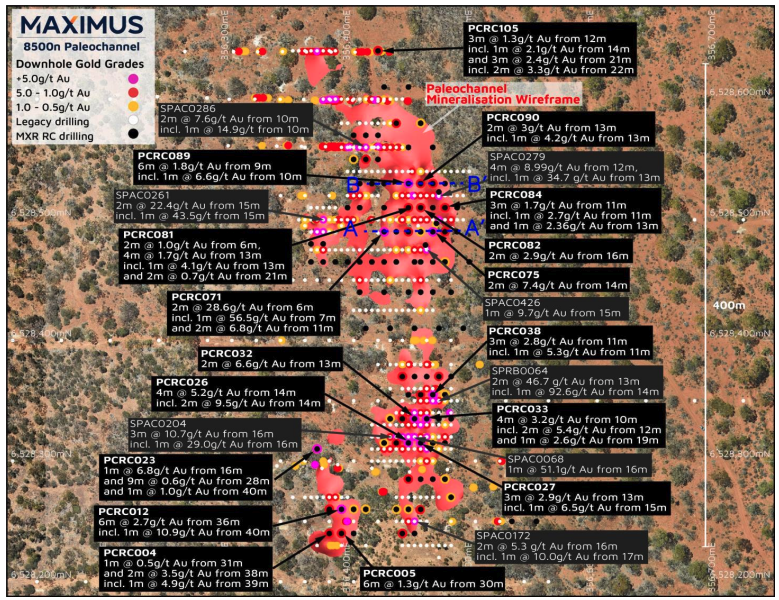
8500N Paleochannel mineralisation with the phase 1 (Black) and legacy (White) drill collars.
Paleochannels represent a low-cost, low-risk production opportunity due to their shallow high-grade gold mineralisation and free-digging qualities of the mineralised and overburden material.
Looking ahead
Geological modelling is underway before confirming the requirements of a second stage, ahead of a maiden mineral resource estimate for the 8500N Paleochannel.
“We have started the geological modelling with geology logging used as an important guide to quantifying the thickness of the paleochannel, acknowledging the potential variability in the assaying of the coarse gold mineralisation,” said Wither.
Future exploration efforts will focus on infilling potential paleochannel extensions and improving the geological confidence of the primary mineralisation beneath the paleochannel.
The company says that the shallow high-grade mineralisation, combined with its free-digging characteristics, positions 8500N paleochannel as a low-cost production opportunity.
Multiple representative samples from the first phase of drilling have been submitted for metallurgical test work to determine gravity recoveries, viscosity and potential reagent consumption under real-world protocols, with results expected in the first quarter of 2025.
Environmental studies including surface hydrological studies are advancing, before the submission of mining proposals, expected to be completed in early 2025.
Maximus also says it remains in active discussions with potential mining and toll-milling partners.