
Giyani Metals Corp (TSX-V:EMM, OTC:CATPF) CEO Charles FitzRoy joined Proactive to discuss advancements at its battery-grade manganese projects in Botswana.
FitzRoy highlighted the commissioning of a demonstration plant in Johannesburg, capable of producing up to 600 kilograms per day of high-purity manganese sulfate monohydrate.
He explained that the demonstration plant serves as a key phase for securing offtake agreements with OEMs. Testing will start in early 2024, with the first product batches leading to indicative terms by the second quarter.
Proactive: We're at Resourcing Tomorrow 2024. Joining me in the studio is Charles FitzRoy. He is the CEO of Giyani Metals. Charles, thanks very much for coming down and speaking to us. So, what brings you to Resourcing Tomorrow?
Charles FitzRoy: I’m here as the CEO of a TSX Venture-listed group with battery-grade manganese projects in Botswana. We're speaking to investors, staying updated on the market, and participating in this fantastic event.
So, we'll see you chatting to investors. What’s the story you're giving them?
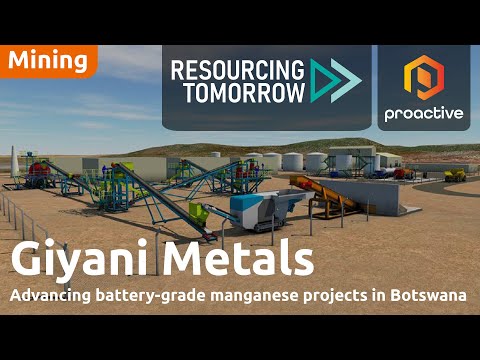
Giyani is developing battery-grade manganese projects in Botswana. Currently, we are commissioning our demonstration plant in Johannesburg. This plant is a 1:10 scale of a commercial facility and can produce up to 600 kilograms per day of high-purity manganese sulfate monohydrate (HPMSM), which is the preferred precursor for nickel-manganese-cobalt EV batteries.
We are in the commissioning phase and will begin producing product soon. This will enable us to start the offtake process with OEMs. Over the last 12 to 18 months, we’ve been speaking with these groups. Once we send them the product, they’ll follow a three-phase testing program.
Phase one involves 3 to 5 kilograms for testing, lasting one to four months. Phase two requires around 100 kilograms, and phase three might involve a couple of tonnes. After phase one, we expect to receive indicative terms in Q2 if we ship product by January or February 2024. This will align with our project financing plans, which will accelerate after our TFS is finalized in 2025.
What sets Giyani Metals and your projects apart?
Giyani has several advantages. First, we operate in Botswana, a fantastic jurisdiction for mining projects. We received our mining license and environmental authorization just nine months after submission.
Battery-grade manganese usage is growing due to legislative requirements like the Inflation Reduction Act and the EU Critical Materials Act, which demand non-China sourcing. This aligns with our development timeline as demand for manganese will peak around 2026-2027, coinciding with our ramp-up in 2027-2028.
Additionally, Botswana is keen to diversify its economy from diamonds. The country has a strong mining history and supports projects like ours in critical metals. Our demonstration plant is one of the largest of its kind for battery manganese and ensures we produce consistently for offtake testing. These factors make us well-positioned to meet future demand.
Quotes have been lightly edited for clarity and style