
Lightning Minerals Ltd (ASX:L1M) has defined strong lithium targets at the Caraíbas project in the prolific Lithium Valley region of Minas Gerais, Brazil, after fielding soil sampling assays of up to 239 parts per million (ppm) lithium.
Elevated assays have been returned from the priority target area within schists of the Salinas Formation geological unit while many contiguous results of >100ppm lithium have also been returned.

Drilling opportunities
These highly encouraging assays represent a compelling soil response in the regional geological context and provide drilling opportunities for early 2025.
Multiple pegmatites and pegmatite float material have been identified during Lightning’s ground reconnaissance work, further supporting its exploration thesis.
This ranks as the company’s second priority target for drilling following last month’s discovery of lithium-bearing spodumene grading up to 4.04% Li2O.
Belief in the region
Lightning Minerals managing director Alex Biggs, who is completing a site visit in Brazil developing strategy for 2025, said: “The Caraíbas project is beginning to yield some very impressive results that further support our exploration thesis and belief in the region.
“The western half of the Caraíbas project was a priority area for us due to its location east of the granite lithologies and the findings of the initial ground reconnaissance works.
“We’re starting to get a strong impression of what the Lithium Valley region can offer since we began our on-ground works in July.”
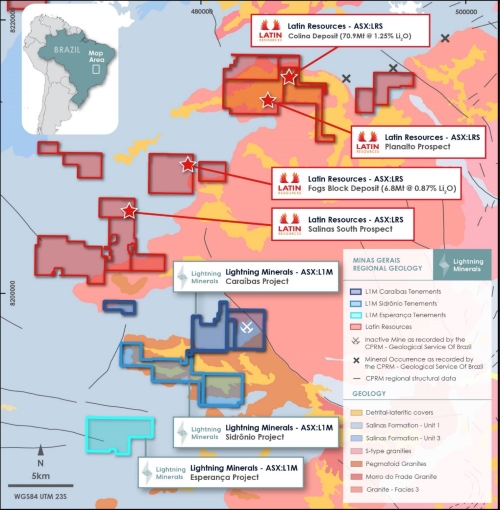
Location of Lightning Minerals’ Brazilian lithium projects.
Sampling program
Following the identification of lithium anomalism at the Canabrava project, analytical results from the first 343 soil samples from the Caraíbas project demonstrate significant lithium in soil anomalism.
The samples at Caraíbas have been collected along 400-metre spaced sample lines orientated in a north-south direction, the sample spacing along these sample lines is 50 metres.
Lithium values returned from analyses at SGS of Belo Horizonte are considered exceptional, with three areas highlighting contiguous elevated responses.
Phase one soil sampling has led to the identification of a large ~2-kilometre x 700-metre soil anomalism trend while a smaller 800 x 300-metre anomaly lies adjacent to the southeast.
Strong targets
The peak result of up to 239ppm lithium is considered very strong for the region and increases confidence in drill targeting at the Caraíbas project.
Both the scale and consistency of the elevated zones provide the company with targets for immediate follow-up works which will focus on further ground reconnaissance to map all outcrops and structures along the trend.
Soil sampling, ground reconnaissance and geophysics interpretation works are ongoing with further results to come over the next few weeks from the Canabrava, Esperança and Caraíbas projects.
These results will include the remainder of the soil program covering the eastern Caraíbas project, which includes previously identified historic workings that yielded results grading up to 0.53% Li2O (lepidolite), tantalum (1,245ppm), rubidium (1,175ppm) and caesium (1,455ppm).
Drilling preparations
“We are aiming to have our phase 1 soil sampling completed across all tenements by Christmas to allow us to start preparations for drilling in Q1 2025 at our Esperança project,” Biggs said
“These results now provide the secondary target area for drilling which is very exciting for the company.
“These results are exceptional and once again demonstrate the potential this region holds.”
Next stages of work
Exploration field soil sampling works have been completed for the Canabrava and Caraíbas projects and exploration results remain pending for both.
Exploration at Esperança is ongoing with infill soil sampling surrounding the spodumene discovery underway.
Further ground reconnaissance and mapping works are ongoing at the Canabrava, Esperança and Caraíbas projects particularly focused on identified areas of interest and trends of which multiple have been identified across all three project areas.
These works are aimed at better constraining pegmatite outcrops and orientations.