
The Estelle Gold and Critical Minerals Project in Alaska’s Tintina Gold Belt has delivered high-grade antimony for Nova Minerals Ltd (ASX:NVA, NASDAQ:NVA) in follow-up sampling, with outcrop grades reaching up to 54.1% antimony along with gold values reaching up to 9.8 g/t.
With antimony’s growing importance as a critical mineral, Nova Minerals remains well-positioned to contribute to secure supply chains and benefit from potential US Department of Defense (DoD) grants.
"Our systematic exploration of the Estelle claim block is yielding promising results, particularly for critical minerals like antimony,” said Nova head of exploration Hans Hoffman.
“These discoveries align with our strategy to supply materials vital to the US and global supply chains."
Critical mineral for national security
Antimony is a critical and strategic mineral essential for US economic and national security interests, as designated by the US Department of Interior.
The mineral is also on the European Union’s critical materials list – and both the US and Europe are 100% import-reliant.
Recognising this, Nova has been leveraging its membership in the Defense Industrial Base Consortium (DIBC) to advance its Department of Defense (DoD) grant application.
The consortium focuses on accelerating the development of cutting-edge materials critical to national defense.
Nova Minerals, through its 100% owned subsidiary Alaska Range Resources LLC, became a member of the Defense Industrial Base Consortium (DIBC) more than six months ago.
The company’s early mover status means it is now well advanced with the Department of Defense (DoD) grant application process.
Highlights
The main Styx occurrence, a one-metre-thick quartz-stibnite vein comprising 50% stibnite, extends more than 20 metres in outcrop.
At Styx, 11 rock samples were collected this year, six of which exceeded 1 g/t gold or 1% antimony.
Samples taken revealed a high of 54.1% antimony, alongside other strong results including 39.1% antimony and 28.0% antimony with 2.8 g/t gold.
Additional splays surrounding the main vein suggest the anomaly may extend over a 150-metre strike length.
The 2024 exploration program expanded on results from the 2023 season, with Nova collecting 511 soil samples, 225 rock samples and five tonnes of bulk material across the Estelle project.
In addition to rock and soil sampling, Nova collected a 500-kilogram bulk sample for metallurgical testing, to further progress its analysis of the Styx vein system and surrounding mineralisation.
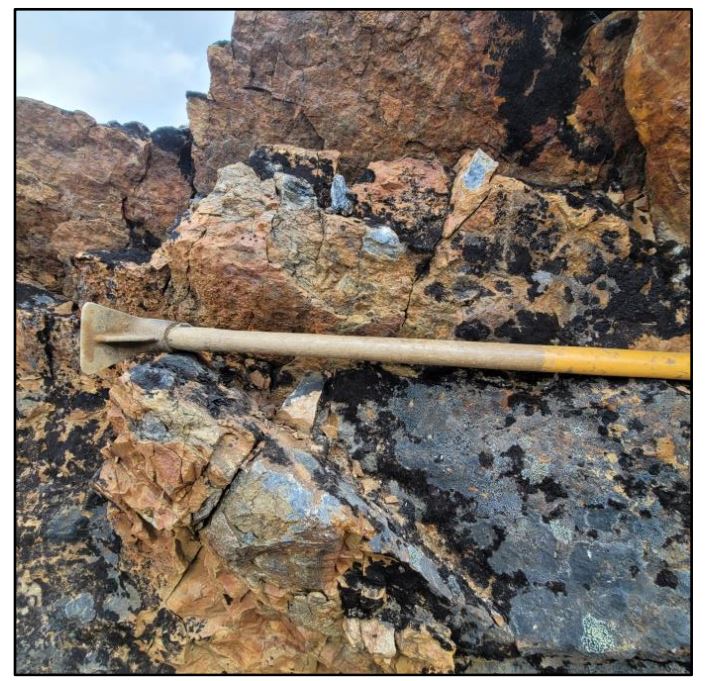
Styx quartz-stibnite vein (~1 metre by 20 metres exposure).
The results indicate potential extensions of the quartz-stibnite vein system, with further mineralisation identified in surrounding quartz monzonite dikes.
What’s next?
Nova continues to explore its Estelle Gold and Critical Minerals Project, covering more than 500 square kilometres, to delineate resources critical to US and European supply chains.
The company plans to update its 3D Vrify visualisation decks and release further exploration results as assays are received.