
Empire Metals Ltd (AIM:EEE) managing director Shaun Bunn talked with Proactive about the company’s promising recent metallurgical gravity test results at the Pitfield project in Western Australia.
Bunn shared insights into Empire Metals’ advances, explaining that their test work shows they can effectively separate titanium minerals from other elements in the sandstone, which would otherwise increase processing costs.
This achievement demonstrates that the company can simplify downstream processing.
Proactive: I'm joined by Empire Metals managing director Shaun Bunn, who's going to talk us through the company's latest news. It has announced results from metallurgical gravity test work at its Pitfield project in Western Australia. Shaun, thanks for joining us today. So, talk us through these test results. I understand they’re pretty encouraging. What have you found?
Shaun Bunn: Yeah, well, we've been working on this now for some time. I think we announced a few months ago that we were shifting our focus to this weathered cap, this weathered zone full of anatase, and we’re seeing great results. We predicted this outcome and have now managed to produce what we would call a "heavy mineral concentrate" in our very first diagnostic test. Around 70-80% of the titanium was recovered in that concentrate, alongside some iron minerals. We’ll discuss the further steps required for that soon, but it’s really exciting to start seeing these positive results from our test work.
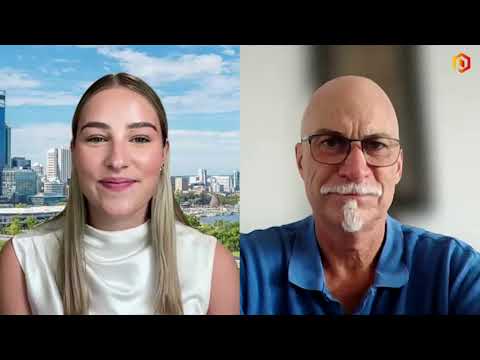
Proactive: And the metallurgical results are underpinned by results from your diamond drilling campaign. Can you remind us of those highlights and talk us through the findings?
Shaun Bunn: Yes, that's right. The drilling campaign had a dual purpose. First, it mapped this highly friable, high-grade surface material, and we drilled down about 60 meters, confirming a substantial weathered cap across the ore body. This cap contains high-purity anatase, which is exciting because it’s already in TiO₂ form, similar to rutile. We were focused on locating higher-grade zones, and we found up to 17-18% titanium in situ—a great result.
Returning to our recent test work, it’s shown we can effectively separate these titanium minerals from the gangue, specifically silicates and sandstone, which would otherwise consume acid and complicate downstream processing. Our simple gravity separation is successfully removing the silicates, and flotation test results confirm that 78% of titanium-bearing minerals are entering the concentrate. The combined steps are highly effective for concentrating the titanium, which we’ll further refine as we advance.
Proactive: That sounds very encouraging. What’s next for the company? Where do you go from here?
Shaun Bunn: We’re moving forward with several key steps. We've produced a heavy mineral concentrate, which includes dense, high specific gravity minerals like hematite. The next step will involve separating the iron oxide from the titanium oxide minerals, and it’s possible we could produce a high-grade iron oxide byproduct, which is also exciting. Following that, we’ll work on leaching the titanium out of these minerals, likely using an acid or leaching process, to then identify the next processing route for a final product.
This stage maps out the pilot plant for us, and although the timing is hard to predict, we could be on the cusp of a breakthrough soon as we approach the design phase for a pilot plant.
Proactive: It sounds like exciting times for Empire Metals. Thanks for joining us today, Shaun.
Shaun Bunn: You’re welcome. It’s a very important part of our process now to make sure people understand the value in this giant ore body. We’re slowly unlocking it, and we hope to return soon with more positive updates.