
An international space mission, launched from Sweden in collaboration with the German Aerospace Center (DLR) and private aerospace firm Enable Aerospace, will investigate the effects of gravity on several elements of human health.
La Trobe University collaborated with the space mission to scrutinise the role gravity plays on human gut cells, which have been launched into space on board the MAPHEUS-15 research rocket.
The University of Adelaide is also investigating the effects of gravity on Australian species of duckweed, a potential food source, as well as the reliability of medicines created in space.
The 'Material Physics Experiments under Microgravity' (MAPHEUS) program is a series of space launches designed to unlock the fundamental mechanisms of cell regeneration and cancer using a microgravity environment.
La Trobe’s gut cells, known by researchers as 'Gastronauts', were housed in 'mini labs', specially engineered by Melbourne-based Enable Aerospace.
Unlocking the secrets of Earth’s gravity
Australia's lead researcher, Professor Patrick Humbert, director of the La Trobe Institute for Molecular Science (LIMS), said scientists hoped to gain a better understanding of how gravity controlled biological processes, which could be harnessed for new therapeutics on Earth.
"Gravity is the only constant force present throughout evolution," Professor Humbert said.
“Conducting experiments in space where gravity is absent provides a means to ask how it is involved in the processes of cell regeneration and cancer.”
DLR project lead Professor Thomas Voigtmann said the MAPHEUS-15 mission was the 600th launch from Esrange, the facility run by the Swedish Space Corporation.
DLR's Dr Jens Hauslage collaborated with La Trobe scientists for the mission.
"The Gastronaut-01 experiment is the first step towards an intensive scientific collaboration between Germany and Australia in the field of microgravity research on sounding rockets," Dr Hauslage said.
La Trobe deputy vice-chancellor of Research and Industry Engagement Professor Chris Pakes said the research could have far-reaching consequences.
"This mission is an example of the high-impact research that La Trobe University conducts that could have the potential to transform health and wellbeing in space and on Earth."
Feeding astronauts in space
The MAPHEUS-15 rocket also held a payload of Australian duckweed on board, a plant species that scientists believe could serve as a long-term food source on space missions.
The experiment, dubbed MiniWeed by The University of Adelaide, and conducted in collaboration with DLR and La Trobe University, will test how gravity effects the plant.
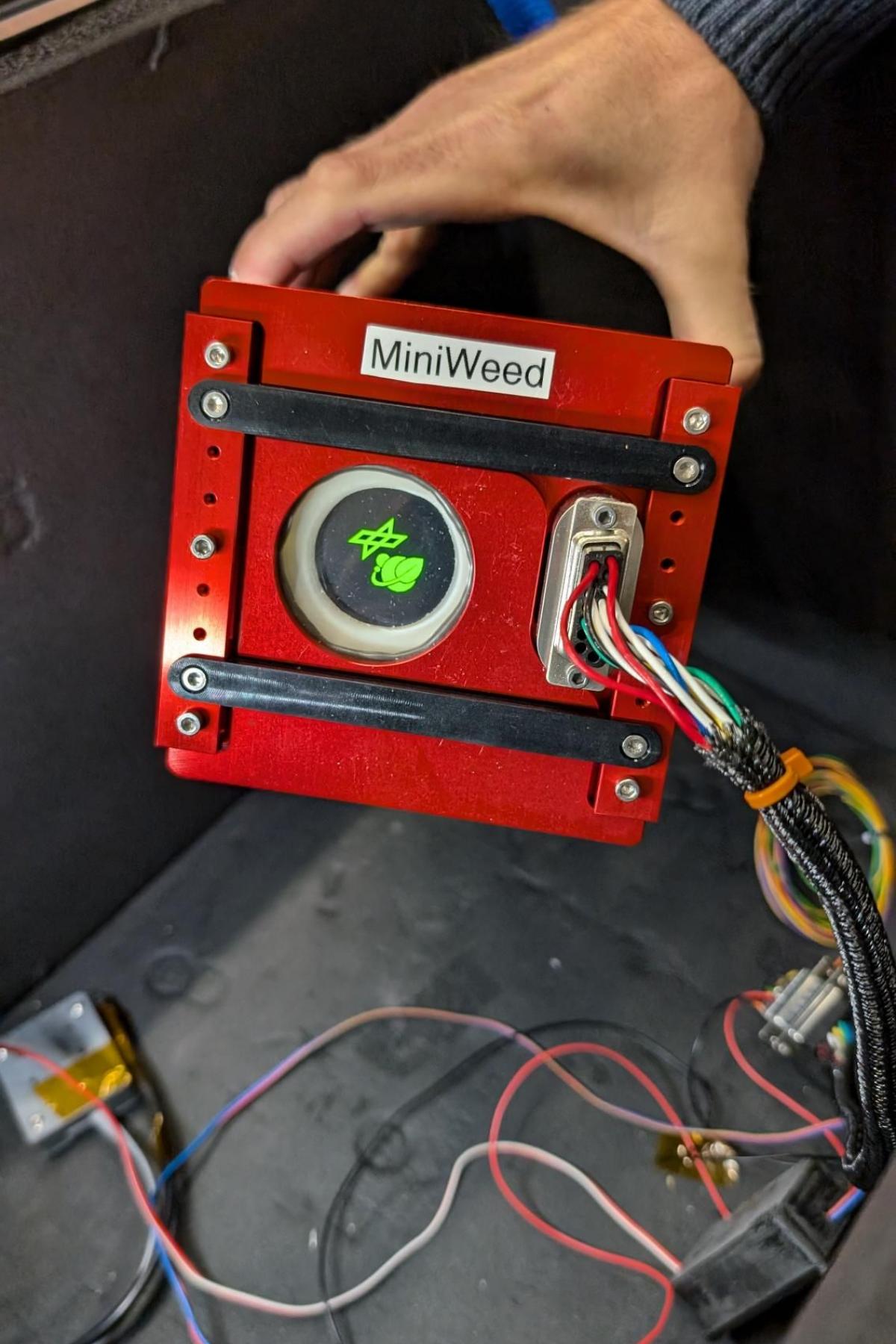
MiniWeed experiment unit Source: The University of Adelaide.
"Our P4S collaborator at the DLR, Dr Jens Hauslage, has designed an experimental system that will chemically pause the plant's development at two points in the rocket's journey: the end of the hypergravity phase, and the end of the microgravity experiment,” University of Adelaide's Associate Professor and chief investigator at Plants for Space (P4S) Jenny Mortimer said.
"Once we retrieve the samples, we will look at the effects of the altered gravity on the plant biology, in particular, gene expression.
"These experiments will also help us understand how well our gravity-simulation systems in the lab mimic these real-world effects, particularly on an aquatic plant like duckweed.
"They will also help us prepare benchmarking data for experiments we're conducting as part of NASA's LEAF program, during which we will grow plants, including Wolffia, on the lunar surface, and return them to Earth."
Exploring therapeutic manufacturing in microgravity
The MAPHEUS-15 rocket was also carrying the StarMed experiment, designed by The University of Adelaide to explore the reliability of medicines manufactured in space.
"If astronauts get sick on the Moon or Mars, they need medicines manufactured at the site of consumption that are stable under microgravity and cosmic rays, as drugs decompose faster in space," University of Adelaide Professor and program lead at the ARC Centre of Excellence Plants for Space, Volker Hessel said.
"The StarMed experiment will show us how the stability of liquid medicinal formulations developed for auto-injection by astronauts under changed gravitational conditions, and we will find out how the controlled release of the encapsulated drug melatonin behaves during the space flight.”
Research into space and its effects on human life has been accelerating at an incredible pace in recent years, as innovations in reusable rockets and similar technologies rapidly reduce the cost of space missions.
The space economy is expected to reach US$1.8 trillion by 2035. It has the potential to have a transformative effect on entire industries, while also deepening and expanding our understanding of health, biology, agriculture, and meteorology.