
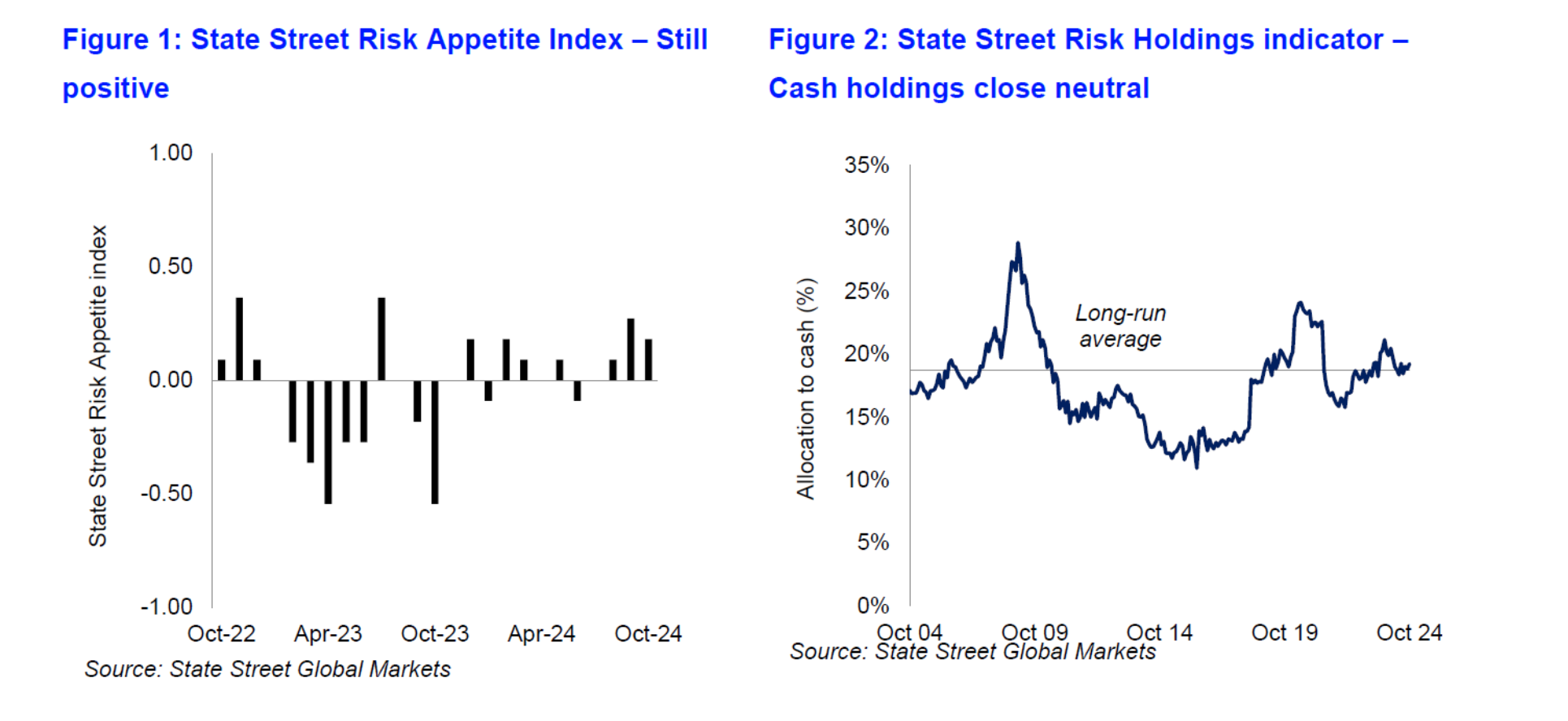
State Street Global Markets has released the results of the latest State Street Institutional Investor Indicators. The State Street Risk Appetite Index remained positive at 0.18 in October, only modestly less risk seeking than the 0.27 reading in September.
The State Street Holdings Indicators showed that long-term investor allocations to equities fell back 39bps to 52.7%.
Allocations to cash rose a similar amount (42bps) to 19.2%, leaving fixed income holdings largely unchanged.
Investors well positioned post US election
State Street Global Markets head of Macro Strategy Michael Metcalfe said: “Long-term investors went into November with their largest allocation to equities ahead of an election in two decades, so they were well-positioned for the initially positive market reaction to the election result.
“Within equities long-term investors remain overweight US equities relative to both European equities and emerging market equities, so are also well-prepared for the potential negative implications of US tariffs if they are enacted.
“Investor holdings of bonds were already at historically low levels, but demand for long-dated Treasuries suffered a serious wobble in October with demand across the month falling to a four-year low. With fiscal sustainability gaining more media and market attention this will be an important behaviour to watch in 2025.
“Long-term investor flows into UK Gilts had been positive through much of October, so investors have been on the wrong side of the sharp spike in yields following the UK budget.
"Watching how long-term investor demand for Gilts evolves in the coming months in the aftermath of the budget will be crucial to judge whether the question of fiscal sustainability escalates further.
“Having hesitated on their US dollar holdings over the summer, long-term investors had only a modest overweight in the currency ahead of the election, suggesting plenty of potential room for the US dollar to overshoot in response to the result.
“Foreign demand for Chinese equities reached a three year high by mid- October but is now beginning to fade gradually. Investors will need to weigh the threat of potential US tariffs against the likelihood of further China stimulus.”