
Andrada Mining Ltd's (AIM:ATM, OTC:AFTTF) head of exploration, Tim Marais, talked with Proactive about the latest drilling results from the Brandberg West mine in Namibia. These results mark the second set of ten holes from a 20-hole inaugural program, which yielded encouraging grades for tin, tungsten, and copper.
Proactive: Tim, you’re out with results from drilling at your Brandberg West mine in Namibia, and they look very encouraging.
Tim Marais: Thanks, yes. So we released the second set of results from our Brandberg West drilling. That's the whole program or the entirety of the initial program. We're really excited because we continue to intersect really high grades for tin, but also tungsten and copper.
Proactive: Take us through some of the highlights of the results, Tim.
Tim Marais: This deposit is a vein-hosted deposit, which means we've got smaller areas of enrichment. But what we found is that the areas are really enriched. Where UIS has an average grade of 0.15% tin, we've had grades of up to 10% tin within these veins. If you look at it in a meter equivalent for the metal, it means a 25-centimeter quartz vein is the same as 17 meters of pegmatite.
In addition to that, we've also found really high grades of tungsten, up to, I think, 2.6%. Our first set of drill results had copper grades up to 3%, and these ones were above 2% as well. So not only is it a tin deposit, but it's also got polymetallic characteristics for tungsten and copper. We also have some trace or individual samples with really high silver and gallium grades. We're going to be looking at those in the future.
Proactive: So, Tim, as you said, this was the second ten holes of the 20-hole inaugural drill program. What was the program aimed at, and how do you take it further?
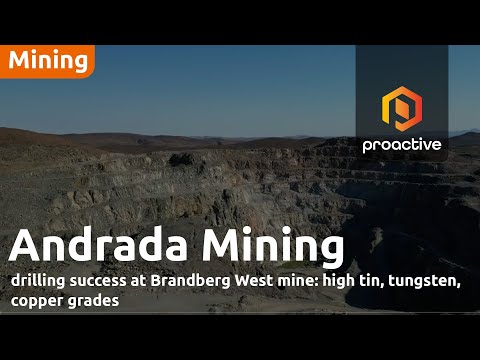
Tim Marais: This program was aimed at investigating this historical mine. It was previously operated by Goldfields, and they were present in the area until the mid-1980s. What we tried to do, or managed to do in this instance, was investigate the existing pits area and extensions of depth. We found multiple vein sets that are really high-grade within the pits, showing that this mineralization extends at least another 100 meters vertically.
The second part of this drill program was to investigate mineralization to the north. We put four drill holes along a line of intersections moving north, covering about 1.5 kilometres. Every single one of those drill holes hit high-grade mineralized veins. So that shows that not only does the deposit continue at depth where it was historically mined, but there's also a continuation to the north across quite a significant area.
Proactive: What's next, then, Tim?
Tim Marais: The next step is a lot of work in the office, putting together a big ore-body model, evaluating what these mineralized trends tell us, and seeing if we can correlate the different intersections and metal values to optimize the next drill program. And obviously, this is working towards a mineral resource estimate not only for tin but also for tungsten and copper. The great news here is that it really adds two important metals to our basket of critical minerals.