
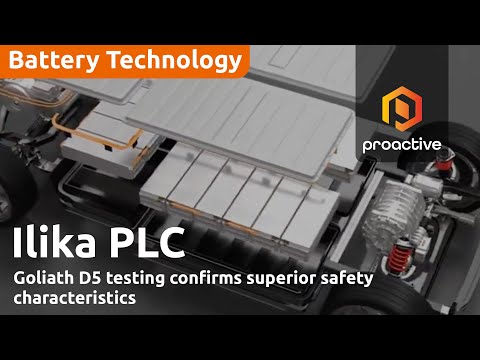
Ilika PLC (AIM:IKA, OTCQX:ILIKF) CEO Graeme Purdy talked with Proactive about the company's advancements in electric vehicle (EV) battery technology. Purdy discussed the importance of proving Ilika's battery safety compared to lithium-ion alternatives. He highlighted how the lighter design enabled by their batteries could lower costs and improve vehicle range. The company has demonstrated safety through rigorous testing, including the nail penetration test, which showed Ilika’s batteries outperforming traditional lithium-ion cells in fire safety.
Proactive: How important is it that you've proved your technology to be safer than lithium-ion equivalents?
Graeme Purdy: You know, it’s really important to demonstrate that we're safer than the lithium-ion incumbents. The reason for that is not that EVs are currently unsafe. In fact, they've been shown to be very safe. But the safety of batteries means vehicle designers can lightweight their designs. They can remove some of the mechanical protection currently required around battery packs, making the vehicles lighter. This allows the vehicles to travel further on the same amount of energy and reduces costs since less material is needed for reinforcement.
Proactive: So what did your cells have to prove to reach this stage, Graeme?
Graeme Purdy: We put them through rigorous testing. I don't know if you saw from our press release, but we mentioned working with the Faraday Institution under the SafeBatt program. We've given our batteries to independent authorities, and they put them through a series of tests. One was the nail penetration test, which is quite spectacular. A benchmark nickel-cobalt-manganese (NMC) battery bursts into flames during the test, causing a fireworks-like effect—a EUCAR 6 event on the scale of these tests. By comparison, our battery remained inert, classified as a EUCAR 3 event, meaning no leakage, venting, fire, or flame.
We’ve also had DEKRA, an independent testing organization, show that the components of our batteries are non-flammable. We also conducted a calorimetry test, demonstrating that even under extreme conditions, our batteries produce a much lower temperature increase than traditional lithium-ion cells.
Proactive: Just going back to the Faraday, how has participation in the Faraday Challenge helped?
Graeme Purdy: Collaboration with leading authorities like the Faraday Institution is a catalyst for our progress. It brings together the best minds in the field to help us move technology forward.
Proactive: What can investors expect from the next design phase for Goliath?
Graeme Purdy: The next milestone is coming as soon as next month. In November, we will demonstrate larger format cells with high capacity. We are moving towards a 10Ah battery, which is quite significant, especially for the automotive industry.
Proactive: How do you see EV battery development progressing, given the current market trends showing a slowdown in vehicle sales?
Graeme Purdy: I think the OEMs need to change their approach. People hesitate to switch from conventional cars to EVs due to range anxiety and cost. Our Goliath batteries can address both concerns, providing longer range and reducing costs. EV manufacturers need to offer state-of-the-art technology to convince remaining doubters to make the transition.