
- FTSE 100 rises 42 points
- Haleon falls after Pfizer sells £2.4bn of shares
- Greggs reports slower rate of growth
- UK retail price deflation at steepest in three years
4.15pm: London rises, the rest Europe and US plummet
London's FTSE 100 index was the only major index still trading in positive territory on Tuesday afternoon, after reports that Iran is preparing to launch a missile attack on Israel sent most global shares plummeting.
This turned what had been a fairly unexceptional start to October trading on its head.
Prices of oil and gold rose, lifting the likes of Shell PLC (LSE:SHEL, NYSE:SHEL) and BP PLC (LSE:BP.), Fresnillo PLC (LSE:FRES) and Endeavor Mining PLC, while defence company BAE Systems PLC (LSE:BA.) topped the risers.
Defensive companies including utilities like Severn Trent, drugmakers like AstraZeneca, and tobacco companies like BAT also were up on the leaderboard.
Airline companies, including BA parent IAG (LSE:IAG), Wizz Air Holdings PLC (AIM:WIZZ) and easyJet PLC, fell between 3% and 4%.
The unconfirmed threat of an imminent attack sent markets "into risk-off mode", says Axel Rudolph, analyst at IG.
Following the bullish tone last week and on Monday following a week of China stimulus ahead of this week's National holiday, there had been lacklustre trading initially in Europe, he noted, while oil prices had been down over 2% earlier in the day.
But although oil prices have since surged on the back of Iran report, market analyst Naeem Aslam at Zaye Capital said, "smart money knows that the current reaction and swollen price action is nothing more than a mosquito bite, and this is because we have seen several episodes of this fireworks.
"If a real threat were to occur, we would not see these mosquito bites, which have caused the prices to rise, but in fact, we would see the price flirting near the $100 price mark."
3.30pm: FTSE resists drop
The FTSE 100 dropped back to almost flat for the day a few minutes ago, but is resisting, up 11 points at 8,248.
Mid-caps are in the red however, with the FTSE 250 falling 144 points or 0.7% to 20,909.
Missed amid the explosive Iran news was the release of more US economic data, with the ISM manufacturing index remaining unchanged for September, although economists said the jump in the production index and rebound in new orders paint a slightly less negative picture heading into the fourth quarter.
The ISM reading stayed at 47.2 for September, mostly attributable to a slump in the inventories index to 43.9 from 50.3, offsetting a jump in the production index to 49.8 from 44.8.
So the top-line reading is "arguably stronger than it first appears", sayd Bradley Saunders, Capital Economics' North America economist.
"Overall, the survey data hint at a less negative outlook for the manufacturing sector than recent releases, though ongoing strikes at Boeing and ports along the East and Gulf Coasts, as well as disruption from Hurricane Helene, may have a negative influence on October’s headline figure."
3.16pm: Iran attack would have 'consequences', officials say
The US is actively supporting preparations to defend Israel against a possible attack from Iran, Bloomberg and Reuters are reporting.
An attack would carry severe consequences for Iran, an official told the newswires.
Meanwhile, an Israeli military spokesman said the country had not yet identified an aerial threat from Iran, with Israel's aerial defence systems fully prepared.
The Israeli spokesperson also warned that any Iranian attack on Israel would have repercussions.
Israel and Iran, it should be noted, launched missiles into each other's territory in April this year, with Israel recently firing missiles into Lebanon, as well as launching troops into its neighbour this week.
The Israeli military said this afternoon that it is targeting Lebanon's capital Beirut, with local Reuters witnesses confirmed an Israeli airstrike on the suburbs.
US officials said the forthcoming attack from Iran against Israel could be similar in scope and scale to the one in April, US media reported, referring to what was a wave of missiles and drones towards Israel, most of which were intercepted by air defence systems.
2.57pm: Markets all fall in Iran reports, apart from the FTSE
What's hit markets are reports from the US that Iran is preparing to launch a ballistic missile attack against Israel.
European markets are now all in the red, apart from the FTSE 100, where the index's defence companies and oil majors are doing a lot of the lifting.
BAE Systems PLC (LSE:BA.) is now p 2.4%, with BP PLC (LSE:BP.) and Shell PLC (LSE:SHEL, NYSE:SHEL) up over 2%.
Oil prices, which were down earlier, are now up, with Brent crude jumping to $73.5 from $70 earlier.
10-year US treasury yield yield have sunk to a session low of 3.5715% on the Iran reports.
Senior White House official just now:
“The United States has indications that Iran is preparing to imminently launch a ballistic missile attack against Israel. We are actively supporting defensive preparations to defend Israel against this attack."
— MJ Lee (@mj_lee) October 1, 2024
2.47pm: Wall Street opening slide hits FTSE
US stocks have opened lower and that's taken the wind out of London traders too.
The FTSE 100, which was up 54 points just at the point when the Wall Street opening bell was still reverberating, has seen its gain cut to 25 points, a 0.3% increase on the day.
Meanwhile, the S&P 500 has dropped 0.8% and the tech-heavy Nasdaq has plunged over 1%, while the blue-chip Dow Jones is down 0.75%.
All the big three tech stocks are in the red, Apple Inc (NASDAQ:AAPL, ETR:APC) is down 2.4%, Microsoft Corp (NASDAQ:MSFT) is down 1% and NVIDIA Corp (NASDAQ:NVDA, ETR:NVD) is down 0.3%.
Google owner Alphabet Inc (NASDAQ:GOOG), Meta Platforms Inc (NASDAQ:META, ETR:FB2A, SWX:FB) and Netflix Inc (NASDAQ:NFLX, ETR:NFC) are all up over 1% though.
2.05pm: Pound in focus
The pound is down 0.4% to $1.332 now, which may be seen as helping some exporters, giving a boost to their shares.
This follows a 5%-plus rise from around 1.24 six months ago.
And one economist is forecasting that it could climb to pre-Brexit rates around $1.50 next year due to the slower rate of BoE rate cuts than the US Federal Reserve and the European Central Bank.
This is according to Steven Bell, chief EMEA economist at Columbia Threadneedle.
Financial markets currently are pricing a BoE cut in November to 4.75%, with around 120 basis points more by next June to bring the base rate to around 3.5%, compared to 165 points of cuts for the Fed and 150 for the ECB.
1.22pm: Cold weather ahead
Britain is set to face some of the coldest weather in Europe this winter as cold spells forecast for October threaten to remain prolonged with the arrival of La Niña.
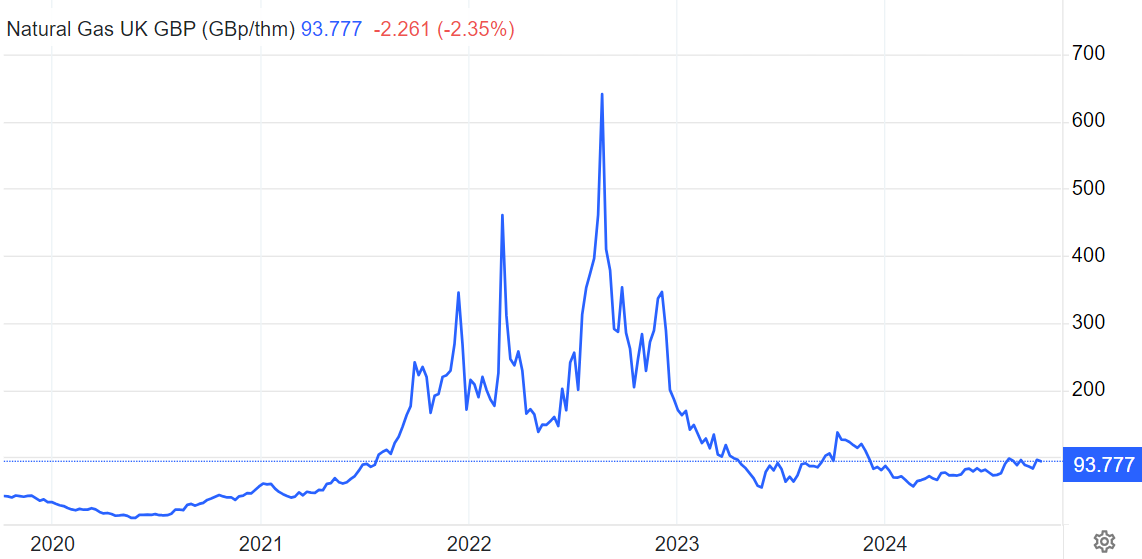
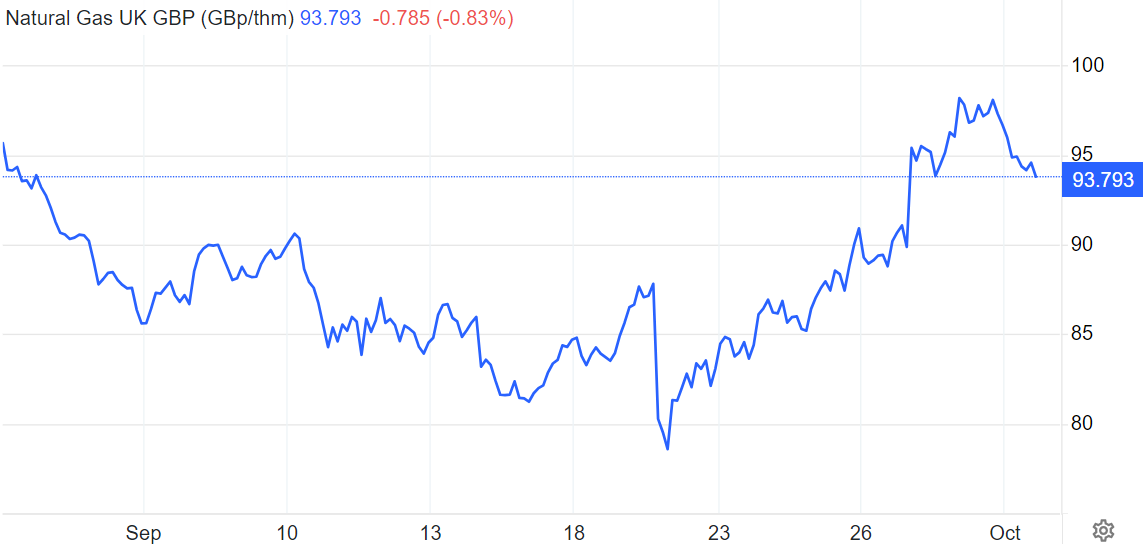
This comes with gas prices at a similar level to where they were a year ago, but well down from two years ago.
Britain, France and Scandinavia are expected to face the coldest temperatures across the continent this month, forecasts show, with this year’s winter set to be cooler than the last.
This comes as the US Climate Prediction Center has recently lifted predictions for a La Niña phenomenon, which would bring cooler weather to Europe, from 74% to 83%.
Gas prices have fallen over the past day, having climbed in recent weeks.
12.43pm: FTSE 100 out in front
US stocks look set for a mixed start, joining in with what is an inconsistent mood around global markets.
Futures for the S&P 500 are pointing to a small decline, while Nasdaq 100 futures are modestly higher, with Dow Jones futures down 0.2%.
Back in London, the FTSE 100 recently hit its highest point so far today, up 41 points or 0.5%, the best performer across European markets this morning.
WPP is top of the leaderboard, up 3.4%, while Rightmove PLC (LSE:RMV) is up 2.5% as it bounces back from the sharp drop yesterday when Aussie suitor REA Group walked away.
There is another 2.3% fall for 3i Group PLC (LSE:III), following the Shadowfall short position report that hit its shares at the start of the week.
Analysts at UBS noted that the hedge fund questioned 3i's practice of valuing its investment in Dutch discount retailer Action at 18.5x earnings.
"This does depend, in our view, on what growth rate investors think Action will have in the future," they say, noting that if ShadowFall believes the EBITDA growth rate will be lower, "we can understand how they would come to their valuation conclusion."
12.18pm: UK grid stability warning
Intermittent generation will be one of the main challenges for the new National Energy System Operator, where the government took back control from National Grid PLC (LSE:NG.) last month.
This is according to EDF commercial director Rachael Glaving in a presentation to the Conservative Party conference on Tuesday, warning that grid “stability” was at risk after the last coal power station was shut as the country swings more towards renewables.
Nuclear stations will take on that role, though she highlighted the closure of five EDF nuclear plants in the UK, while replacements Hinkley Point C in Somerset and Suffolk’s Sizewell C remain under construction.
Does it mean we need more batteries to store renewable energy?
12.10pm: FTSE indices both positive
The FTSE 100 and 250 are both in positive territory now, up 0.4% and 0.2%.
European markets remain mixed, with the DAX up 0.4% in Frankfurt, while the CAC 40 in Paris and FTSE MIB in Milan are either side of flat.
The IBEX 35 is down 0.5% in Madrid, with Spanish banks proving a drag.
11.49am: Lammy says situation in Middle East 'getting worse'
UK foreign secretary David Lammy said British nationals in Lebanon should evacuate immediately, stating "the situation in Lebanon is volatile and getting worse."
Lammy also told broadcaster that, "none of us want to see a regional war. The price would be huge for the Middle East and it would have a significant effect on the global economy.
"None of us want to return to the years in which Israel found itself bogged down in a quagmire in southern Lebanon," Lammy told broadcasters.
Lammy also announced in a statement on X/Twitter that the UK government is "providing an option for British nationals to leave now. My message is clear — take it."
He said the Foreign Office has been working to provide support, including increasing the number of commercial flights and securing seats.
"We know that events can escalate with little warning, and the situation on the ground could become much, much more dangerous. This means there's no guarantee that another option will become available," he warned.
11.35am: Vapes close to overtaking ciggies in UK
Numbers of UK smokers has fallen to the lowest level since records began, according to research released today by the Office for National Statistics, with numbers of vapers almost catching up.
Around 6.0 million people aged over 18 cigarettes in the UK last year, about 11.9% of the total, based on ONS estimates from the annual population survey.
The largest reduction in smokers was among those aged under 24, which fell to 9.8% from almost 26% when records began in 2011, while those aged 25 to 34 years had the highest proportion of current smokers at 14%.
Use of disposable vapes and other reusable e-cigrattes rose to around 5.1 million adults aged 16 years and over, or around 9.8% of the total, based on regular or occasional use.
It will not surprise many to hear that e-cigarette use was highest among people aged 16 to 24, with 15.8% using e-cigarettes either daily or occasionally.
Shares in cigarette makers British American Tobacco PLC (LSE:BATS) and Imperial Brands PLC (LSE:IMB) are little moved this morning, up 0.6% and down 0.7% respectively.
11.19am: Eurozone inflation could see ECB step up pace of rate cuts
The euro-zone inflation reading was weaker than most analysts had expected, though a bounce back in the fourth quarter has been expected, says Bert Colijn, economist at ING.
He notes that the ECB knew that this inflation print would come in weak as President Christine Lagarde alluded to it at the September press conference.
The question is, says Colijn, whether the Q4 inflation rebound will materialise as petrol prices have been dropping quickly on the back of falling oil prices.
"With core inflation slowly dropping at this point, it looks like the 2% target in the medium term is achievable," he says, with recent survey data confirming slowing selling price expectations from businesses as demand weakens from an already modest pace in the second quarter.
"Since the summer, concerns about inflation have made way for concerns about economic growth," says Colijn.
"As the ECB seems quite convinced that inflation is on track towards 2%, the question is now how fast it wants to move interest rates back to neutral. If it keeps interest rates restrictive for too long with the economy already slowing, it risks pushing inflation below its 2% target.
"With growth under pressure now, it seems that the door is open for the ECB to move faster. While it does not seem like a done deal, it does bring the October meeting into play for a possible step up in easing."
10.48am: Oil falls despite fighting in Lebanon
Oil prices are falling further despite reports of intense fighting in southern Lebanon, following the launch of a ground offensive by Israel.
Brent crude front-month futures prices are down 2.2% to $70.10 per barrel, while the US gauge, West Texas Intermediate, is down 2.4% at $66.53.
Analysts at Goldman Sachs said the fall in oil prices was due to "softer realised and expected demand" from China and better than expected oil inventories.
Goldman Sachs also predicted price could fall to as low as $60 by the end of 2025 - back to levels not seen since early 2021 - as it sees a “limited” risk of prices being pushed higher by the Middle East conflict as the market is “shifting away” from the price support provided by Opec.
Fiona Cincotta at City Index said prices were lower as the "prospect of increased supply from OPEC+ offsets supply concerns in the Middle East", with the oil producers cartel expected to gradually unwind some production cuts starting in December, raising concerns about an oversupplied market next year.
"Tensions in the Middle East are ramping up, which is offering some support to oil prices. However, given that oil production hasn't been materially affected yet, the risk premium on oil remains relatively low.
"This could change, and the risk of supply disruption would increase dramatically if Iran became more directly involved."
Gold prices picked up, though, from a week's low of $2,627 overnight to $2,648.
10.29am: John Lewis sees swarm of customers after famous pledge returns
John Lewis has enjoyed a quick customer response to the return of its 'never knowingly undersold' pledge, with online and store sales both picking up “aggressively”, according to an interview given to a trade magazine.
Since a series of new ads featuring the slogan launched last month, the John Lewis website received an extra 89,000 visits per day through natural traffic, executive director Peter Ruis told Retail Week.
John Lewis said last month that the pledge will return after being ditched in 2022, with artificial intelligence used to match prices against 25 rival retailers, including M&S, Currys and House of Fraser, while also applying to online sales for the first time, having just covered in-store items before.
10.10am: Euro-zone inflation falls below 2%
Eurozone inflation came in lower than expected for last month on an annual basis, with the consumer prices index actually falling month-on-month.
CPI was up 1.8% in September 2024 versus a year ago, down from 2.2% in August and in line with estimates from economists.
This followed the euro area CPI falling 0.1% from a month ago, following a 0.1% previous monthly move, while the market had expected a flat reading.
10.02am: Greggs down as analysts say focus is on slower sales
Greggs is the biggest faller on the FTSE 250 this morning, down 3.7%.
The overall mid-cap index is just below flat, down seven points at 21,046.
Analysts at Barclays note that the full-year outlook was unchanged, "so Greggs is on track for another year with >10% PBT growth".
However, given the premium valuation rating of the shares, the analysts say "we believe there may be some focus on slower LFLs in Q3 vs H1, but the recovery in September should help to allay investor concerns".
LFLs (like-for-like sales growth) in the third quarter was 5%, slightly slower than 7.4% in the first half.
"Trading appeared to have dipped in July and August before recovering in September [as] growth was said to be supported by menu development, extended trading hours, digital channels, and a faster rollout of over-ice drinks (available in 800 shops now, with 1,000 by year end)," the analysts conclude.
Elsewhere in the FTSE 250, Ocado is the top riser, up 2.8%, followed by Carnival after its quarterly update yesterday.
9.41am: Manufacturing sector still in growth, but confidence tumbles ahead of Budget
The UK manufacturing purchasing managers' index has landed at 51.5 for September, unchanged from the flash reading from mid-month, and down from the 52.5 mark the previous month.
Growth of output and of new orders both eased slightly, said S&P Global, which compiles the index, while business confidence sank to a nine-month low.
The domestic market remained the main propeller of growth, the report said, with "signs of a wait-and-see approach entering decision-making" ahead of the forthcoming Budget, which led to slower gains in both production and new business and a dip in future expectations.
"The UK manufacturing sector is still expanding at a solid, albeit slightly slower, pace," said Rob Dobson, director at S&P Global.
"However, manufacturers have become more nervous about the outlook, suggesting that the current spell of impressive growth is fading".
He said the extent of the drop in confidence was "striking", beaten only by that in the March 2020 lockdowns.
"Uncertainty about the direction of government policy ahead of the coming autumn Budget was a clear cause of the loss of confidence, especially given recent gloomy messaging, though firms are also worried about wider global geopolitical issues and economic growth risks."
He said price pressures are also becoming a "more prominent feature", with input cost inflation accelerating to a 20-month high due to freight cost rises stemming from the Red Sea crisis and other conflicts, leading manufacturers to further push up their selling prices.
9.19am: SpaceX malfunction
SpaceX's Falcon 9 rocket fleet has been grounded for the third time in three months due to a second-stage malfunction, as the company prepares for key missions in October for NASA and the ESA.
This follows in the wake of yesterday's successful launch of NASA’s Crew 9 mission to the International Space Station to bring back two stranded astronauts.
However, the second stage’s deorbit burn failed to operate as planned, leading to its disposal in the ocean, but outside the targeted area.
As a result, the Federal Aviation Administration (FAA) has launched an investigation into the anomaly.
9.03am: Pound and oil fall, gold rises
The FTSE 100 had gone on a little charge higher in recent minutes, up around 30 points, while the pound has been dropping.
Sterling is down 0.3% against the dollar to just under $1.333.
Chemicals group Croda and aerospace parts maker Melrose are currently top of the blue-chip leaderboard, with a collection of utilieis, airlines, retailers and housebuilders queueing behind.
Commodities companies are among the main fallers.
Oil prices have dropped sharply in recent minutes, despite Israel saying it has begun a ground offensive into Lebanon, intensifying its campaign against Hizbollah after recent air strikes.
Brent crude futures are down 0.6% at $71.24 per barrel, dragging Shell PLC (LSE:SHEL, NYSE:SHEL) and BP PLC (LSE:BP.) down a similar amount.
Gold prices are back on the rise, having fallen yesterday. An ounce will now set you back $2,645. Precious metals miners Fresnillo, Endeavour, Hochschild and Centamin are all up.
In Europe, other benchmarks are mixed, with some rebounds from losses in the previous session ahead of inflation data later.
The Stoxx 600 index is up 0.2%, while Germany's DAX is the top mover, up 0.5% with Covestro a big riser as the chemicals giant agreed to be taken over by Abu Dhabi oil company Adnoc for €14.7 billion.
The CAC 40 in Paris and IBEX 35 in Madrid are both down slightly.
Eurozone inflation figures are due at 10am UK time, coming a day after ECB chief Christine Lagarde said she and her colleagues are more confident over the direction of inflation.
8.54am: Mulberry rejects Frasers offer
Mulberry Group (AIM:MUL) has rejected the takeover offer from minority shareholder Frasers Group PLC after the Sports Direct owner swooped with a proposal at the weekend.
The Mulberry board said that the offer from Mike Ashley's retail group, which valued the handbag maker at £83 million, "does not recognise the company's substantial future potential value".
Frasers Group, which currently owns a 37% stake in Mulberry, announced the offer to acquire the rest of the company on Monday in response to news that Mulberry had agreed to raise £10 million from majority shareholder Challice.
8.37am: Shop price deflation steepens
UK shop prices fell last month, with the steepest deflation in three years as non-food prices continued to drop but food prices rose.
The BRC-NielsenIQ index of shop prices showed September prices fell 0.6% on a year ago, accelerating from deflation of 0.3% the previous month.
This was also below the three-month average rate of -0.3% and the lowest since August 2021.
"The most notable movement to us is within the two key components of the BRC-NIQ shop price index (SPI) with non-food prices deflation deeper to the tune of 60 bps MoM but food prices tickling higher (+30 bps) driven by fresh goods," said analyst Clive Black at Shore Capital.
The overall trend "may be a source of comfort" for the Bank of England, he said, "but there is something for everyone here ahead of the much-vaunted Reeves Budget later this month".
"We sense that UK retail October may be a little unnecessarily muted ahead of that event".
8.22am: Now FTSE on back foot
Now the Footsie has dived into the red, down 6.9 points to 8,230.
Miners are one of the causes, with copper giant Antofagasta down 1.85%, then Glencore, Rio Tinto and Anglo American down between 0.8% and 0.6%.
The biggest faller is Prudential PLC (LSE:PRU), the Asia focused financial group, which points to a possible retreat following a few days of bullishness about the China story.
GSK, BT and BP are also among the fallers.
8.09am: FTSE on front foot, tentatively
The FTSE 100 has climbed 14 points to just over 8,251 in the first few minutes of Tuesday trading, beginning October cautiously on the front foot after a sharp drop yesterday.
Haleon is the biggest blue-chip faller, down 1.1% after former co-parent Pfizer sold a multi-billion-pound chunk of shares.
Topping the leaders is WPP PLC (LSE:WPP), up 2.3%, after its ad agencies benefitted from a media review concluded by major customer Unilver, according to trade press.
7.57am: Greggs growth cools
Sausage roll slinger Greggs PLC has served up a rate of growth the past quarter that was rather cooler than some of its piping hot recent offerings.
Total sales were up 10.6% for the third quarter to 28 September, compared to 13.8% in the first half of the year and 20.8% in the same period in 2023.
Company-managed shop like-for-like sales were up 5%, nearly a two-thirds below the 14.2% rate of growth in 2023.
7.29am: Pfizer sells down stake in Haleon
Haleon PLC (LSE:HLN, NYSE:HLN) said it has agreed to buy £230 million of its own shares from former co-parent Pfizer Inc (NYSE:PFE, ETR:PFE), which offloaded almost a $3.3 billion stake in the Sensodyne maker at a price of 308p per share.
It said the purchase includes 30.2 million shares, worth approximately £114.6 million, which will be cancelled and represent the remainder of its £500 million share buyback, therefore wrapping up this scheme launched in August.
Pfizer's stake in Haleon's is expected to fall to 15% from 22.6%.
7.16am: FTSE 100 called higher
The FTSE 100 has been called higher ahead of the first day of trading in October on Tuesday, with the first of a new round of economic data to help oil the market's wheels.
Futures were pointing to the London benchmark climbing around 23 points at the open, after the index tumbled almost 84 points or 1% yesterday to 8,236.95.
Overnight, the main Wall Street gauges finished higher, with the S&P 500 and the Nasdaq adding 0.4%, while the Dow Jones finished just above flat and the small-cap Russell 2000 inched up 0.2%.
In the US, 2-year yields jumped after Federal Reserve chair Jerome Powell stated that he is in no rush to cut rates quickly, signalling two more 25bp rate cuts this year if the economy evolves as expected.
Asian markets are mixed this morning, with the Nikkei bouncing back 1.9% in Tokyo, India's Sensex flat and Chinese markets on holiday.
In economic news this morning we will have the first of the week's PMI data on manufacturing, plus after the focus is on euro area inflation, then US ISM manufacturing index and JOLTs job openings.
London company news includes a Greggs update.