
Australia’s June quarter economic growth figures were released today, showing meagre growth in Q2 – the first sub-1% (0.97% y/y) annual rise since 1991.
An increase in government expenditure and a jump in spending by foreign students are currently preventing the economy from halting.
The Bureau of Statistics reported that in the three months to June, Australia’s GDP expanded by just 0.2%, with inflation, a soaring income tax take and high interest rates squeezing Australians and restricting private sector activity.
Treasurer Jim Chalmers has referred to the figures as an “inevitable consequence of global economic uncertainty”.
“This is an economy being buffeted by global uncertainty, price pressures and higher interest rates.”
The Treasurer noted the backwards trend for consumption and the substantial fall of discretionary spending.
In trying to spin the government’s case, he noted government spending as driving growth.
“Without government spending or without government spending growth, there would be no growth in the economy at all and the main contributors to that are our health spending,” he said.
“Public final demand growth in annualised average growth terms is still lower at 3.3% than the 4.7% we saw under our predecessors but it is making a vital contribution here.
“Let me make that clear again, without growth in government spending, there would be no growth in our economy at all. That is primarily health spending.”
Krishna Bhimavarapu, APAC economist at State Street Global Advisors, said the figures were the clearest indication yet that policy was restrictive enough in Australia. This data should at the very least lead the RBA to make a dovish pivot, considering how uncertain they were during the last meeting.
Sixth consecutive fall
CreditorWatch chief economist Anneke Thompson noted GDP per capita had now fallen for six consecutive quarters.
"A fall in real national disposable income over the March quarter accelerated over the June quarter, with this measure falling by 0.9%.
"Not only do households have less to spend – which is absolutely being felt by retailers across the country – they do not have much to save, with the household saving ratio the lowest it has been since 2006/07, at a mere 0.9% on an annual measure.
"This points to continued pain for Australian businesses. Given today’s figures, it is highly unlikely a recovery in consumer spending will be apparent until some interest rate relief is provided to household and business borrowers, who are bearing all of the economic pain that higher interest rates cause.”
CreditorWatch reported that the average value of invoices in July 2024 was half that of July 2023, indicating a significant slowdown in business activity across Australia.
This downturn is contributing to rising insolvency rates and an increasing number of business failures. Companies with low cash reserves and high costs are facing particularly difficult conditions as demand softens across various sectors of the economy.
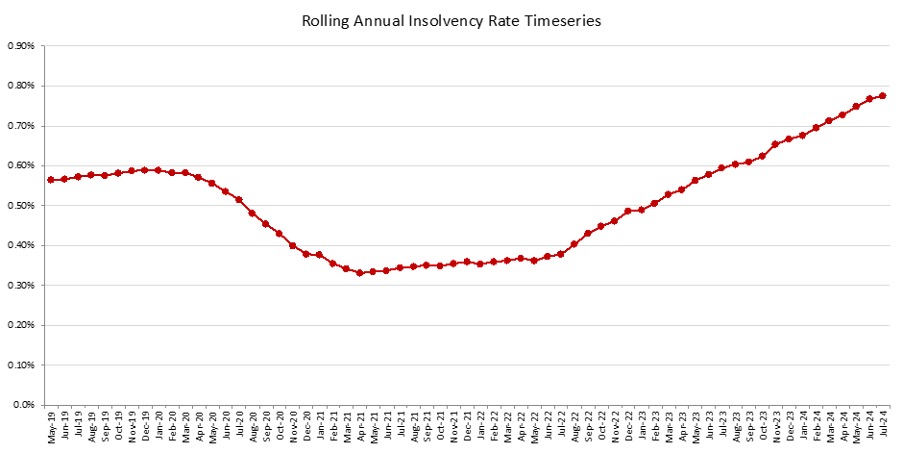
The annual insolvency rate now exceeds pre-COVID levels and has been rising steadily since mid-2022. The trend is expected to continue with insolvency rates likely to increase further through 2025.
Businesses suffering
Moody’s Analytics economist Harry Murphy Cruise highlighted the woes faced by business.
“On the business front, investment fell 1.5% q/q. Falls in machinery and equipment investment drove most of the drop, with retreating non-dwelling investment adding to the woes.
"Data released last week showed the drop in investment has been sharpest in interest rate-sensitive industries, particularly retail.
“Government spending helped to paper over some of the June quarter’s cracks. Government consumption jumped 1.4% q/q, with public investment rising 1.5%. Combined, public demand added 0.4 percentage point to the quarter’s growth.
“Trade also provided a helping hand. Exports rose 0.5% q/q, largely on the back of a solid 5.6% jump in services.
"After a run of weakness, international students upped their spending, helping to partially offset the fall in tourist visitors through the quarter.
"In contrast, commodity export volumes were weak; combined with a fall in prices, the terms of trade fell 3% q/q. The other side of the trade coin saw imports drop 0.2% q/q.
“Inflation remains the weathervane for the economy; the Reserve Bank of Australia won’t be able to ease off the brake until it is comfortable inflation is back under control.
"To that end, new cost-of-living relief, including energy rebates and tax cuts, are a double-edged sword. While they help to ease pressure on households today, they also risk adding a bunch of spending into the economy.
"If that happens, price pressures could linger, stretching out inflation’s tail and pushing back the prospect of rate cuts.”
Murphy Cruise did point out some positives.
Household deposits increased by more than 2% in July, as cost-of-living support was saved.
Additionally, the Melbourne Institute’s inflation gauge indicated a reduction in inflation during August. However, there is caution over whether this trend will continue, with the RBA potentially easing monetary policy earlier than expected if the inflation reduction persists.
Despite the positive signs, the household saving ratio remains low at 0.6%, and there is still the possibility of households spending the cost-of-living relief.
As a result, inflation is expected to remain steady throughout the rest of the year, and interest rate cuts are anticipated no sooner than February. The tight labour market is offering some protection to households, but this is likely to weaken as job creation slows over the coming year.
GDP growth is forecast to decrease from 2.1% in 2023 to less than 1% in 2024 with a rebound to 2.1% by 2025 as rate cuts accelerate.