
ATHA Energy Corp (CSE:SASK, OTCQB:SASKF) announced it has completed its 2024 Exploration Program at its Angilak uranium project in Nunavut, which hosts the Lac 50 uranium Deposit.
The “highly successful” program was carried out from early June to late August and involved 25 diamond drill holes totalling about 10,051 meters.
ATHA highlighted that it achieved all of the program’s objectives, including expanding the historic footprint of mineralization along the Lac 50 trend and identifying new parallel mineralized trends called the Lac 48, Lac 52, and Lac 54 Trends.
These new trends show high potential for further discoveries as they remain open in all directions, ATHA highlighted.
Regional drilling at Lac 50 uncovered new uranium lenses and extended known zones.
Notably, high-grade mineralization was encountered at multiple points, including the Blaze target in the Lac 48 Trend and along the Lac 52 Trend's Pulse and Mushroom Lake target areas.
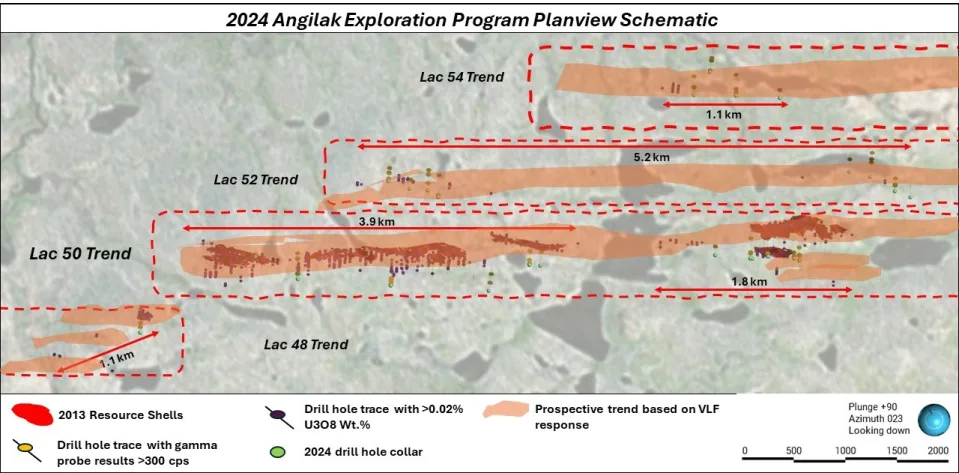
Samples from the 2024 exploration program have been sent to SRC laboratories in Saskatoon, Saskatchewan for analysis, with results pending.
“The successful identification of uranium mineralization along strike at the deposit, combined with the confirmation of uranium mineralization across multiple proximal parallel trends, underscores the immense potential of this project,” ATHA CEO Troy Boisjoli said in a statement.
“These results not only extend the footprint of known mineralization but also illuminate new opportunities for significant resource growth.”
Cliff Revering, ATHA VP Exploration, added: “The combined results from our drilling campaign and surficial mapping program have allowed us to build on the understanding of the lithological and structural controls on mineralization within this highly prospective uranium district.
“The geological picture at Angilak continues to develop and we are excited by the direction the project is heading.”
Additionally, the company commenced Phase 2 exploration at the project in early August, which includes airborne geophysics and ground geochemistry sampling and mapping. It is expected that this program will be wrapped up by mid-September.