
An ongoing sanctions tit-for-tat between China and the US threatens to destabilise the global supply of semiconductors used in artificial intelligence and military technology, industry stakeholders have warned.
In comments published by the Financial Times, a major buyer of germanium and gallium warned that “if China reduces gallium exports as it did in the first half of the year, then our reserves will be consumed and there will be shortages”.
Jan Giese, a manager at raw minerals broker Tradium, echoed this sentiment, warning that the company has secured “a fraction of what we bought in the past” of these metals.
Germanium and gallium are two critical metals used in the semiconductor manufacturing process.
According to the Critical Raw Materials Alliance, which represents producers, traders and associations, China is responsible for around 60% of global germanium production and 80% of gallium production.
This puts China in a strong bargaining position that threatens to create a bottleneck in global chip supply.
China’s curtailing of these metals is a likely response to strict technology sanctions imposed by US President Joe Biden since October 2022.
Under these export controls, technology companies are forbidden from supplying cutting-edge microchips to the Chinese market in order to restrict China’s access to military-grade AI and computing technologies.
The US worries that high-end designs being produced by Nvidia Corp and its competitors pose a national security threat.
When these restrictions were further strengthened in October 2023, the US Secretary of Commerce Gina Raimondo stated: “Today’s updated rules will increase the effectiveness of our controls and further shut off pathways to evade our restrictions.
“These controls maintain our clear focus on military applications and confront the threats to our national security posed by the (People’s Republic of China) Government’s military-civil fusion strategy.
“As we implement these restrictions, we will keep working to protect our national security by restricting access to critical technologies, vigilantly enforcing our rules, while minimising any unintended impact on trade flows.”
Prices escalate
But pricing trends suggest that trade flows have indeed been impacted.
Contracts for difference on germanium are up nearly 80% since the beginning of 2024, according to Trading Economics data.
A kilogram of 50-ohm-resistant germanium currently costs 16,750 Chinese yuan (US$2,349/£1,777). This makes germanium around 130% more expensive than in October 2022, when the Biden administration ramped up export controls against China.
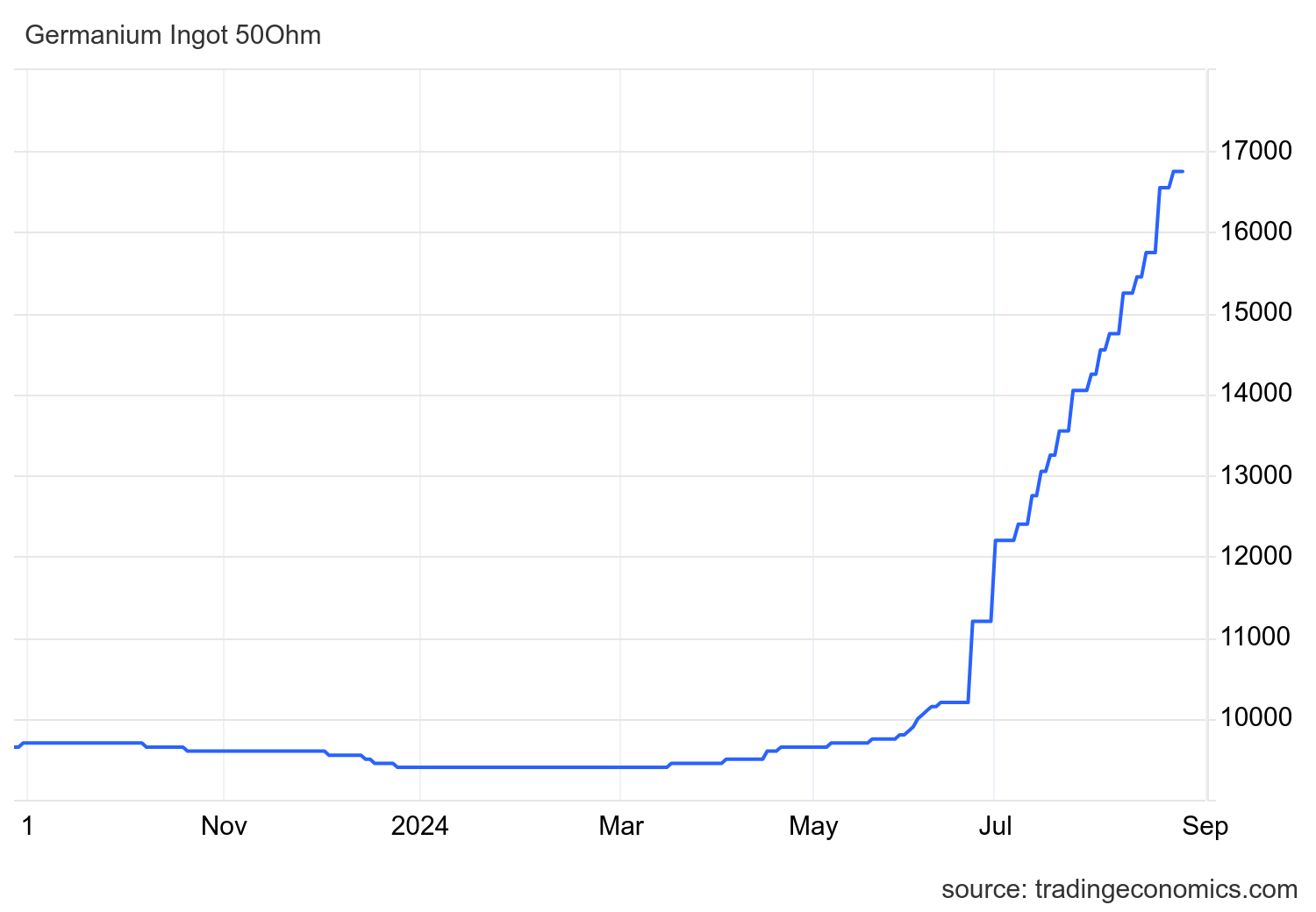
Gallium is up around 34% year to date though only 6% since October 2022. This is partially due to Covid-related logistics issues that pushed the price of gallium to record highs in 2022.
The trade spat between China and the US has caused a headache for Nvidia, the world’s most valuable chipmaker.
Under US-imposed export controls, Nvidia is prohibited from selling its high-end AI chips to China, causing a dip in Chinese-based sales.
Stakeholders will gain a deeper insight into Nvidia’s Chinese revenues when it reports its second-quarter results on Wednesday.