
Corazon Mining Ltd (ASX:CZN, OTC:CRZNF) has a diamond drilling campaign underway at the high-priority May Queen copper-gold porphyry target of the Mt Gilmore Project in northern New South Wales from which copper samples up to 10.75% have been returned.
The May Queen prospect has mineral chemistry characteristics typical of giant porphyry copper-gold deposits, such as large Northparkes Copper-Gold Mine also in NSW.
This chemistry is supported by outcropping sulphide mineralisation, favourable hydrothermal alteration, a coincident high-copper-in-soil signature and geophysical anomalism.
Strong sample results
Rock chip samples from the May Queen Skarn outcrop, which is adjacent to the drill target, provide further optimism for Corazon as it embarks on an initial two-hole diamond core program for around 1,000 metres. Samples returned:
- 9.29% copper, 0.11 g/t gold and 74.7 g/t silver;
- 8.63% copper, 0.11 g/t gold and 51 g/t silver;
- 6.61% copper, 0.06 g/t gold and 43.7 g/t silver; and
- 10.75% copper, 0.1 g/t gold and 70.5 g/t silver.
“An exciting target”
Managing director Brett Smith said: “May Queen is a particularly exciting target. The entire 20-kilometre strike of the Mt Gilmore Project displays many characteristics typical of large porphyry copper-gold systems.
"The identification of May Queen as a distinct high-priority target, at this very early stage of exploration, provides a great opportunity for Corazon and will be a good initial test of the advanced mineral vectoring targeting methodologies provided by CODES and the University of Tasmania.”
Large surface anomalism
Mt Gilmore's surface anomalism for metals covers a large area. Corazon’s recognition of the surface expression of a large hydrothermal system of more than 20 kilometres in strike, possibly associated with mineralised intrusions, presents a compelling exploration undertaking.
The large size of the Mt Gilmore copper-gold-cobalt-silver geochemical anomaly presents a challenging exploration play.
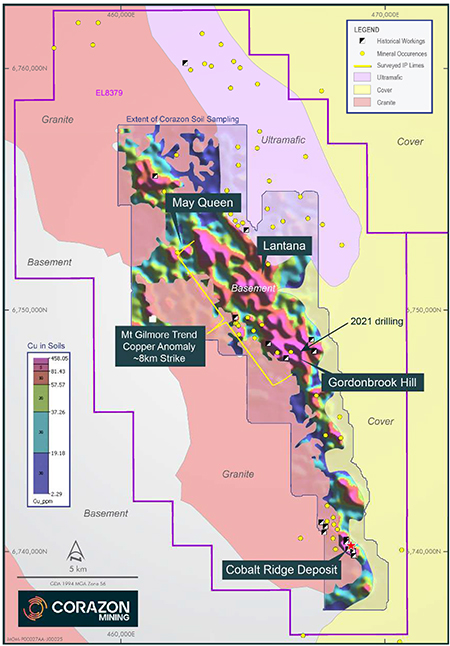
Mt Gilmore Project interpreted geology with a copper in soils geochemical image over the sedimentary/volcaniclastic basement rocks, with mineral occurrences and prospect locations.
About May Queen
May Queen target, a significant feature of about 2 kilometres in strike, has been identified from two phases of advanced alteration mineral chemistry studies.
Mapping defined favourable hydrothermal alteration and sulphide mineralisation at surface, supported by strong copper in soil anomalism and encouraging geophysical features such as a magnetic-high halo (rim) and an Induced Polarisation (IP) chargeability high at depth.
Highly encouraging results have been returned from two phases of Advanced Mineral Chemistry Vectoring Studies undertaken by the Centre for Ore Deposit and Earth Sciences (CODES) at the University of Tasmania (UTAS) for the Gordonbrook Hill and May Queen areas at Mt Gilmore.
May Queen has a signature of porphyry systems, notably into the 'giant' porphyry copper deposit category, with some samples demonstrating strong skarn signature.
Encouragingly, the mineral chemistry and fertility studies of samples from May Queen have mineral and geochemical characteristics comparable to representative samples from the Northparkes Copper-Gold Deposit.
Two-hole program
A moderate to strong IP chargeability high anomaly of around 400 metres in diameter will be tested by drill hole MQDD001, which is about 500 metres east of a copper skarn mineralised outcrop.
Drill hole MQDD002, to the north of the IP cross-section, is planned to intersect a related north-northwest trending IP chargeability high anomaly.
Corazon’s two-hole drill program at May Queen is designed as an initial test of a potentially concealed copper-gold porphyry system and its related mineralisation.