
Galileo Mining Ltd (ASX:GAL, OTC:GLMGF) has the reverse circulation drill spinning north of the Callisto deposit at the company’s 100% owned Norseman project in Western Australia with platinum group elements (PGE) along with nickel/copper targeted.
The 2,000-metre campaign is planned to be completed within three weeks and the well-funded company, which had $13.6 million in cash as at June 30, 2024, is expecting first assay results in late September/October.
Drilling is designed to test a combination of geophysical EM targets, geophysical IP targets and geochemical targets with the targets being between one and five kilometres to the north of the 17.5 million tonnes Callisto resource.

High-priority targets
Galileo managing director Brad Underwood said: “RC drilling has commenced at our Norseman Project with a number of high priority targets to be drilled in this work program.
"Having proven the prospectivity of the area with the discovery of the Callisto deposit, we are now exploring this newly discovered fertile region for further resources.
"The current program will be drilling a combination of geophysical and geochemical targets between one and five kilometres north of Callisto.
"At the same time, we are continuing our target generation through detailed interpretation of the large-scale IP geophysical data sets we have collected over the entire prospective belt.
"With $13.6 million in cash we are fully funded to undertake all planned activities and we will maintain our focus on exploration through the present market conditions.
"We believe a new resource discovery will always create value and that is what we aim for each time we go drilling.”
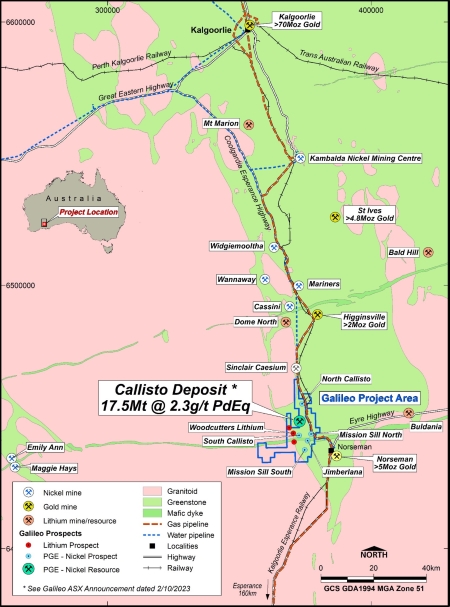
Norseman project location map with a selection of mines, resources and infrastructure.
Target selection
All targets are within the Callisto North prospect, which is between one and five kilometres north of the Callisto deposit.
The drill targets are based on the results of down hole EM surveying, updated IP survey data and geochemical/geological targeting.
Downhole EM surveying was undertaken on drill hole NRC493, which was originally drilled into a high chargeability/low resistivity geophysical anomaly defined by pole-dipole IP surveying.
The geology intersected in this hole was unable to explain the geophysical response while intersecting a thick zone of ultramafic rock interpreted to be a unit of the same prospective sill which hosts the Callisto nickel-copper-PGE deposit.
Data from the down hole survey showed a highly conductive response which was modelled with a plate size of 202 metres strike length, 432 metres down dip extent, and a conductance of 16,129S. The model dips to the southeast and passes about 10 metres beneath drill hole NRC493.
Another prospective result from the May 2024 round of drilling was received from NRC498, drilled adjacent to a moderately strong geophysical response. This response will be the subject of follow-up drill testing in the current drill program.
Further prospective results were received from NRC496 drilled on section line 6,449,700. A large zone of anomalous mineralisation has been identified in ultramafic rock which broadly matches the top of a change in chargeable response and a change in geology to the west.
This target will be drilled to determine whether the subtle geophysical response and the ultramafic/mafic contact zone are linked to zones of mineralisation.
Survey work
Regional pole-dipole surveying of the 20-kilometre Callisto trend and the 12-kilometre Mission Sill trend is complete with ongoing interpretation to determine which geophysical responses will be selected for drill testing.
The exploration strategy is to build on the understanding of the geophysical data gained from recent drilling and to continue working from areas of higher data density (areas with drilling) to those with no drilling.