
Cobre Ltd (ASX:CBE) is awaiting results from pioneering seismic survey work that has been completed on the Kitlanya West Copper Project in the Kalahari Copper Belt of Botswana.
This work included the completion of field acquisition of 62 kilometres of active 2D reflection seismic survey and overlapping 100 square kilometres of passive seismic survey (Ambient Noise Tomography).
Aim of program
This pioneering program has been developed and generated through the support of the BHP Xplor program in which Cobre says it is proud to have been a participant in the 2024 cohort.
Active and passive seismic surveys were designed to image potential large-scale fold trap-sites where Tier-1 copper deposits may be hosted and identify structures which may provide pathways for copper mineralisation.
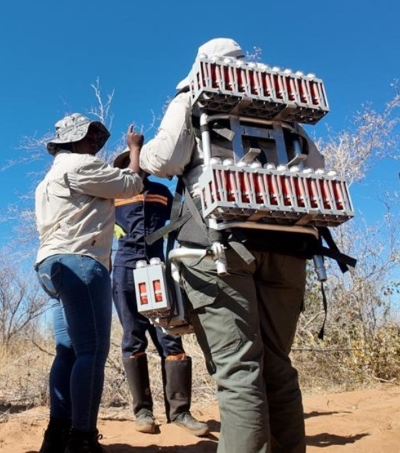
StrydeTM active seismic node deployment.
Understanding architecture
The program is also expected to complement and help resolve the basin architecture interpreted from recently completed airborne gravity gradient surveys.
Cobre’s chief executive officer Adam Wooldridge said: “We’re pleased to have successfully completed the acquisition phase of both active and passive seismic surveys.
"The results from the programs are expected to be hugely informative for our understanding of this important basin margin and associated copper-silver targets.”
Towards drill targets
Reflection seismic survey results are being processed and interpreted by HiSeis of Australia with results expected towards the end of the quarter.
Passive seismic nodes are being shipped for data harvesting and processing by the Institute of Mine Seismology.
Cobre expects that this work will provide diamond drill targets for the compelling Tlou target at Kitlanya West, which was defined in the company’s 2023 soil and reverse circulation drill campaign.