
Trading contracts for difference (CFDs) is a high-risk/high-reward endeavour, in the sense that as CFD buyers take on more risk, the seller sees a higher reward.
Take CFD platform Plus500 Ltd (LSE:PLUS), which just delivered another supersized dividend while upgrading its full-year profit forecast.
This has helped Plus500’s valuation swell over 50% so far this year and more than 80% over the past 12 months.
What is underpinning this remarkable growth?
Leveraged to the hilt
Unlike commission-based revenue models at Hargreaves Lansdown, AJ Bell and other online wealth platforms, Plus500 makes its money through spreads and overnight fees (though it also earns a bit through net interest earned on customer cash).
These fees are amplified through the leverage effect, which allows traders to control a larger position than their initial investment.
For example, with 10x leverage, a trader with $1,000 can control a position worth $10,000.
Right now, a retail investor can open a position on a gold CFD on Plus500 with 20x leverage.
There is a one-off ‘dynamic spread’ charge on opening the position, meaning around 0.5% of the position amount immediately goes to Plus500. The dynamic spread fluctuates in response to demand for the CFD.
Plus500 then charges overnight fees to keep your positions open.
The overnight fee for holding a long position is substantially larger than that of a short position, though both are mere fractions of a percentage point.
The gold 20x leverage product, for instance, charges 0.0365% each night for longs but just 0.0073% for shorts.
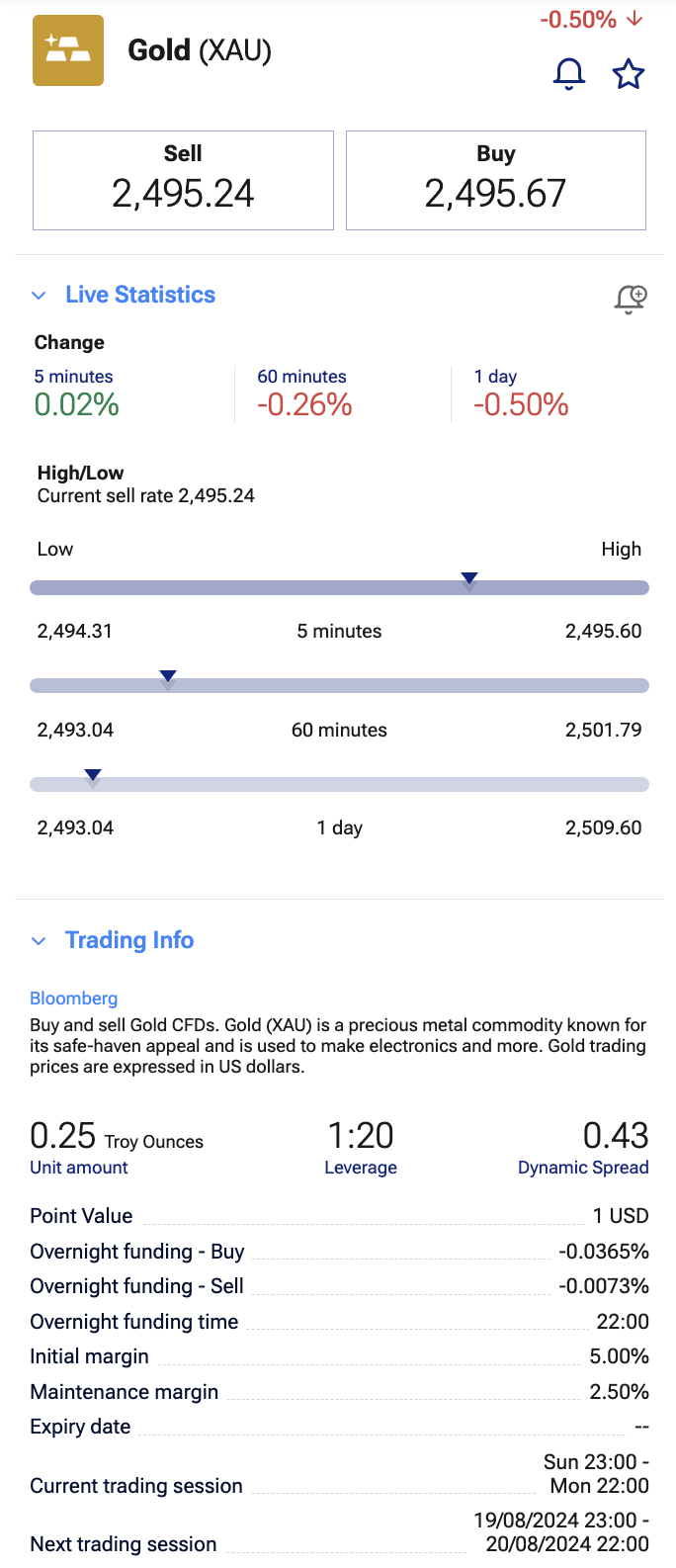
Plus 500's 20x gold CfD product -- Credit: Plus500
Nonetheless, when millions of leveraged trades are involved, this adds up to a lucrative, high-margin business model (Plus500’s adjusted margin in the first half of 2024 was 46%).
As a bonus, Plus500 also charges an ‘inactivity fee’ of up to US$10 per month if a user has not logged in for three months.
Risk appetites surge
Since Plus500 earns revenue on the full value of the leveraged position, there is a clear impetus to offer the most attractive leverages the UK financial regulator will allow.
When you put all this together, you get a lot of cash generated for Plus500. A record amount, in fact: its cash position exceeded $1 billion for the first time in the first half of 2024.
As analysts at investment bank Jefferies pointed out, this is more than half of Plus500’s market capitalisation.
Naturally, a lot of this free cash is being channelled back to shareholders.
Plus500 announced additional shareholder returns of $185.5 million in the first half, comprising share buybacks of $110.0 million and total dividends of $75.5 million, bringing the total shareholder returns for the first half to $360.5 million.
Jefferies highlighted that Plus500 has made $2.7 billion in profit since its 2013 initial public offering, of which $2.3 billion (including today's announced returns) has or will be returned to shareholders.
Is this sustainable? That all depends on Plus500's customers’ attitude to risk going forward.
According to new research shared with Proactive by Charles Stanley, 42% of DIY investors "are seeking a higher-than-usual-level of risk in the next three months, with 10% seeking a significantly higher risk profile than normal”.
Gen Z DIY investors are most open to taking a high-risk approach to investing, followed by millennials, said Charles Stanley (LSE:CHAS).
Some 80% of these investors will lose money trading CfDs on Plus500 (according to Plus500’s own data). 100% of shareholders, however, can expect the dividends to continue if the cash keeps rolling in.