
Kingfisher Mining Ltd (ASX:KFM) has a co-funded diamond drilling program underway at carbonatite pipe targets in the Mick Well Rare Earth Elements (REE) Project in the Gascoyne region of Western Australia.
Three large carbonatite pipe targets at Mick Well have been identified below the company’s high-grade vein and dyke REE mineralisation discoveries and these will be the focus of the planned program of two diamond drill holes for approximately 1200 metres.
These carbonatite pipe targets were generated through three-dimensional modelling of gravity and magnetics data, with areas with more dense and more magnetic rocks identified from the geophysics.
WA EIS funding
The WA Government Exploration Incentive Scheme (EIS) administered by the Department of Energy, Mines, Industry Regulation and Safety (DEMIRS) will contribute $200,000 of co-funding for the program which is expected to take a month to complete.
In addition to the co-funded drilling, Kingfisher continues with the ongoing evaluation of the base metal opportunities within its Gascoyne tenure.
Kingfisher’s non-executive chairman Warren Hallam said: “We are excited to have the co-funded diamond drilling program underway.
"The program integrates the geophysical targets within an area surrounded by high-grade REE mineralisation and the carbonatite targets are potentially the source of REE mineralisation at depth.
"The successful awarding of co-funding vindicates the high-quality targets and technical work of the Kingfisher team to date. Kingfisher is grateful for DEMIRS support in awarding the co-funded drilling.
"In addition to the co-funded drilling the company is on the ground evaluating the base metal opportunities within the company’s tenement package.”
About the target pipes
Each of the target pipes is more than 1,000 metres in diameter and close to surface, with the depth to the top of each target being less than 50 metres below the ground surface.
These carbonatite pipe targets are all in the centre of the large area of outcropping carbonatites and associated fenite alteration at Mick Well.
The modelled targets are also directly associated with the vein and dyke REE mineralisation which envelop and radiate away from the interpreted intrusion centres.
Kingfisher’s drilling will target the central and eastern pipes, with additional drilling planned in other locations.
Base metals review
As well as the REE work, the company continues to undertake a review of historic base metal occurrences at Mick Well.
Recent on-ground surface sampling returned high-grade copper values ranging from 1.73% up to 15.3% as well as gold values up 0.6 g/t and bismuth up to 0.26% with elevated bismuth commonly occurring within Volcanogenic Massive Sulphide (VMS) deposits.
The company’s base metal evaluation aims to investigate the presence of mineralisation not identified by existing geophysics surveys and previous wide-spaced drilling.
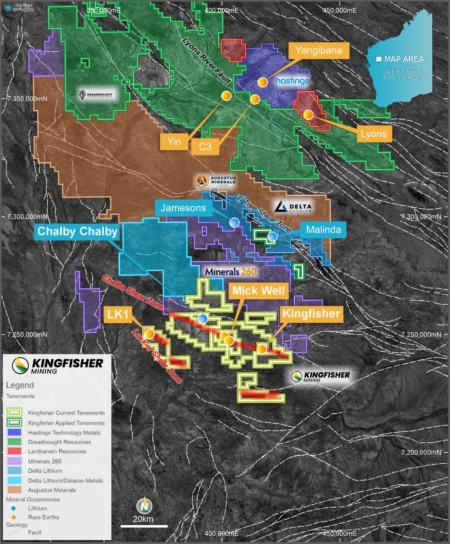
Location of the Mick Well and LK1 REE projects and the Chalby Chalby Lithium Project in the Gascoyne Mineral Field. The location of the Yangibana REE Deposit, Yin REE and C3 deposits which are 100 kilometres north of Kingfisher’s projects as well as the Malinda Lithium Deposit, 45 kilometres north of Kingfisher’s projects, are also shown.
Gascoyne region
Kingfisher’s Gascoyne tenure is prospective for carbonatite REE mineralisation similar to Hastings Technology Metals’ world-class Yangibana Deposit which includes 29.93 million tonnes at 0.93% TREO and the recent Yin and C3 discoveries of Dreadnought Resources which include mineral resources of 40.82 million tonnes at 1.03% TREO.
It is also prospective for lithium-bearing Thirty Three Suite Pegmatites which hosts Delta Lithium’s Yinnetharra Project and has a mineral resource of 25.7 million tonnes at 1.0% Li2O from the Malinda Prospect and rock chips results of 4.2% Li2O from the Jamesons Prospect.
The Kingfisher prospect has historically been explored for base metals with base metals mineralisation outcropping at surface.
Kingfisher has made discoveries of hard rock and clay rare earth elements mineralisation at Mick Well. Both styles of mineralisation are associated with carbonatites that intruded along a crustal-scale structural corridor, the Chalba Shear, which extends over a strike length of 54 kilometres within the company’s tenure.
The company has also identified a second structural corridor along the Lockier Shear which extends for 18 kilometres across the company’s Mooloo Project and 12 kilometres across the Arthur River Project.
Kingfisher is also advancing the Chalby Chalby Lithium Project with mapping and sampling delineating an area of 3.3 by 3 kilometres that includes multiple stacked pegmatites with a cumulative strike length of more than 13 kilometres and with surface sample results up to 0.61% Li2O.