
Noxopharm Ltd (ASX:NOX, OTC:NOXOF), an innovative biotech company, has soared on new data regarding its CRO-67 preclinical drug for pancreatic cancer that shows significantly reduced pancreatic tumours and barrier cells in a complex model.
Pancreatic cancer is especially difficult to treat because tumours are surrounded by a dense barrier of cells that protects them from anti-cancer drugs, as well as from the body’s immune system.
CRO-67 targets pancreatic cancer in a different and innovative way by acting as a novel dual-cell therapy, destroying both tumour and barrier cells.
Investors reacted positively with shares as much as 48.81% higher in ASX trading this morning to A$0.125, a 2024 high.

Decrease in metastatic cancer spread
The new data from a highly sophisticated study that tested CRO-67 in a complex model, in which human pancreatic cancer cells as well as barrier cells were transplanted into the pancreas of mice, showed a significant decrease in metastatic cancer spread.
This is a far more stringent approach than most pancreatic cancer studies because it involves replicating human pancreatic cancer much more closely by not only growing a human pancreatic tumour, but also growing the barrier cells around the site of the tumour.
Providing more encouragement for Noxopharm is that the studies were safe and well tolerated preclinically.
Dual-cell therapy effect
Noxopharm CEO Dr Gisela Mautner said: “We are very pleased with the outcome of these studies as they show that CRO-67 continues to have a dual-cell therapy effect in a variety of pancreatic cancer models, including this complex model where the bar is set much higher.
"This data will be used to inform the next steps of our project and will also be important in future regulatory contexts.
“Pancreatic cancer has a very poor survival rate. There is clearly an unmet need to develop new treatments, either alone or in combination with existing treatments, to help alleviate patient suffering and help save many lives.”
UNSW collaboration
The research is part of an ongoing collaboration with the world-leading pancreatic cancer team at UNSW Sydney and follows work conducted in 2023 and 2022 which showed that CRO-67 significantly reduced tumour volume in vivo, slowed down the rate at which tumours grew and was also effective in an advanced human patient pancreatic tumour explant model.
Professor Phoebe Phillips, the lead investigator at UNSW said: “These results are encouraging, especially as we have generated a substantial amount of data from a broad range of studies involving stringent scientific models and innovative research techniques.
"Further studies are now warranted to identify next steps and build on what we have achieved so far.”
Mimics human microenvironment
The CRO-67 mimics the intricate tumour microenvironment in humans and the challenge that treating patients presents.
The study had three major results:
- Significant decrease in tumour volume growth rate;
- Significant decrease in barrier cells; and
- Significant reduction in cancer spread.
As the target for CRO-67 is proliferating barrier and cancer cells, the following analyses were based on tumours with more than 150% growth at the end of study relative to the starting tumour size, with non-growing tumours excluded from the analyses.
Analyses
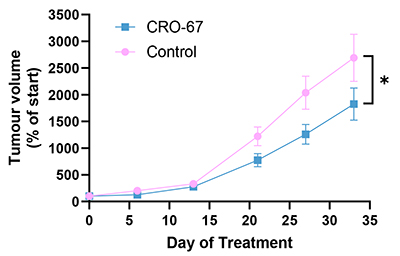
CRO-67 treatment (blue) resulted in a significant decrease in tumour volume (p=0.0496) when compared to untreated controls (pink). Tumour growth rate is expressed as the percentage change in tumour volume from its pre-treatment volume over the course of drug treatment. Tumour growth was inhibited by 39.15% at the study’s endpoint compared to untreated controls.
In this and the following figures, asterisks represent a p-value of less than 0.05, indicating statistically significant results.
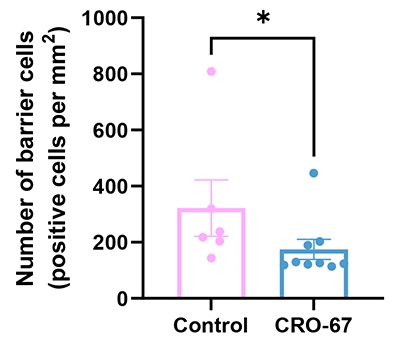
Demonstrating the dual-cell therapy inherent in the drug, the number of barrier cells surrounding the pancreatic tumour was significantly reduced by 45.77% (p=0.0176) with CRO-67 treatment (blue) compared to untreated controls (pink).
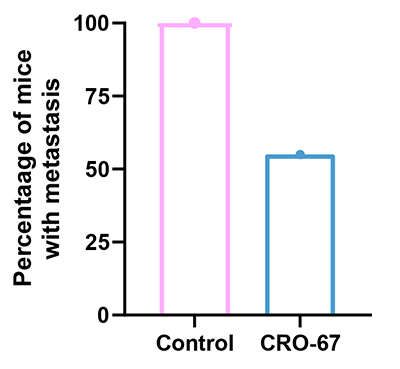
CRO-67 had a dramatic effect on metastasis, the spread of cancer cells to other organs in the body when compared to the untreated controls.
The number of metastatic sites per mouse was significantly reduced by CRO-67 (blue) compared to the untreated controls (pink).
Of the mice treated with CRO-67, 55% or five out of nine had metastatic disease compared to untreated controls where all mice saw the cancer reach other organs.
Collagen findings
The research team also microscopically examined collagen, which is a key component of the barrier cells. Changing the high- and medium-density collagen to low-density collagen is a way of normalising and remodelling the barrier cells, degrading their role in cancer growth.
CRO-67 significantly increased the level of low-density collagen by 71.3% (p=0.012), suggesting the drug not only reduces the number of barrier cells but also weakens the barrier structure, which could potentially improve drug access.
Finally, the investigators’ overall assessment found that CRO-67 was well tolerated, and organ examination at the end of the study showed that CRO-67 was safe in the administrated doses.