
At a time of growing global interest in nuclear power and resulting strong uranium prices, Alligator Energy Ltd (ASX:AGE, OTC:ALGEF) has made a significant new uranium discovery during its inaugural drilling program at the Big Lake Uranium Project in the Cooper Basin of northeast South Australia.
Drilling has intersected significant thicknesses of anomalous uranium mineralisation within interbedded palaeochannel sand units in the Namba Formation.
Anomalous uranium intersected
To date, four aircore drill holes in the ongoing program have intersected palaeochannel sand units hosting anomalous uranium mineralisation located between 90 to 130 metres below surface.
This discovery is the first proof of concept that significant uranium is present within the Lake Eyre basin sediments that lie above the hydrocarbon-rich Cooper Basin and within potentially In-Situ Recovery (ISR) amenable host and depths.
Of significance is the presence of oxidised and reduced sands in all holes drilled in this area which is synonymous with roll-front uranium mineralising systems.
First discovery since 2007
Alligator’s CEO Greg Hall stated: “This is the first significant greenfields discovery of uranium in South Australia since the Samphire Uranium Project in 2007 by the company UraniumSA Ltd.
"The thickness extent of mineralisation layers ranging up to 20 metres in these discovery holes is impressive for this style of mineralisation.

"While estimated grades are still on the lower side, to have grade thickness intersections close to the cut-off used at our Samphire Project from the initial discovery area is very encouraging.
"The discovery appears to validate the uranium formation model developed by the previous Big Lake geologists from whom Alligator acquired the initial tenement, and we acknowledge their work.”
An inaugural drill program on Alligator’s 100%-owned EL6367 reported evidence of potential paleochannel sands at drill-target 'Site 10'.
About the drilling
Drilling resumed on August 8, 2024, in this area after a three-week break due to rain affecting access.
The objective of the inaugural program was to investigate the region's stratigraphy and the potential for uranium mineralisation in the shallow basin sediments that lie above the hydrocarbon-rich Cooper Basin.
This setting has many attributes seen in other global hydrocarbon-related ISR uranium fields around the world.
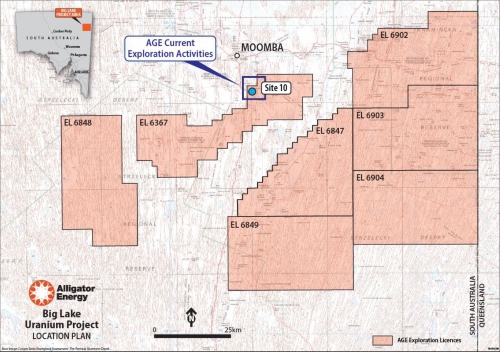
Alligator’s significant tenement holding over the southern Cooper Basin which comprises the Big Lake Project.
pXRF readings
Using a calibrated portable X-ray fluorescence analyser (pXRF) on drill samples, initial preliminary estimates of the tenor of uranium grades include:
- 20 metres at 110 ppm uranium (U) from 106 metres including 1 metre at 241 ppm from 123 metres, and 1 metre at 185 ppm from 129 metres;
- 5 metres at 130 ppm U from 107 metres;
- 5 metres at 45 ppm U from 104 metres; and
- 10 metres at 120 ppm U from 180 metres.
Indicative uranium grades found in these holes are approximately 10 to 50 times background levels.
Two further holes are being drilled within the limited heritage-cleared area of discovery.
Potential for new ISR field
"The sediments above the Cooper Basin cover are an extensive area and we hope this has the potential to develop into a new ISR amenable uranium field, similar to the Curnamona Province which hosts the Beverley, Four Mile and Honeymoon deposits,” Hall said.
"I would like to congratulate our exploration team: for their initial EM interpretation work on the project back in 2019; the detailed seismic interpretation work carried out during 2022/23; and the planning, logistics and safe drilling operations carried out to date.
"We are also very appreciative to the Traditional Owners, pastoralists and other stakeholders in the region that have facilitated access for our work.”
AGE’s strategy is to specifically target the northern extensions of the same Tertiary Namba and Eyre sedimentary formations which host the Beverley, Four Mile and Honeymoon ISR uranium mining operations in South Australia, south of the Big Lake project.
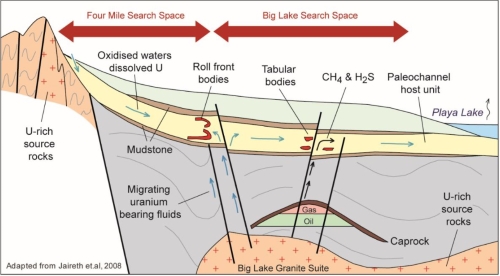
Basic conceptual model for the Big Lake Project.
The aim of this initial drilling program has been to target the shallower Namba formation, with the objective of corroborating seismic/airborne electromagnetic survey interpretations of potential mineralisation-bearing palaeochannels.
Site 10 was specifically targeted to confirm the presence of an inferred palaoechannel and assess if this channel contained the key ingredients of the model.
What’s next?
At the end of the drilling program, all samples will be transported to Adelaide for detailed laboratory assaying and analysis.
Following full analysis of data, including refinement of the geological model, Alligator will begin approvals and initiate heritage clearances for follow-up drilling.
Results from XRF analysis are stated as estimates only and are preliminary to subsequent confirmation (or otherwise) by geochemical laboratory analysis.