
The copper bellwether is tolling. Prices rose as much as 31.7% from the beginning of this year, hitting an all-time high of $11,000 per tonne in May.
The rise of artificial intelligence (AI) and resulting massive upswing in global data infrastructure investment has accelerated copper demand, which had already picked up the pace with the advent of the energy transition and the kilometres of electrification infrastructure required to meet net-zero goals.
Solis Minerals Ltd (ASX:SLM, TSX-V:SLMN, OTCQB:SLMFF) holds one of the largest and most prospective holdings in the coastal belt region of Peru, a copper producing powerhouse second only to Chile.
With the closure of Canadian miner First Quantum’s Cobre Panama mine eliminating a full 1.5% of global copper production, SLM is positioning its projects to meet the 427 million tonnes of copper projected to be needed by 2050.
Peruvian Coastal Copper Belt
Solis Minerals holds four core copper projects in Peru, all along the Peruvian Coastal Copper Belt, about 760 kilometres south of the capital Lima near the city of Arequipa.
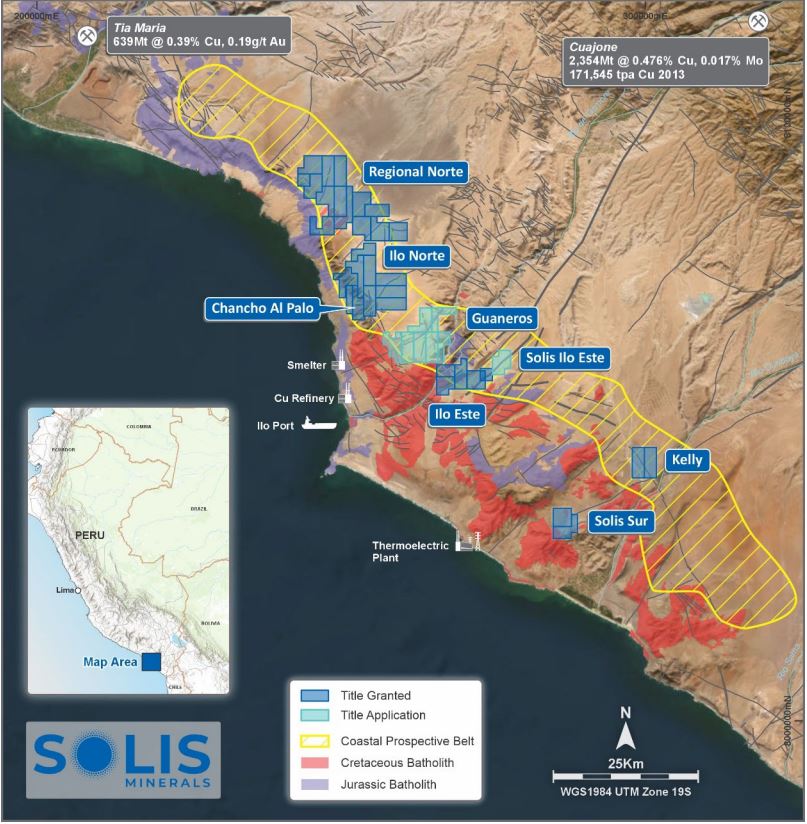
Solis Mineral's projects along the Coastal Copper Belt in Peru.
Chancho al Palo (formerly known as Ilo Norte) is host to two types of mineralisation, iron oxide copper-gold (IOCG) and porphyry style.
With geophysical surveys already complete, Solis intends to drill beginning in the fourth quarter this year, having confirmed the presence of surface copper mineralisation in several areas.
Ilo Este and Cinto are both host to surface porphyry mineralisation, with plans to drill test targets in the first quarter and first half of 2025, respectively.
Guaraneros sits directly between the Ilo Este and Chancho al Palo projects.
The high levels of copper fertility demonstrated thus far by the Peruvian Belt prompted Solis to acquire the land and plan a suite of geophysical exploration over the holding, which has never been explored.
A 2008 United States Geological Survey (USGS) study identified strong potential for sizeable copper deposits along the Belt, estimating discoveries could contain 2.5 million to 5 million tonnes of copper per deposit.
With 41,400 hectares already staked, Solis is very well placed to investigate the true potential in the region, which offers the local advantages of an experienced mining labour force and strong infrastructure with sealed roads, major export port facilities and third-party smelting capacity already in place.
Is copper the new oil?
Copper has been on an upward trend since 2020, responding to accelerations in energy and data infrastructure investment.
“Copper is the new oil,” The Carlyle Group chief strategy officer Jeff Currie said in an interview with Bloomberg Television.
“It’s the highest conviction rate [for copper] I’ve ever seen. You've got decarbonisation, green CapEx demand, AI data centre demand, military demand.
“It takes 12 sometimes 26 years to bring on new supply. You can’t come up with a better story.”
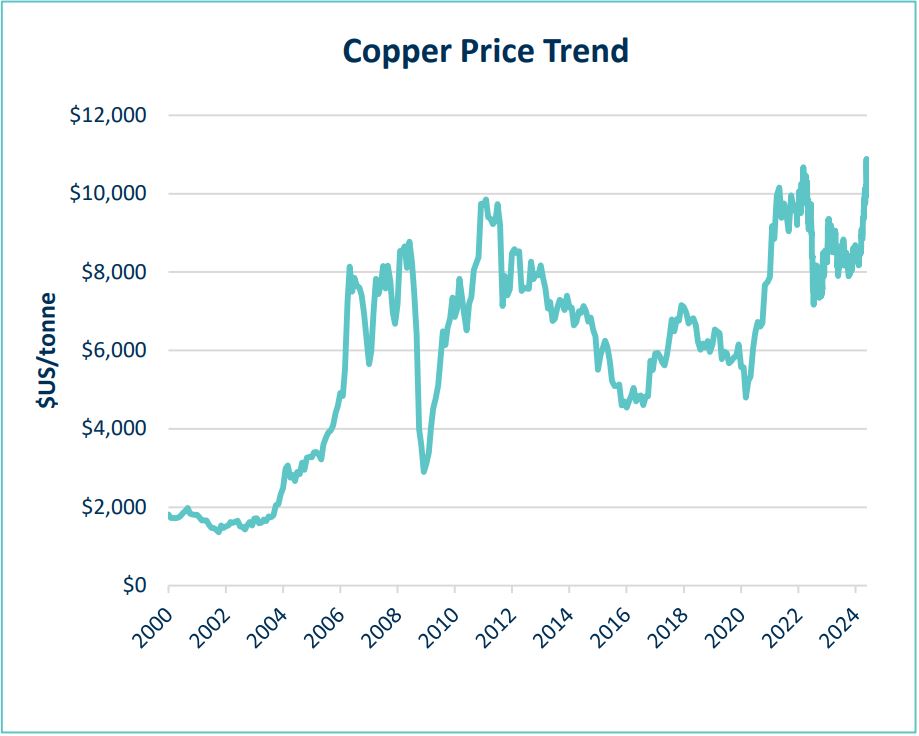
(source: Bloomberg)
Analysts estimate AI data centres need around 65,000 tonnes of copper for every gigawatt (GW) of applied power – the US alone is expected to add 18GW of capacity by the end of the decade, the equivalent of 1.17 million tonnes of copper.
“If you look at the demand that is coming from data centres and related to that from AI, that growth has suddenly exploded,” Trafigura chief economist Saad Rahim said.
‘‘That one million tonnes is on top of what we have as a 4-5 million tonne deficit gap by 2030 anyway.
“That’s not something that anyone has actually factored into a lot of these supply and demand balances.”
Copper supply crisis on horizon
Compounding demand pressures, a 2023 report by BloombergNEF estimated 152 million kilometres of electricity grid infrastructure will be necessary to reach net-zero by 2050, more than double the current size today.
“If you deconstruct the electricity grid and lay it out in a single line, those cables will stretch all the way to the Sun,” the report reads.
Considering copper accounts for about 10% of total power grid metal demand, that’s a hell of a lot of copper.
In April, the Bank of America declared in a note that the “copper supply crisis is here”, stating: “Tight copper mine supply is increasingly constraining refined production: the much-discussed lack of mine projects is finally starting to bite.”
With the Cobre Panamá mine’s closure reducing global outputs by 1.5% – brought about by a referendum vote in Panama – the table is set for copper’s rise, and Solis Minerals has plans to fill the yawning copper demand-supply gap.