
Maximus Resources Ltd (ASX:MXR, OTC:MXRRF) has the reverse circulation (RC) drill spinning at the Hilditch Gold Project in the Kambalda region of Western Australia in a bid to upgrade 19,500 ounces of inferred resources into the higher confidence indicated category.
The 24-hole program for around 1,500 metres, which is expected to take 1-2 weeks to complete, will also provide samples for additional metallurgical testing to support initial tests that confirmed the shallow resource is free milling and amenable to conventional cyanide extraction methods.
This drilling at the project, which is 25 kilometres from Kambalda, will follow-up previous shallow intercepts which include:
- 7 metres at 7.9 g/t gold from 51 metres including 2 metres at 16.9 g/t from 52 metres;
- 7 metres at 3.7 g/t from 11 metres including 1 metre at 18.6 g/t from 16 metres; and
- 6 metres at 3.4 g/t from 30 metres including 2 metres at 8.1 g/t from 34 metres.
Aim for resource upgrade
“This RC program drilling aims to bring more of the resource into the higher confidence JORC indicated category, whilst completing representative holes for additional metallurgical testing to determine gravity recoveries, grind size and reagent consumption for optimal gold recovery,” Maximus’ managing director Tim Wither said.
"The company continues to make consistent improvements in mineral resource classifications through efficient drilling and as our geological understanding of the deposits continues to grow, so does the potential across Maximus’ fertile tenements.”
The 19,500-ounce Hilditch gold resource at a grade of 1.3 g/t is on granted mining tenements, with excellent access to infrastructure, service providers and several toll-treating options within a ~60-kilometre haulage.
This resource is shallow with mineralisation commencing at the surface and is open at depth with significant strike extension to be tested.
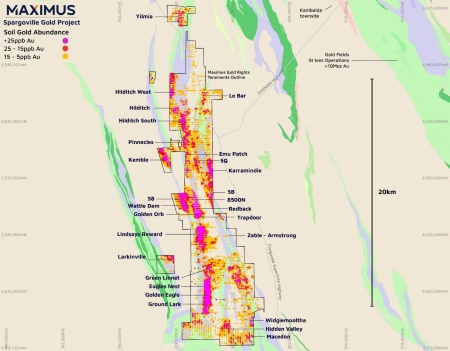
Location plan of the Spargoville Gold Project with gold in soils, regional geology and downhole gold grades >0.5g/t gold.
Metallurgical testing
Hilditch is just one of the several highly prospective regional gold deposits in the company’s Spargoville tenements.
This next drilling phase will also include several representative holes for additional metallurgical testing to determine gravity recoveries, grind size and reagent consumption of the Hilditch mineralisation.
Preliminary metallurgical test-work of the open-pit resource showed encouraging results, with gold recoveries between 91.4% and 95.8%.
These tests were conducted on samples over a range of gold grades and various stages of weathering and oxidation, ensuring adequate spatial representation of expected mining depths throughout the resource.
Samples were tested to measure the gold extractable by cyanide and to estimate potential recovery rates in conventional Carbon in Leach (CIL) gold processing before advancing to more detailed metallurgical analysis.
The high recovery rates across the deposit suggested consistent amenability to standard gold extraction techniques, reinforcing the potential for efficient processing and robust economic viability of the resource.
What comes next?
Upon receiving assay results, which are expected in 3-5 weeks, and assessing these a resource upgrade at Hilditch will be completed, thereby bolstering the company's future production opportunities.
"Hilditch’s shallow gold resource represents a potential near-term gold production opportunity for Maximus, located on a granted mining tenement next to the Coolgardie-Esperance Highway and within a short trucking distance to several regional gold processing plants.
"With the completion of a flora and fauna survey, the company has commenced preparations for the Mining Proposal and Mine Closure submission for open-pit mining operations at Hilditch.”
Workstreams are progressing for submission of the documentation during the current quarter.
Meanwhile, the second-phase drill program at Wattle Dam Gold Mine has been completed, targeting a potential structural offset of the high-grade gold mineralisation. Assay results are expected within 3-4 weeks.