
National Grid PLC (LSE:NG.) launched one of the largest rights issues in recent times last week, to generate £7 billion in fresh cash from existing shareholders.
But, what does this mean? And what should shareholders be doing?
In basic terms, a rights issue is a way for a company to raise cash directly from its existing shareholders by giving them the option to buy new shares.
In National Grid’s case, for every 24 shares owned investors will be given the option to purchase an additional seven – around 1 new share option for every 3.5 existing shares.
Of course, the first concern of stakeholders when new shares are issued is the dilution it will cause.
That’s where nil-paid rights come in.
A nil-paid places a monetary value on the right to purchase the new shares and can be traded in the interim known as the ex-rights period.
In National Grid’s case its nil-paid currently is worth around 190p.
It means that should an investor want to reject the offer to buy new shares, they can sell their nil-paid and receive compensation for the devaluation of their stake.
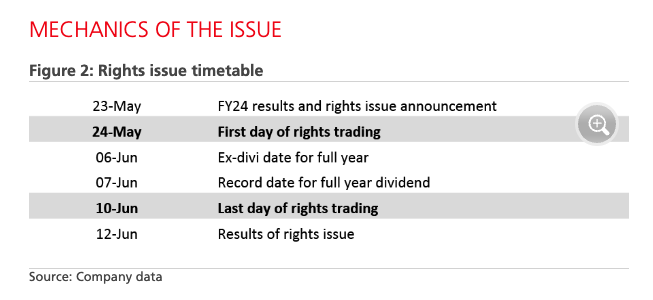
Source: UBS
So, what are the range of options available to investors?
Option 1: Do nothing
A shareholder may receive the nil-paid rights but choose to do nothing before the June 10 deadline.
If this is the case, their nil-paid rights will be sold for them at the best possible price and this cash will be returned to the investor’s account, like receiving a dividend.
A small fee will be taken for administrative expenses, but there is no minimum requirement for how much an investor can receive.
A shareholder who takes this option must remember that while they receive up-front cash, their stake in National Grid will have been diluted, meaning they are entitled to less of the group’s profits.
Option 2: Take up the rights
Shareholders who receive the nil-paid rights can decide to take up the offer, meaning they will continue to own the same percentage of the company, effectively avoiding dilution.
Investors who chose this route are required to pay their broker 645p for National Grid’s newly issued share before the June 10 deadline.
A letter and email were sent out to National Grid shareholders detailing who they need to contact should they want to convert their share option.
Option 3: Sell National Grid
A shareholder who has been discouraged by the utility firm’s performance and need for new cash may decide they want to cut their stake completely.
Should they sell their shares, the nil-paid rights will be sold with it, meaning that opportunistic investors cannot flog the shares and then later sell the option to make a free bit of cash.
Option 4: Sell nil-paid yourself
A similar route to doing nothing, however by selling it on the open market rather than at the deadline there is a chance for investors to make a little extra.
This is because the value of nil-paids are directly tethered to the value of National Grid.
It means that if the company’s value increases, the value of the nil-paids will increase substantially more.
For example, on Friday, National Grid shares jumped close to 4%, resulting in its nil-paid rights surging 22.5%.
Therefore, a shareholder looking to sell may wait for a day when the group is doing particularly well to offload the nil-paid rights.
Option 5: Trade nil-paid rights
Day traders, brokerage firms and keen investors may opt for this choice for a chance to make an extra bit of cash but maintain the same percentage stake in the company.
Like option 4, shareholders can look to sell their rights at a point when the value is particularly high and hope to buy the nil-paid when they are low.
It would mean that when it comes to converting the nil-paid into shares, the investor would have made an extra bit of cash on the side.
Nil-paid rights started off at 200p when the issue was first announced and since then have slipped as low as 150p, highlighting the ample opportunity for traders.
Option 6: Buy nil-paid rights as a non-shareholder
Those who do not have a stake in National Grid may also look to the nil-paid market.
Again, investors who carefully monitor the share price movement may find the nil paid rights slip lower.
Converting a cheap nil-paid into a new share could result in the shareholder making a slight profit if the National Grid share price has lifted in the period between buying and selling.
If the price stays flat until the deadline but converts the right, they will become a shareholder in National Grid.
Option 7: Ignore completely
This option can only be taken up by those who do not have shares in National Grid.
It’s pretty self-explanatory, but should an investor show no interest in the utility firm they can avoid the rights issue and look for opportunities elsewhere.
Although, this wouldn’t be the recommendation of UBS analysts.
“We see NG as offering high growth and low valuation – the best of both worlds – at the existing share price,” they explained
“Returns are rising under the current mechanism while underlying profits growth [EBITDA] of c8-9% year across 2024-30E is in line with renewable players.”