
With their unique catalytic, metallurgical, nuclear, electrical, magnetic and luminescent propertiesRare earth elements (REEs) are increasingly important to new technologies and global decarbonisation efforts, while also vital to our everyday lives.
The strategic and economic importance of REEs has seen governments around the world, including Australia, US, EU, Canada and the UK, list REEs as critical minerals.
However, some 60% of all REEs produced globally come from mines in China, with a significant proportion of these from clays. This presents risks to the supply chains of many existing and new technologies.
Venture Minerals
Capitalising on the bright outlook for REEs, Venture Minerals Limited has a vision to become one of the best rare earths and critical minerals companies in Australia.
In line with its strategy to expand its exposure to REEs, with a particular focus on the clay-hosted REE mineralisation type, VMS has assembled a significant tenement package of prospective rare earths elements (REE) tenure in Western Australia.
The centrepiece of the company’s portfolio, and presenting world-class potential, is the clay-hosted Jupiter Rare Earths Project, which sits within the 1,353 square kilometre Brothers Rare Earth Elements Project which is 300 kilometres east of Geraldton.
The Brothers REE project is highlighted by a high-grade 7-element (cerium, europium, lanthanum, samarium, thulium, yttrium and ytterbium) REE laterite soil result of 1,864 ppm combined REE amongst other higher values.
Jupiter, which spans more than 40 square kilometres and has the potential to host REEs of significant scale and grade, is not far from Lynas Rare Earths’ Mt Weld rare earths concentrator and Iluka Resources’ Eneabba Rare earths Refinery.
Impressively broad zones of high-grade mineralisation at Jupiter
The Jupiter REE target was defined by a coincident magnetic/gravity anomaly over the 40 square kilometre prospect, hosting extensive REE rich clays.
Ongoing exploration at the project is revealing consistent high-grade zones of more than 2,000 ppm total rare earth oxides (TREO) over widths of 20-30 metres. These high-grade zones sit within broader zones up to 80 metres that grade well over 1,000 ppm TREO, while some of the best results from Jupiter show very high-grade intercepts of up to 10,266ppm and 20,538ppm TREO.
Such results have propelled this project well above its peers in terms of both grade and scale and made it the immediate focus of VMS.
(REEs are often referred to as TREOs, which represent 14 REEs excluding promethium and yttrium and are expressed as oxides.)
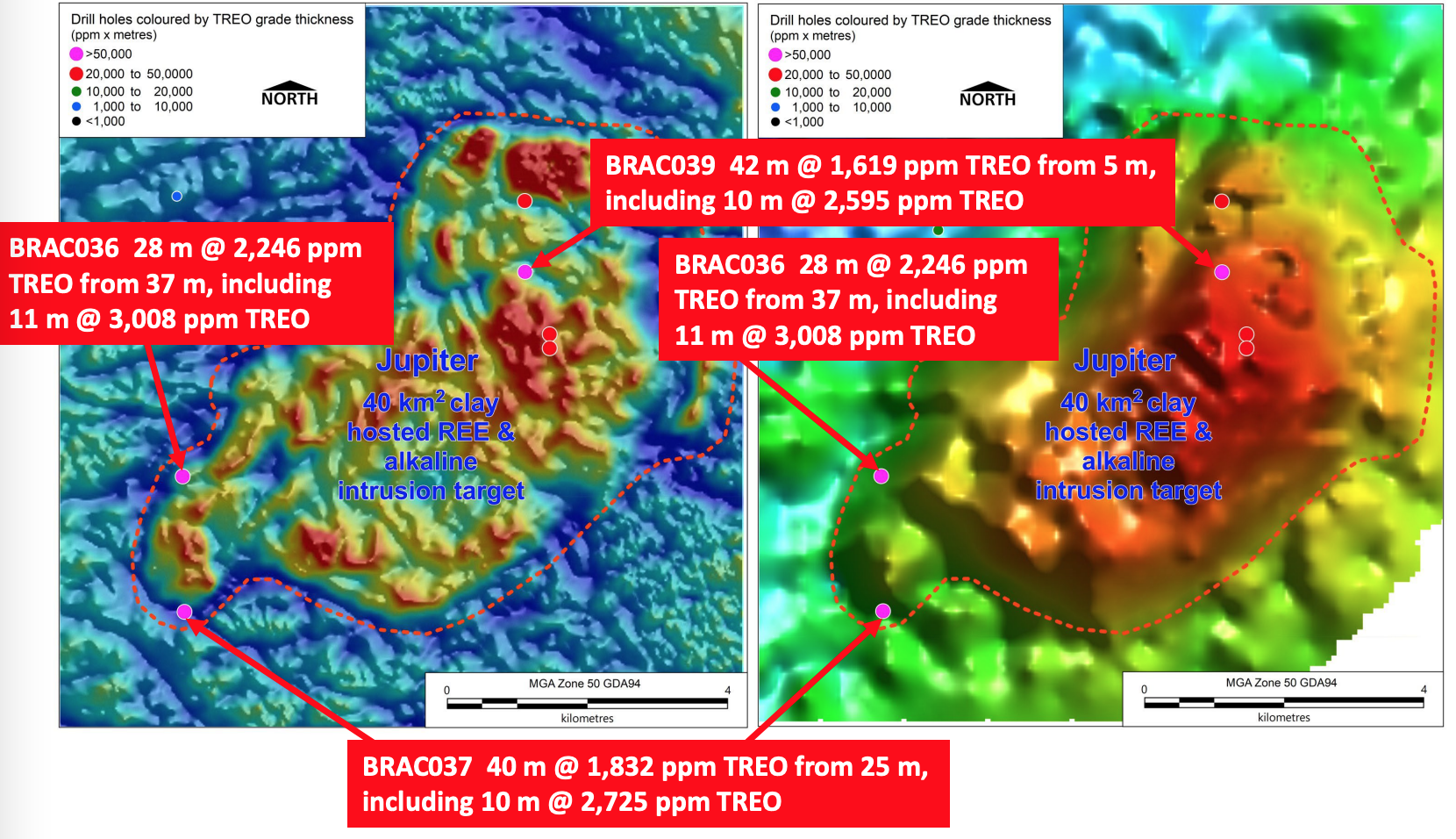
VMS continues to intersect consistent high-grade zones at Jupiter, with drilling results underscoring the potential for the discovery of a notable rare earth deposit in Western Australia.
As such, Venture says it has “a once-in-a-lifetime opportunity; the asset, the people and the timing at the bottom of the pricing cycle.”
Jupiter’s scale, grade and tier 1 location all play into the strategic nature of the discovery. This potential is the basis for the vision of VMS to restructure the company to become one of Australia’s best rare earths and critical minerals companies, while delivering meaningful shareholder value.
A well assembled experienced team
Recognising a clear opportunity to significantly advance the Jupiter Rare Earths Project, the board has restructured VMS to best position it for opportunities in critical minerals, and create substantial shareholder value.
The exploration team features experienced geologist Dr Stuart Owen along with former IGO and Northern Star geo-metallurgist Dr Natalee Bonnici.
This included making a number of changes to both the board and management team, including the appointment of former non-executive director Philippa Leggat as managing director.
With more than 20 years of experience in the mineral industry, Leggat brings a wealth of knowledge gleaned from roles as an executive director and advisor to several ASX-listed companies, where she was instrumental in capital raising, exploration, development and project evaluation.
Leggat has a proven track record in negotiating value-accretive project acquisitions and effectively communicating an organisation’s competitive advantages to enhance its profile.
In addition to advisory roles, Leggat has held key positions in various ASX-listed companies, including CEO of Comet Resources, executive director of Geopacific Resources and non-executive director of Kula Gold and Ensurance Ltd (ASX:ENA).
She also serves as a non-executive director of Harena Resources, a private company focused on developing a significant ionic clay rare earths project in Madagascar.
As a board member, Leggat led the board renewal process in 2023 which brought in the experienced Tim Lindley and Nick Cernotta, securing “expert guidance founded on decades of delivering shareholder returns through capital markets and resource expertise” said Leggat.
She added, “I hope investors recognise how unusual it is to see people like these venturing into the junior end of the market. This is not their natural habitat and the implication of that for shareholders should set hearts racing.”
Other VMS projects
In addition to the Jupiter REE Project and the wider Brothers Project, VMS has a portfolio of projects across Western Australia and Tasmania.
This includes the advanced Mount Lindsay Tin-Tungsten Project, which is well positioned to take advantage of the strong EV and critical mineral markets as it targets sustainable tin and tungsten production to capitalise on the global demand for decarbonisation commodities.
VMS is also looking to extract short term value out of the Riley Iron Ore Mine whilst the iron ore price remains strong.