
Nevada Lithium Resources Inc (CSE:NVLH, OTCQB:NVLHF) has discovered a new element to its Bonnie Claire project in Nevada that could have positive implications for the economics of the lithium operation.
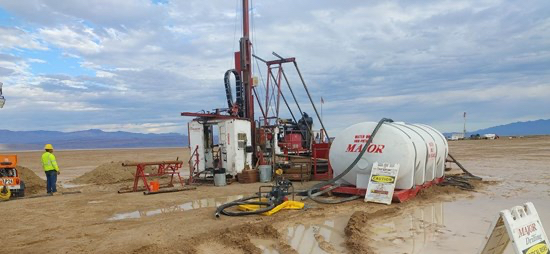
Drill results showed high levels of boron that appear to be associated with high levels of lithium at Bonnie Claire.
Boron, a mineral present in numerous household essentials from laundry detergents to electric vehicles, holds a crucial role in the energy transition alongside lithium. While lithium prices fluctuate, boron's demand and pricing remain stable. Despite its lesser-known status, boron is ubiquitous, found in glass for durability, fertilizers, and even eye drops.
Borate deposits, rich in boron, are linked to volcanic regions and dry climates, predominantly mined in Turkey, which boasts the world's largest reserves, and the United States, notably at the U.S. Borax Mine in California, now controlled by Rio Tinto.
Turkey and California collectively dominate the borate market, which is projected to reach nearly $8 billion in 2024. Boron's importance extends beyond household goods; it plays a critical role in decarbonization efforts, with applications in electric vehicles, wind turbines, and solar panels.
In this interview with Proactive, Nevada Lithium CEO Stephen Rentschler elaborates on the importance of boron to the operation and what comes next at Bonnie Claire.
Proactive: Nevada Lithium just reported a new discovery of high-grade boron. Can you elaborate on the significance of that discovery?
Stephen Rentschler: Boron is something we had observed in earlier drilling, but not at the levels we've uncovered through further examination of our high-grade lithium mineralization at depth. So, why is this exciting? The potential for a significant secondary revenue stream from boron is very real. Not only are these grades extraordinary, ranging from 10,000 to 11,000 parts per million, roughly equivalent to 1% concentration or higher, but we've also identified substantial vertical intercepts spanning hundreds of meters. These intercepts appear to align closely with the extensive high-grade lithium mineralization we've encountered.
Moreover, this mineralization remains open-ended in three key areas, suggesting significant potential for further exploration and development. What's particularly intriguing is the parallel we've drawn with an analog site, Rhyolite Ridge, located approximately 100 to 110 kilometers away. Drawing insights from this analog, we're exploring optimal strategies to unlock the full value of our discovery.
Are there a lot of these types of projects around the world?
There aren’t. Boron is an element that spans a wide spectrum in terms of purity when mined. However, there's only a handful of deposits worldwide that combine lithium and boron, with Rhyolite Ridge being one of them.
What's particularly interesting is the comparison with Rhyolite Ridge (owned by Nasdaq-listed Australian firm Ioneer Ltd (ASX:INR, OTC:GSCCF, NASDAQ:IONR). When we examine their boron processing grades, we find ourselves in a similar ballpark. While some areas show slightly higher grades and others slightly lower, the overall lithium concentration at Bonnie Claire appears to surpass that of Rhyolite Ridge. That bodes very well for the potential economic outcomes of our project.
At Rhyolite Ridge, there are significant cost savings associated with extracting boron, estimated at around $700 to $800 per ton. This represents a substantial advantage that can significantly reduce operational costs. Moving forward, we'll delve into metallurgical studies to understand potential changes in material characteristics, particularly as we transition from shallower depths. Our aim is to optimize extraction methods to maximize the value derived from our findings.
We’re not finished looking for boron. With the potential for thousands of meters of mineralization in three directions, there's still a wealth of discovery ahead of us. Needless to say, we're incredibly enthusiastic about our prospects.
Put this into perspective. What does this all mean for Bonnie Claire?
One word that I always try to emphasize with investors is 'optionality.' In the junior resource sector, having various avenues for advancing asset development is always a plus. In this case, it's a massive advantage. What we've uncovered is a significant swath of mineralization, particularly in what we refer to as our lower zone. This high-grade mineralization extends in three different directions, potentially for thousands of meters, though the full extent is yet to be determined.
The comparison to Rhyolite Ridge serves as a compelling analog, highlighting the immense potential of our discovery. Additionally, previous findings in locations like Bacanora in the Sonoran Desert indicate coexisting mineralization, further adding to the project's appeal. Moreover, there's the prospect of discovering brine, thanks to underlying geological structures leading toward Albemarle, located 60 miles away.
From an investor's perspective, I’d say this is a big plus. Lithium prices still seem to dominate the overall sentiment in the area, but it's noteworthy that we have a direct analog to Rhyolite Ridge, where Ioneer sold 50% of its stake to Sibanye-Stillwater from Albemarle for $500 million. With our current market capitalization at around C$35 million, I believe it represents a favorable risk-reward scenario.
Quotes have been edited for style and clarity