
- FTSE 100 falls 7 points to 8416
- Pennon hits water sector after cutting £2.4m from dividend
- AstraZeneca sets new targets for rest of decade
4.37pm: FTSE 100 lower at close
The FTSE 100 ended the day 7 points lower at 8,416.
4pm: FTSE back to flat, almost
The FTSE 100 almost wiped away its early losses, coming within a whisker of climbing back into the green.
It's currently back seven points in the red at 8417.
The FTSE 250 has not enjoyed the same afternoon tonic, down 66 points at 20,807.
Lifting the blue-chip index is a further gain for the index's biggest company, AstraZeneca, now up 2.8% as analysts and US investors seem to like its strategy update.
Other heavyweights are also higher, with Shell up 0.2% and BP flat, while copper miner Antofagasta is up 1% and diversified miners Rio Tinto and Glencore are modestly higher.
Schroders PLC (LSE:SDR) is one of the top risers, helped by a UBS upgrade after the shares have underperformed so far this year with shares down 9%, underperforming the STOXX 600 by 16% and the listed EU asset managers by 11%.
"While we don’t envision any immediate catalysts for the shares, we think the risk-reward at these valuation levels is compelling," says analyst Michael Werner, pointing to a P/E ratio that has compressed to 10.5 times from 12.6 and fund flows that have improved over the past few months.
3.51pm: Activist ejected
Activist Mikaela Loach was one of the protestors at the Shell AGM, attending with "every right to be there" as a proxy voter allocated by a shareholder, but said she was repeatedly spoken over when trying to ask a question before being ejected.
She said on X/Twitter that while every questioner before her was "given as much time as they wanted to speak without interruption" she was "repeatedly cut off and then surrounded by six security guards".
Loach, author of 'It’s Not That Radical', a book calling for "real climate action", said she shared a story with the AGM about a "friend’s sister, father and baby niece unexpectedly died in the same year after their only water source was contaminated with Shell’s oil for three years" and talked about Nigeria's Bille and Ogale communities Shell court case in the UK.
"Shell knows that this court case has the ability to ruin them financially," Loach said.
In one of the latest developments in the case, in March the High Court ordered Shell and its Nigerian subsidiary to disclose documents that the court says could relate to the company’s liability for oil spills between 2011 to 2013 that devastated the Bille community’s land.
3.35pm: Shell AGM result
More than a fifth of Shell shareholder votes opposed the oil giants’s climate strategy at an annual meeting that saw protestors sing "Shell kills" and some that made it into the meeting ejected after some heated exchanges.
The resolution to approve the current energy transition strategy, including scaling back several short-term and medium-term climate targets, received 21.8% of votes against, Shell said.
A separate resolution put forward by a Dutch activist group, Follow This, that called on the board to align decarbonisation targets with the goals of the Paris climate agreement, received support from 27 institutional investors prior to the meeting.
But it was supported by only 18.6% of in-favour votes, down from 20.2% from an identical proposal last year.
Chairman Andrew Mackenzie, whose reappointment was opposed by 9.8% of the vote, defended the company, saying: "While it might be tempting to stop using oil and gas before the world is ready, we must not do so at the expense of the energy needs and aspirations of a growing global population."
To the tune of Dolly Parton's Jolene, Shell protestors sang "Shell kills, Shell kills, Shell kills, Shell kills" and held signs that read: "Shell profits kill" and "Your greed is killing humanity".
3.21pm: Water companies looking to a big hike in bills
A handful of water sector stories for your delectation.
Sewage pollution controversies and contentious shareholder payouts have not stopped privatised water companies across England and Wales from lobbying for large bill hikes in the coming years.
According to the BBC, Southern Water is asking the Consumer Council for Water (CCW, which is a sub-department of Defra) to allow a 91% increase in bills over the next five years.
Meanwhile, Thames Water’s parent company Kemble’s defaulted bonds have plummeted to an all-time low of just 5.8 pence in the pound, according to data compiled by Bloomberg.
Kemble’s debt was already heavily discounted after defaulting on £400 million of bonds in April, but recent turmoil on the board of directors showed there was further room to fall.
And the earlier results from Pennon Group PLC (LSE:PNN, OTC:PEGRY) offered “no positives”, according to analysts at UBS.
Underlying earnings came below estimates, debt was also a concern and a £2.4 million downward adjustment to the final dividend raised questions of further dividend adjustments should pending investigations result in further fines for UBS, which said this could be as much as £55 million.
3.05pm: US stocks open mixed
It's a mixed open for US stocks, with the Dow Jones up, the Nasdaq down and the S&P 500 somewhere in the middle.
The Dow's risen 0.14%, the S&P is down 0.01% and the Nasdaq Composite has fallen 0.21%.
Lifting the Dow are shares in IMB, up 2.5%, JPMorgan Chase bouncing back from yesterday's drop, and Goldman Sachs.
Weighing on the Nasdaq is a 1.3% fall for NVIDIA, a 2.4% decline for ASML and 1.2% decline for Broadcom, while Amazon is down 0.95%.
The Financial Times is reporting that Amazon's AWS cloud services arm has paused orders from Nvidia in order to wait for a more powerful chip.
Investors are fretting about a dip in demand too, the newspaper says.
What's more, market analyst Kathleen Brooks at XTB, wonders: "But, whisper it, is the market getting bored of Nvidia’s mega earnings reports and its domination of the GPU market?
"Signs that it is include lower options trading volume in Nvidia shares in the week before the latest earnings release. Last week’s total Nvidia options trading volume was 47% lower than the week before the previous earnings report in February. This suggests that the market is not only focused on the AI darlings as the global stock market rally broadens out.
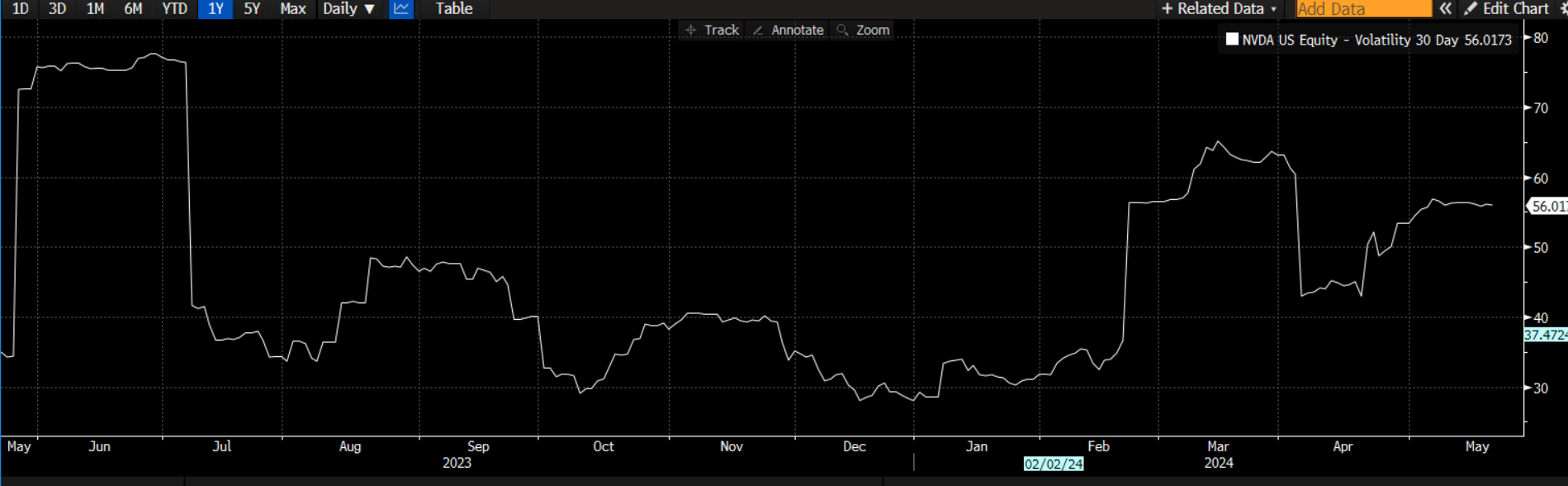
"Added to this, volatility is lower. As you can see in the chart below, 30-day volatility in Nvidia is lower than the peak reached in March. A lower level of volatility suggests that going forward, movements in Nvidia’s share price could be lower than they have been in the past."
2.30pm: IMF view
The International Monetary Fund (IMF) reckons the Bank of England could cut interest rates up to three times this year.
Alongside an upgrade to the UK's growth forecast for 2024, predicting the economy is "approaching a soft landing" the body advised against any further tax cuts.
The Washington-based fund warned the government of a £30 billion hole in the UK’s public finances, saying current spending plans looked unrealistically low and that "difficult choices" lay ahead.
The IMF said it would have advised Chancellor Jeremy Hunt not to cut national insurance contributions (NICs) by two percentage points, as he did, expressing further doubts about his reported plans for a third cut in NICs before polling day.
To stop debt rising, it said the Treasury may need to raise more via VAT, road pricing and scrapping the pensions triple lock.
2.22pm: US futures pointing lower
US stock futures have swung into the red just ahead of the open, led by the tech-powered Nasdaq.
While Dow Jones futures are pointing to a flat start, those for the S&P 500 indicate a fall of 0.1% and for the Nasdaq 100 a 0.3% decline.
Federal Reserve governor Christopher Waller said the latest inflation data is "reassuring" but that further more months of positive price developments would be needed before rate cuts.
Some people categorize Waller as a hawk, but IMO he's pretty close to the center. He just talks in a more blunt way than most. Anyway, these headlines only really mean June/July is off the table, which it was anyway. The statement about CPI is prob more important. pic.twitter.com/DZpZ40qLR1
— Tom Graff???? (@tdgraff) May 21, 2024
Meanwhile, back home, the Footsie is down 26 points or 0.3% and the mid-cap FTSE 250 is down 97 points or 0.5%.
Europe is deeper in the red, with the DAX down 0.4%, CAC 40 down 1%, FTSE MIB down 0.9% and IBEX 35 down 0.23%,with the broad Euro Stoxx 600 sitting 0.45% lower.
1.49pm: Reasons to be cheerful from UBS
An upbeat note from the UBS chief investment office, as the FTSE losses are cut slightly ahead of the US open.
The feeling among many is that UK economy is finally pulling out of the doldrums, says UBS economist Dean Turner.
"Recent data releases support this optimism," he says, pointing to the much-stronger-than-expected initial GDP guestimate as well as stressing with the other hand against placing too much weight on any single data point.
"But other prints also underpin the view that the outlook is getting perkier. Inflation, even in the US, is behaving better and labour markets are cooling, not collapsing, which should mean the gradual improvement in real income growth already under way is likely to continue over the coming months."
On monetary to be precise, despite dovish soundings from the Bank of England, he expects August will see the first move (though it could come as soon as June, data permitting).
"But the key point is not to focus too much on the exact timing of any moves, and rather to concentrate on where rates are heading."
For investors, Turner acknowledged that it is generally not easy to gain exposure to economic trends as the economy and the stock market are two very different things, especially for the UK, with the FTSE 100’s skew toward large international companies.
"But this doesn’t mean there is no impact. An improving UK economy will be beneficial for the profits of firms that operate here (of which there are many).
"Consumer-focused companies are one area that should reap the benefits. The rosier economic outlook may also help international investors see the UK through a different lens, especially as valuations look attractive."
UBS upgraded its view on the UK market as one of its most preferred a few weeks ago.
1.15pm: Flat start for US stocks predicted
Wall Street futures are pointing to a flat start, continuing the generally restrained start to the week.
After the Dow Jones retreated from Friday's record high yesterday it is seen starting just above flat, same with the S&P 500.
After the Nasdaq set its own all-time high yesterday, today futures are pointing to the tech-heavy index opening just below flat.
Yesterday, the Dow was weighed down by JP Morgan which fell 4.5% after CEO Jamie Dimon suggested that he may relinquish his role earlier than expected, and that the banking giant wouldn’t be buying back much stock at current levels.
Overnight, cybersecurity firm Palo Alto Networks reported numbers in line with expectations, but disappointed in its outlook for the second quarter.
The stock is currently down around 6.4% in pre-market trading.
12.56pm: How can we increase investment in the UK?
Tomorrow, as well as the UK inflation data and results from M&S, British Land, National Grid and NVIDIA, there will also be an interesting Q&A session in Westminster about how to increase investment in the UK.
The House of Lords Financial Services Regulation Committee is hearing evident from the City of London Corporation's policy chairman, Chris Hayward, and director of policy and innovation, Kerstin Mathias.
This session is open to the public and is to be streamed live on Parliament TV.
Topics the committee says are likely to be covered include:
- What regulators could do to enhance the UK’s growth and competitiveness and to support investment in the UK
- How onerous regulations are in the UK when compared to other jurisdictions
- Whether regulators have the right technical capabilities to support both new and incumbent firms in the UK
- The impacts of excessive capital requirements on firm growth
- How greater investments can be mobilised through pension schemes.
This is the second evidence session of the committee’s new inquiry into the Financial Conduct Authority (FCA) and the Prudential Regulation Authority’s (PRA) secondary growth and competitiveness objective.
12.28pm: Superdry's backup plan
Superdry is poised to launch an emergency sale process if creditors block founder Julian Dunkerton's plans to delist the shares.
Last month, after reporting lower sales and higher losses, the Cheltenham-based company announced a restructuring plan that will see it delist from the London Stock Exchange in order to cut costs and "implement its turnaround plan away from the heightened exposure of public markets".
Sky News is reporting today that a four-week process to put the business up for sale would be launched if a restructuring plan is not approved by creditors in the coming weeks.
According to a document circulated to creditors in recent days and seen by Sky News, rejection of the restructuring plan would be followed by a four-week sale process for Superdry, with the likely outcome a pre-pack administration deal.
In other founder funding news, Talktalk Telecom founder Charles Dunstone and other shareholders are being pressed to inject £180 million into the broadband provider to help it meet its upcoming debt repayments.
According to the Telegraph, the telco’s lenders want a £330milion revolving credit facility reduced to £150 million ahead of a refinancing in November.
Dunstone and other shareholders are said to be holding talks with the bank over meeting the shortfall.
12.03pm: Crypto markets boosted by ETFs again
Ethereum is turning heads in the crypto markets, getting greater attention than its more talked-about larger rival.
The price of bitcoin is on the slide this morning, after climbing 7.8% at the start of the week, the strongest single-day performance in over two months to lift the BTC/USD pair above $70,000 for the first time since mid-April.
Despite inching lower, it remains above that level.
But it's Ethereum that is where the action is, clocking in nearly 20% worth of gains to soar above $3,600.
Markets are bracing for a hotly anticipated decision from the US Securities and Exchange Commission (SEC) on the approval of spot ether exchange-traded funds (ETF) this week.
Applications filed by VanEck and Ark Invest are due to be approved or rejected on Thursday and Friday respectively, according to our daily crypto report.
11.53am: FTSE 100 and 250 fall but plenty of positive news about
A market round-up as we head towards midday.
The FTSE 100 is down 34 points or 0.41% at 8390, while the mid-cap FTSE 250 index is down 0.45% at 20,779.
Only one of the top 10 largest blue chips is not in red and that is AstraZeneca, after it set out its new revenue and profit margin targets for the rest of the decade.
Shares in the pharma giant are up 1.4%, putting it top of the leaderboard, ahead of Schroders, Reckitt Benckiser and Flutter.
Bottom of the list is precious metals miner Fresnillo, fashion house Burberry, box-maker DS Smith and water company United Utilities, all down at least 2%.
As for the FTSE 250, sandwich and lasagne maker Greencore is top of the pile, up almost 19% after more than doubling first-half profits and upping guidance.
Self-storage investor Big Yellow is up 6% after publishing results after the close yesterday, in line with expectations but further growth in occupancy since the year end. Sector peer Safestore is lifted 2.8%.
Fallers are led by South West Water owner Pennon, down 8.3% after cutting its potential dividend payment by £2.4 million to allow for environmental fines.
Automotive component maker Dowlais fell 8.4% after cutting guidance after a mixed first half and uncertainty about the EV manufacturing sector.
Into the small caps, XP Power is up 48% after rejecting a third unsolicited approach from US energy company Advanced Energy despite the bid coming at a 68% premium on yesterday’s closing price.
XP Power called the bids "a series of highly conditional, opportunistic, indicative proposals".
Battery-focused investment trust Gore Street Energy Storage issued a trading update that analysts at Stifel says are "far better than the fund’s peers who have suspended dividends".
Shoe Zone fell 7% even though digital revenues offset a decline in brick-and-mortar sales in the first half.
Retailer Topps Tiles fell 2.4% as it continued to show cracks in revenues and profits in the first half as challenging trading conditions remained.
11.16am: Problems with payments
There is "currently no effective competition" to Visa and Mastercard in the UK payments market, leading to businesses paying more than £250 million extra annually to Mastercard and Visa due to fee increases.
A provisional report published today by the Payment Systems Regulator (PSR) suggests "the supply of scheme and processing services is not working well" and that pricing has risen "substantially" over the last five years.
The PSR launched the review into the fees paid by retailers and banks to Mastercard and Visa following concerns being raised that "a substantial proportion of prior increases in these fees to acquirers could not be explained by changes in the volume, value or mix of transactions".
Fees have risen by over 30% in real terms in five years and become more complex, as a result, the PSR suggests a number of potential remedies to improve competition, including:
- improving transparency of costs
- making it easier for businesses to switch between scheme operator
- and a requirement for the large scheme operators to justify any price increases.
10.57am: Best city ranking
A new ranking of the best cities in the world has been published by Oxford Economics.
The inaugural Global Cities Index is a "comprehensive evaluation of the world’s 1,000 largest urban economies", the economic research outfit says.
Of the 27 indicators used to compile the index, the most emphasis is placed on economic factors such as GDP and employment growth, with other categories including human capital, quality of life, environment and governance.
Top of the maiden list is New York, USA, followed by London in second, San Jose (in California) in third and Tokyo in fourth.
Australia's Melbourne was in ninth place, Sydney in 16th and Perth in 23rd.
Mark Britton, director of city services at Oxford Economics, says the new index "provides a consistent framework for assessing the strengths and weaknesses of the largest 1,000 cities across the world, and when coupled with our forecasts, it enables organisations and policymakers to make more informed strategic decisions.
"While the index scores cities based on how they are performing now, there is potential for significant movement within the rankings in the coming years, as the 1,000 global cities navigate the concurrence of several global trends. These include economic turbulence, political instability, high debt levels, trends in globalisation, pressures on healthcare and housing, and the effects of climate change.
"There are several global trends that have the potential to buck these rankings,” says Britton.
10.33am: Germany not as bad as some say
"Construction output in the Eurozone climbed at the end of the first quarter, but much less than we expected based on the advance data, and the Q1 trend more generally, mainly in Germany," said Claus Vistesen at Pantheon Macroeconomics.
Production climbed by 1.0% and 1.1% month-to-month in Germany and France, respectively, and by 0.2% in Spain. It fell by 1.9% in Italy, however, extending the fall from a 3.0% slide in February.
Overall, the increase means that EZ construction output rose by 1.3% quarter-on-quarter in Q1, said Vistesen, rebounding solidly from a 0.9% fall in Q4.
"That’s great, but the Q1 increase was flattered by a leap in Germany due to mild weather. Mean-reversion looms in Q2, in line with still-terrible survey data."
10.20am: European data
There's been an influx of European data this morning, with Germany in the spotlight in particular.
Some right-leaning UK newspapers are gleefully leaping on new real estate data, which shows overseas buyers fell to the lowest level in 11 years in the first quarter.
Foreign buyers accounted for 35% of commercial real estate purchases, BNP Paribas Real Estate found, the lowest since 2013.
Elsewhere we've had more positive eurozone construction data and trade data.
Euro-area construction output rose by 0.1% month-to-month in March, after a revised 0.4% increase in February.
The headline non-seasonally adjusted trade surplus in the eurozone was at €24.1 billion in March, up from compared to €19.1 billion a year earlier and above the consensus estimate of €19.9 billion.
The seasonally-adjusted surplus, meanwhile, rose to €17.3 billion, up from €16.7 billion in February.
9.59am: Mid cap movers
Looking at the movers, Pennon is bottom of the FTSE 350 fallers, down 8.2% after not quite cutting its dividend but raising it less than expected.
Analyst Aarin Chiekrie at Hargreaves Lansdown says: "With media, public, and regulatory scrutiny of the water sector running high, Pennon’s dividend growth has taken a hit."
Every investor on @SouthWestWater results call has asked about the dividend. The company says it's reduced it in line with pollution fine as a "signal". But investors want clarity over future dividends given future fines are likely. The problem with privatised water in a nutshell https://t.co/ewleejs19N
— Paul Kelso (@pkelso) May 21, 2024
SSP Group plc (LSE:SSPG), the operator of airports and train station food concessions, is next, down 6.4%. Seems to be profit taking, with the shares having risen in the run-up to results.
Analyst Anna Barnfather at Liberum says the group "remains on track to deliver full-year expectations" and "with travel still recovering and strong pricing power continuing, we expect a strong [second half] performance", with inflationary pressures outpaced by margin expansion.
Dowlais Group PLC (LSE:DWL) has dropped almost 6% after the owner of GKN Auto lowered its outlook for this year, after gains for its Driveline, Powder Metallurgy and China joint venture were more than offset by weakness in the ePowertrain products.
Analyst Harry Philips at Peel Hunt said it was "a decent performance", adding that ePowertrain reflects the reorganisation of carmaker EV plans in Europe, "where the supply chain has seen big swings up in anticipation of follow-through last year, and then significant reassessment this year".
9.25am: Modstly negative markets
Analysts are providing their hot takes on equity markets around the world, first we have some from Saxo and then from Finalto.
"Negative Asia session with Japanese equities 0.4% lower and Hong Kong equities down 2.2% pulled lower by a worse than expected outlook from Chinese EV maker Li Auto (shares down 18.6%) questioning the rebound case for the Chinese economy," the Saxo team say.
"European and US equity futures are trading slightly lower this morning as the market awaits Nvidia earnings scheduled for tomorrow after the US market closing.
"Palo Alto Networks shares tumbled almost 10% in US extended trading hours yesterday as its fiscal Q4 revenue forecast came in a bit lower than consensus estimates highlighting the fragility to growth stocks with high equity valuations if revenue forecasts do not meet expectations."
Neil Wilson at Finalto notes that European stock markets are down "as the positive momentum eased a bit", with FTSE 100 losses similar to those elsewhere on the continent.
He also points to gold easing back from the record high above $2,240, while oil, silver and copper also retreated a bit.
"Meanwhile we are in the midst of a torrent of central bank speakers this week," Wilson adds, with Fed speakers saying inflation was disappointing and did not provide confidence to ease policy.
We hear from the Fed’s Williams, Bostic, Barkin and Waller today. "Waller is the one to pay closest attention to since he is the best cue for changes in Fed policy," says Wilson.
After Bank of England’s deputy governor Ben Broadbent laid the groundwork for a summer cut, governor Andrew Bailey is due to speak later.
9.02am: Travel industry recovery uneven
International tourist travel and the sector’s contribution to the global economy are expected to return to pre-pandemic levels this year, according to a study by the World Economic Forum with the University of Surrey.
The Middle East had the highest recovery rates in international tourist arrivals, at 20% above the 2019 level, while Europe, Africa and the Americas all showed a strong recovery of around 90% in 2023.
However, the report found the recovery has been mixed, as although 71 of the 119 ranked economies increased their scores in the Travel & Tourism Development Index since 2019, the average index score is just 0.7% above pre-pandemic levels
Having moved past the shock of COVID, the sector has faced other external challenges, including growing macroeconomic, geopolitical and environmental risks, plus global cost and price inflation.
8.53am: Supermarket price inflation falls again
Grocery price inflation has fallen to the lowest in over two and a half years, according to new industry research.
Supermarket inflation dropped for the 15th month in a row to 2.4%, the lowest level since October 2021, Kantar said in a report out this morning.
"Grocery price inflation is gradually returning to what we would consider more normal levels," said Fraser McKevitt, head of retail and consumer insight at Kantar.
"It’s now sitting only 0.8 percentage points higher than the 10-year average of 1.6% between 2012 and 2021, which is just before prices began to climb."
Take-home grocery sales rose by 2.9% over the four weeks to 12 May, the research found, with Ocado Retail, the joint venture between Ocado Group PLC (LSE:OCDO) and Marks and Spencer Group PLC (LSE:MKS) the fastest growing retailer, while Tesco PLC (LSE:TSCO) and J Sainsbury PLC (LSE:SBRY) both increased market share.
M&S shares are the only ones of that quarter in green this morning, up 0.2%, with Ocado down 0.8%, Sainsbury's down 0.5% and Tesco down 0.1%.
8.46am: Sea of red
It's not just the Footsie in the red this morning, with most European benchmarks also lower.
Germany's DAX is down 0.1%, France's CAC 40 is down 0.4% and Italy's FTSE MIB the worst at 0.6%, while Spain's IBEX 35 is up 0.1%.
The Stoxx 600 is down 0.2%.
"European markets are in the red taking their cues from declines in Asia," says market analyst Victoria Scholar at Interactive Investor.
"UK investors await a lecture from the Bank of England’s governor Andrew Bailey later today as well as UK inflation figures tomorrow."
Scholar points out that cryptocurrencies have been "on a tear so far this week", with ethereum up 13.3% amid speculation that a spot ether ETF could be approved by US regulators.
"Bitcoin is also gaining ground, breaking above resistance at $70,000. After an extremely strong first quarter, bitcoin peaked in March and drifted lower afterwards. But May has seen a return to bullish price action with gains accelerating this week, heading back towards its all-time high when the price surpassed $73k in March.
"A break above that level could encouraging further buying and push the cryptocurrency to fresh record highs."
8.28am: Water companies weigh
After almost half an hour the shape of the FTSE 100 index is now settling down, with the morning likely to be spent in red.
The blue-chip benchmark is down 22 points at 8402, joined by the FTSE 250 index today too, after they diverged yesterday.
The mid-cap index is down 80 points at 20,793.
Markets are likely to be cautious after the falls in Asia earlier this morning and ahead of a speech from Bank of England governor Andrew Bailey this evening and UK inflation data tomorrow.
Water companies Severn Trent PLC (LSE:SVT) and United Utilities Group PLC (LSE:UU.) are at the bottom of the blue-chip list after mid-cap peer Pennon Group PLC (LSE:PNN, OTC:PEGRY) fell 5% on the back of its annual results.
The owner of South West Water has raised its dividend less than expected after navigating a series of widely publicised water offences.
“In the context of the wider group performance, we have carefully considered Ofwat's new dividend guidance for water businesses,” said Pennon, reducing its expected payment by £2.4 million to reflect the £2.1 million fine it received for a series of environmental offences across Devon and Cornwall spanning a period of four years.
Kingfisher PLC (LSE:KGF) is down just 0.2% after it reported a smaller fall in sales in the first quarter.
AstraZeneca PLC (LSE:AZN) is up 0.9% as it set out a new target to grow revenue around 75% to $80 billion by the end of the decade.
In an announcement made ahead of the drug giant's investor day event on Tuesday, CEO Pascal Soriot, who has revitalised the company's drug pipeline over the past decade, highlighted potential blockbusters such as the lung cancer drug Tagrisso, Calquence for leukaemia, and diabetes treatment Farxiga.
Iran announced it will hold presidential elections on June 28, state media reported, following the death of President Ebrahim Raisi and his entourage in a helicopter crash. #OOTT #Iran
— Amena Bakr (@Amena__Bakr) May 21, 2024
8.07am: FTSE 100 falls out of bed
The FTSE 100 has dropped 30 points to 8394 in initial trades, with all but two of the top 20 shares by market cap in the red.
Fallers are led by several Asia focused names, including insurer Prudential and lender Standard Chartered, drinks maker Diageo, fashion house Burberry, which all ties in with the falls in Asia stocks this morning.
AstraZeneca is one of the rare risers, up over 1% on the back of its new 2030 targets.
7.47am: Bigger fall expected now, Asia setting tone
Spread-betters are now calling the FTSE over 36 points lower.
Asian markets are in the red this morning, led by the Hang Seng in Hong Kong, down 2.2%.
Japan's Nikkei, China's Shanghai Composite, India's Sensex and Singapore's STI are all lower too, with the Asia Dow down 0.99% and the MSCI Asia Pacific up 0.1%.
7.39am: Kingfisher sales down but guidance maintained
B&Q and Screwfix owner Kingfisher PLC (LSE:KGF) reported a 0.9% decline in like-for-like (LFL) sales in the first quarter, worsening into the second quarter.
Full year guidance was unchanged, however, as the FTSE 100 group said it was "making progress against our key strategic priorities".
Total sales came to £3.3 billion in the three months to 30 April, down 0.3% on a year ago, or up 0.3% on a constant currency basis.
Sales in the UK & Ireland were up 2.6%, or 1.2% on a LFL basis, while France was down 8.1% or 5.3% LFL.
"We have seen continued resilience in our core categories, although 'big-ticket' sales have been weak reflecting the broader market as expected," said CEO Thierry Garnier.
He hailed the gaining of "considerable" market share, with positive LFL sales at Screwfix and strong LFL sales growth of 8.5% at TradePoint.
"In France, while slightly improved on Q4, trading reflects the weak overall retail market. And in Poland, we are seeing encouraging sales trends as the consumer environment improves."
7.28am: AstraZeneca profit plan
AstraZeneca PLC (LSE:AZN) has set out its ambition to deliver $80 billion in annual revenue by the end of the decade, boosted by the launch of 20 new drugs from its pipeline.
This would almost double the level of sales, having generated $45.8 billion in 2023.
It believes this growth can come from its existing oncology, biopharmaceuticals and rare disease portfolio and the flow from its pipeline.
As for profits, it is targeting a mid-30s percentage core operating margin by 2026, then "at least" that same range after that.
7.22am: JPMorgan boss's announcement hits Dow Jones
The reason the Dow Jones fell yesterday was that JPMorgan Chase CEO Jamie Dimon, 68, signalled that his retirement is closer than ever.
It was the big surprise at the Wall Street bank's investor day, with Dimon having held the reins for nearly two decades and driven the lender to become the largest in America by assets and market cap.
"The timetable isn’t five years anymore," Dimon said adding that new board assignments were being made to prepare. "We’re on the way, we’re moving people around," he added.
Dimon also said he wouldn’t repurchase stock at the current levels.
JPM shares fell 4.5%.
7.15am: FTSE 100 called lower on Tuesday
The FTSE 100 has been called sharply lower on Tuesday after a mixed finish on Wall Street overnight and a fall in oil prices.
Ahead of the opening bell, the London benchmark was trading down 22 points on spread-betting platforms, after closing almost four points higher at the start of the week at just over 8424.
As for oil prices, Brent crude futures are down 0.6% at $83.19, down 3.8% over a month.
Overnight, the Nasdaq Composite rose 0.65% to a new all-time high, but still off its elusive 17,000, while the Dow Jones retreated from its own ATH, falling 0.49%. The S&P 500 was slightly above flat.
This morning in the UK we have results from B&Q owner Kingfisher, water company Pennon, hot on the heels of an apology over Brixham's water-related diarrhoea outbreak.
Later on there will be grocery sector data from Kantar and the CBI industrial trends numbers.