
The FTSE 100 hitting record closing highs in successive days brings feelings of patriotic pride to some market watchers, but a large proportion of them would admit this does not signify a huge amount about the UK economy.
However, it could be the start of something good for investors.
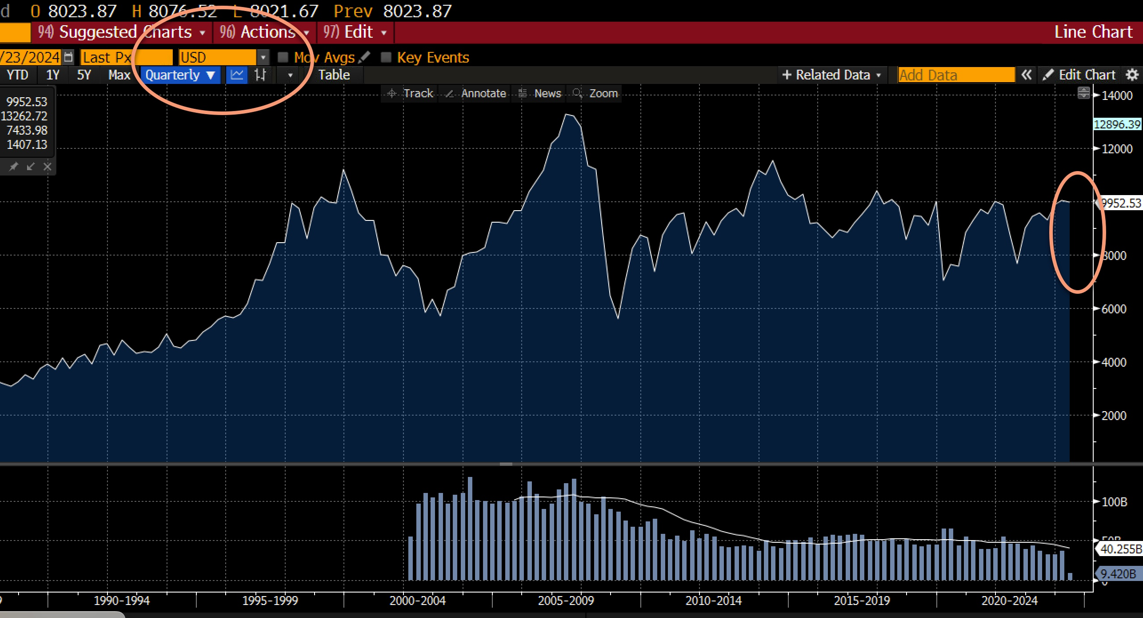
For one thing, if you adjust for currency effects, the FTSE 100 is lower by 0.66% in the past month.
In sterling terms the index is at a record high, but in US dollar-adjusted terms the performance is weaker because of the underperformance of sterling versus the greenback in the long term, says Kathleen Brooks, research director at XTB, supplying the below chart.
"Thus, the FTSE 100 may be lagging its peers because US investors are not so interested in the UK index when returns are lower in USD."
The money flowing into London's blue chip index looks like it has come out of New York, with the Footsie’s all-time high coming amid a slide in US equities over the last three weeks, as the Magnificent Seven seems to have been whittled down to a Super Six given the terrible performance of Tesla not to mention a big slide for Apple.
This new record could usher in a new dawn for UK equities, suggests Jason Hollands, managing director of online investment platform Bestinvest.
He noted that 20 years ago, UK equities made up 10.9% of the MCI All Country World Index, but now comprise just 3.3%, having been muscled out largely as the proportion of US equities grew from 52% to 64%.
“While the waning relative fortunes of UK equities in recent years have been down to a myriad of factors, including diminishing allocations by domestic pension funds, one of the main drags on the UK market since 2008 has been its large exposure to financials, which represent over a fifth of the FTSE 100 Index today," Hollands says.
With banking shares having been unloved since the global financial crisis, this, combined with negligible exposure to technology companies, has been a large part of driving divergent returns between the UK and US, he says.
But while the FTSE 100 is breaking new records it does not mean shares in the index are "expensive" based on traditional fundamental terms, which some investors see as a problem for US tech stocks.
One such metric is to measure shares prices are in relation to expected earnings, the price/earnings ratio, which suggests the UK market is cheap compared to global equities.
UK shares are trading at a price/earnings ratio of around 11 or 12 times earnings, depending on who does the calculating, which puts them at a discount of around a third to a 37% discount to global equities, which is well below their long-term level.
This also compares to a p/e of 13.4 times for Germany's DAX and almost 20 for the S&P 500 in the US.
“At such giveaway valuations, expect to see continued bids for UK-listed companies by overseas buyers – the number of takeovers of UK public companies reached the highest level in a decade last year – but cheap valuations are also spurring many companies to launch share buybacks, which should boost shareholder returns," says Hollands.
But discounts and premia exist for a reason, points out Russ Mould, investment director at AJ Bell.
"Right now, the US economy is firing on all cylinders and inflation is running hot, largely because the Biden administration is onshoring and running a huge fiscal deficit to boost the economy. The UK is very different, at least so far," he says, though data has been improving in recent months.
"US firms are generally more profitable than their UK peers – larger domestic market, bigger economies of scale, and frankly they are leaner, meaner, and quicker to hire and fire to boost profits and the price of the stock. Two weeks holiday a year, not five or six, less unionised labour and so on."
In this respect, he says US stocks deservedly command a premium, "though the issue of how big is relevant, especially now".
Some of that calculation also comes down to the difference in the index mix and the economic backdrop on the two sides of the pond.
The economic environment in the last decade or more has been of low growth, low inflation and low or zero interest rates, which Mould notes has been perfect for "long duration assets like secular growth stocks (tech, biotech) and long-dated bonds for that matter.
"The US equity market has lots of those, the UK much less. If that environment persists, maybe we get more of the same.
"But if we switch to a higher nominal growth, higher inflation higher rate environment then the picture may change."
In these circumstances, hard assets like commodities, which are represented more prominently in the FTSE 100, may do better than paper ones, he says, while short-duration assets like cyclicals, miners and oil may do better than tech and biotech.
The FTSE 100 is much better represented by these sectors in both absolute and relative terms and so looks like being a key index to track.