
- Lead index up 3 points at 7,644.
- Gold and Bitcoin at all-time highs.
- Tax cuts rumoured for Spring Budget.
4.10pm: FTSE 100 in green late on
Come late Tuesday, London’s blue-chip index sat 3 points higher at 7,644, boosted by strong gains from Intertek, Endeavour Mining and M&S.
According to AJ Bell’s Danni Hewson, investors could well be eyeing a potential split between M&S and joint venture partner Ocado over a legal spat relating to missed performance-linked payments to the latter.
“Buying out its partner’s stake would be a logical move as it would give [it] full control and the ability to do things the M&S way,” she said.
Shares in the retailer were up almost 4% come Tuesday afternoon, beaten only by gains of 4.8% by miner Endeavour and of almost 6% by laboratory testing group Intertek.
The latter had been boosted after reporting a 13% jump in pre-tax profit on the back of its strongest like-for-like revenue growth in ten years earlier in the day.
Ashtead continued to lead the day's biggest losers meanwhile, dropping over 8.6% after cautioning full-year revenue would come in at the low end of expectations following soft third-quarter trading.
3.58pm: How much will Hunt have to play with in the budget?
Eyes are now firmly on Wednesday’s Spring Budget, through which Jeremy Hunt will hope to tempt voters with tax cuts ahead of a looming general election either late this year, or early next.
Indeed, according to reports, a 2p cut to national insurance has all but been confirmed, while a 5p freeze on fuel duty is also expected to remain in place.
These are said to cost the Treasury a combined £15 billion annually initially, before declining to £12.5 billion in the medium term, as per Deutsche Bank analysts.
Questions remain, then, how much fiscal headroom Hunt actually has prior to the budget, as well as how much he wants leftover afterwards.
The Office for Budget Responsibility forecast in November that Hunt had £13 billion worth of headroom to meet fiscal rules - whereby government net debt needs to fall in the final year of five-year forecasts.
Such projections from economists have since risen to £18 billion ahead of Wednesday’s budget, but were actually higher in recent weeks before inflation and interest rate forecasts changed.
According to Berenberg, Hunt’s fiscal headroom could even sit as high as £25 billion, though the bank also noted that “to retain credibility” Hunt would “need to leave at least some”.
“The market focus on the Spring Budget will ultimately come down to three things,” Deutsche explained ahead of the Parliamentary statement.
“First, how much fiscal loosening, including the size of the 2024 to 2025 gilt remit. Second, how sustainable are the Chancellor's medium-term fiscal plans. And third, how much fiscal headroom left for another fiscal event later this year.”
According to the German bank, the key risk lies in the gilt remit, with Deutsche forecasting sales worth around £271 billion, compared to consensus estimates of closer to £260 billion.
Where Hunt then sources further funding for what he hopes will be election-winning tax cuts then lies in where he can reduce public spending, Deutsche continued.
“We expect very marginal cuts to departmental day-to-day and capital spending,” analysts said, “anything more could leave markets concerned about the sustainability of the current public finances outlook”.
3.35pm: Bitcoin hits record high, gold continues charge
Bitcoin finally reached a new record high on Tuesday afternoon after repeatedly scoring strong gains over the year so far.
Spiking at roughly US$68,800, the cryptocurrency completed an impressive comeback from lows of around US$16,500 seen in late 2022.
So far this year, Bitcoin has risen over 50%, with gains stretching to almost 200% from early 2023.
The rise has been driven by the approval of spot-Bitcoin exchange-traded funds (ETFs) earlier this year, with anticipation of April's halving event - aimed at limiting supply of the digital assets onto the market - driving inflows even further.
Fellow safe haven asset gold continued trading in record-breaking territory at around US$2,130 per ounce on Tuesday afternoon, meanwhile.
"The metal’s rate of progress might be less spectacular [than Bitcoin]," AJ Bell's Russ Mould commented, "but its steady gains may reflect the ongoing increase in government debt around the globe, but particularly in the USA".
2.24pm: Gold could ‘be vulnerable from here’ after hitting record - analysts
Gold’s record high on Tuesday may well be the end of the safe haven’s latest climb, analysts say, as conditions start to swing back in favour of other commodities.
Indeed, the rise of spot prices to US$2,136 and futures to US$2,145 came on the back of mounting global tensions and rising US budget deficit, Charles Stanley (LSE:CAY) chief investment officer Patrick Farrell said on Tuesday.
However, how long such conditions remain, given these have already been priced in, now poses a question, according to Farrell.
“It seems inevitable that financial conditions will loosen in the year ahead, even if the timing and extent of a shift in central bank policy is still unclear,” he said.
“There are likely to be stimulus measures from China at some point, as its government seeks to address weakening growth.
“In the meantime, US policymakers seem disinclined to rein in spending and growth continues to outpace expectations.
“This is an environment that should favour more economically sensitive parts of the commodity complex.”
Farrell added that real yields - which tend to inversely correlate with gold prices - have also been rising as inflation falls but interest rates remain high.
“This is a tough hurdle for gold to overcome and it looks vulnerable from here,” he added.
1.42pm: Fuel duty cut to be extended in budget
A 5p cut to fuel duty will likely be extended by Chancellor Jeremy Hunt in Wednesday’s Spring Budget, according to Sky News.
This would continue a “temporary” freeze which was introduced by Rishi Sunak in 2022 and extended last spring until the end of this month.
Such a move would keep fuel costs down for motorists ahead of what will likely be the government’s final budget before the next election, but would cost the Treasury an extra £5 billion, as per reports.
12.46pm: M&S boss slams ‘economically illiterate’ business rates before budget
Marks & Spencer chief executive Stuart Machin has called on Chancellor Jeremy Hunt to unveil steps in Wednesday’s Spring Budget aimed at Britain’s retail sector.
Hunt should reform the “broken” business rates system, a levy on firms to fund apprenticeships and grant tax-free shopping to overseas tourists, Machin said on Tuesday.
“Government policy makes being an employer of people and running stores - which the same MPs vaunt in their constituencies - really hard,” he added in a LinkedIn post.
Business rates are set to climb by almost 7% from April, which Machin argued was “economically illiterate” given the government’s pledge to tackle inflation.
12.35pm: US stocks called lower at open
The Nasdaq is expected to lead US markets lower on Tuesday’s opening bell, as investors remain focussed on a score of economic news this week.
Futures had the Nasdaq down 111 points at 18,150 pre-market, while the Dow Jones and S&P 500 sat 52 points and 15 points off at 38,970 and 5,123 respectively.
Reports of China’s “ambitious” 5% GDP growth target for the year overnight already underwhelmed the market on Tuesday, XTB analyst Kathleen Brooks noted.
Coupled with “key event risk this week,” Brooks added equity markets were “jittery” on Tuesday.
Tuesday’s key data includes the release of factory orders and the ISM services PMI for February, after the figure hit an 11-month high of 64 in January.
“Services sector inflation remains a thorn in the side of the Fed, and thus traders should keep a particular eye out for the ISM services prices metric,” Scope Markets’ Joshua Mahony commented.
Later in the week brings an interest rate call in Europe, a budget in the UK and jobs data in the US, meanwhile, as Federal Reserve chair Jerome Powell offers a congressional testimony between Wednesday and Thursday, with markets awaiting any clues on when base rate cuts may come.
Among equities, Apple fell over 2% in pre-market trading, as a hefty fine in Europe was then followed by news that its iPhone had been overtaken as China’s bestseller, also prompting tech firms Broadcom, Micron Technology and Qualcomm to fall.
11.56am: FTSE 100 swings back into green
By mid-morning the FTSE 100 had regained losses seen earlier in the day to sit one point higher and just in the green at 7,641.
Intertek Group led the index’s risers, with the laboratory testing group gaining 7% after reporting a 13% jump in pre-tax profit on the back of its strongest like-for-like revenue growth in ten years.
M&S also gained ground, climbing 4.9% after the retailer has repeatedly made headlines in recent days, including as chief executive Stuart Machin slated the government for its “economically illiterate” business rates ahead of Wednesday’s budget.
However, it’s most likely an ongoing legal spat with joint venture partner Ocado which has the share up, as per analysts, after M&S has withheld performance-linked payments from the grocery delivery firm.
“There is a bigger issue to consider, and that is whether the tensions could see a parting of ways in time,” AJ Bell’s Danni Hewson commented.
“M&S is on a roll with its business turnaround and the food e-commerce venture is one of the few areas still underperforming. Buying out its partner’s stake would be a logical move as it would give [it] full control and the ability to do things the M&S way.”
Ashtead marked the FTSE 100’s main faller meanwhile, with the industrial equipment rental firm slipping 4.7% after warning slow third-quarter trading meant full-year revenue growth would be at the low end of expectations.
11.16: National insurance will be cut but income tax left unchanged in budget
National insurance will reportedly be cut by 2p in Wednesday’s Spring Budget, but Chancellor Jeremy Hunt will leave income taxes unchanged.
According to Telegraph-cited government sources, such a cut to income tax was deemed by Hunt to be too expensive, given the potential knock-on effects to inflation.
However, the reduction in national insurance will likely save the average UK worker £450 a year, stretching to £900 when combined with last autumn’s cut, which came into effect in January.
The latest cut will take effect in April, next month, and comes as the government looks to offer giveaways in what is likely to be its final budget before the next general election.
10.49am: Close Brothers calls for incentives to boost EV sales in Spring Budget
Flagging private demand for electric vehicles has prompted merchant bank Close Brothers to call for incentives for consumers in Wednesday’s Spring Budget.
Battery electric vehicle registrations increased by 22% to 14,991 in February, Society of Motor Manufacturers and Traders (SMMT) data showed on Tuesday, against a wider 14% uptick in car sales over the month.
However, such growth was dominated by firms buying cars for their fleets, with fewer than one in five new EVs being bought privately.
“While battery EV market share and volumes continue to grow during the first year of mandated targets for manufacturers, the increase in uptake is entirely sustained by fleets, thanks to compelling fiscal incentives,” the industry body said.
Close Brothers Motor Finance director Lisa Watson noted muted demand put government targets for 22% of cars sold in the UK this year to be electric in jeopardy.
Just 12% of private new car buyers now consider electric models, down from 14% a year ago, Watson said, citing Close Brothers’ research.
“Both consumers and manufacturers will be hoping that the government’s spring statement will address concerns surrounding EV uptake, such as inadequate infrastructure, and contain incentives to encourage widespread EV adoption,” she added.
9.57am: Service sector enjoys strong February
Britain’s service sector enjoyed a “sustained increase” in business activity during February, boosted by rising employment and new orders, S&P Global has reported.
At 53.8, S&P Global’s seasonally adjusted purchasing managers' index (PMI) reading for February was down on the 54.3 recorded in January.
This was higher than at any time in the second half of 2023 though, the financial information firm noted, when the UK slipped into technical recession.
"Another solid expansion of business activity across the service sector in February adds to signs that the UK economy has turned a corner after entering a technical recession,” S&P director Tim Moore said.
New orders buoyed the figures, with service providers reporting the fastest order book growth since May last year.
Staffing rates increased, though modestly as per S&P, by the fastest rate since July last year, meanwhile.
“A turnaround in customer demand and the prospect of interest cuts on the horizon helped to boost business optimism across the service economy,” Moore added.
That said, higher shipping and salary costs meant input price growth was at its highest in five months, adding to “signs of robust domestic inflationary pressures,” as per Moore.
9.30am: China sets targets to reignite flagging economy
China’s premier Li Qiang has unveiled an ambitious 5% gross domestic product (GDP) growth target for the upcoming year, as the country looks to reignite its economy.
Speaking at the National People's Congress on Tuesday, he emphasised the need to boost consumer spending, after growth since the pandemic has been muted.
Qiang unveiled a range of measures aimed at stimulating the economy, including targets to add 12 million jobs in rural areas, new schemes to reverse China’s property crisis, funding for research in the likes of artificial intelligence and further regulation of financial markets.
Some 1 trillion yuan (or £110 billion) in “ultralong special treasury bonds” will also be issued in 2024 and beyond, he said.
Defence spending, which is closely watched internationally given China’s tensions with Taiwan, will be increased by 7.2% over the year, meanwhile.
“We should communicate policies to the public in a well-targeted way to create a stable, transparent and predictable policy environment,” Qiang added.
9.10am: Ashtead leads fallers after outlook caution
Ashtead PLC led the FTSE 100 lower in early trading after warning slow third-quarter trading meant revenue growth would be at the bottom end of expectations for the year.
Rental revenue growth in North America was constrained by longer-than-expected strikes by actors and writers, the industrial equipment rental firm said in an update, alongside lower emergency response activity to natural disasters.
As a result, full-year rental revenue growth will likely sit at the lower end of the 11% to 13% guided range.
Revenue for the three months to January climbed by 9% to US$2.7 billion meanwhile, Ashtead added, though operating profit slipped 3% to US$591 million.
Shares slipped 7.7% to 5.286p.
8.55am: The morning so far
The FTSE 100 started the day in the red this Tuesday, after retail sales fell well short of expectations.
Per the BRS Retail Sales Monitor, sales rose a flat 1% year on year in February, widely missing the 1.5% mark expected by the market.
Bad weather and persistent cost-of-living pressures weighed, while the Valentine’s Grinch meant a Feb 14 sales bump failed to materialise.
It was an up-and-down morning on the company news front.
On the one hand, sausage roll stalwart Greggs dished out a special dividend while doubling down on its expansion plans after reporting a 27% jump in pre-tax profit to £188.3 million.
Merchant Travis Perkins (LSE:TPK), however, slashed its full-year dividend to 18p from 39p in 2022, with worrying macroeconomic factors and mounting debt feeding into the decision.
Travis Perkins (LSE:TPK) also said it will be lowering capital expenditure to £80 million compared to medium-term guidance of £125 million in order to tackle spiralling debt- currently at 2.6 times ratio to underlying earnings.
Fresnillo PLC (LSE:FRES) shares were sent over 3% higher after the Mexican mining group espoused a “sound operating performance” in financial 2023.
Meanwhile, gold of the digital and physical variety was rallying. Bitcoin moved within a whisker of its all-time high, while gold did hit an all-time high US$2,118, with April futures pointing to further gains as traders eye up interest rate cuts.
The blue-chip index was seen 27 points lower at 7,613 as of 8.55am.
8.40am: IWG shares dip as yearly losses surge
IWG PLC (LSE:IWG) shares were sent 6% lower after the FTSE 250-listed services offices firm published its preliminary results for 2023.
The group delivered its best year of revenues on record, though operation profit declined 2% to £145 million.
Losses for the year totalled £216 million compared to £72 million in 2022 due to high financial costs and overheads.
Management declared that it is resuming its progressive dividend policy on the back of decent cash flows.
Shares were last seen swapping for 173.7p
8.25am: Bitcoin and gold chasing all-time highs
Bitcoin (BTC) came within US$300 of its all-time high on Monday when the BTC/USD pair touched US$68,700.
It has been a marvellous year for the world’s largest cryptocurrency, thanks in part to the sweeping approval of spot-bitcoin exchange-traded funds in the US.
Tuesday trades were less lively, with bitcoin falling 2.6% to US$66,450 as of 8.25am, UK time.
Year to date, bitcoin is up more than 57% against the US dollar.
Gold, meanwhile, has reached a new record high of US$2,118, with April futures pointing to further gains as traders eye up interest rate cuts.
8.16am: Greggs delivers special divi
Greggs PLC (LSE:GRG) has issued a special dividend and doubled down on its expansion plans after reporting a record number of store openings for last year.
A 40p per share divi was declared after the sausage roll purveyor reported a 27% jump in pre-tax profit to £188.3 million and an end-of-year cash position of £195.3 million.
220 new shops opened in the year to December, representing a net increase of 145 to 2,473.
Shares were up 1.3% in morning trades.
The FTSE 100 is currently 32 points lower at 7,607.
7.51am: Travis Perkins (LSE:TPK) slashes dividend
Bulider’s merchant Travis Perkins (LSE:TPK) has announced a final dividend of 5.5p for the 2023 financial year, bringing full-year payouts to 18p.
As expected, this is significantly below the 39p dividend paid out in 2022.
Worrying macroeconomic factors and mounting debt fed into the decision to cut dividends.
Travis Perkins (LSE:TPK) said it will be lowering capital expenditure to £80 million compared to medium-term guidance of £125 million in order to tackle spiralling debt- currently at 2.6 times ratio to underlying earnings.
On the industry outlook, Travis Perkins (LSE:TPK) said: “A recovery in the UK construction sector is unlikely to gather any momentum before the UK general election is concluded with the group’s customers, large and small, inevitably waiting to see if there is a post-election government stimulus package for the sector and also seeking clarity on the future direction of interest rates.”
Shares slid 5% in opening exchanges.
2023 revenues came in 4.4% lower at £4 billion with adjusted operating profit crashing 32.5% to £212 million.
7.23am: Wet Feb hits retail sales
UK retail sales fell short of expectations in February, with the BRC Retail Sales Monitor rising a flat 1% year on year, clearly missing the 1.5% mark expected by the market.
Bad weather and persistent cost-of-living pressures weighed on sales, with February's figure the lowest since August 2022.
Sales on non-food items declined by 2.5% in the three months to February, while food sales over the past three months increased by 6%.
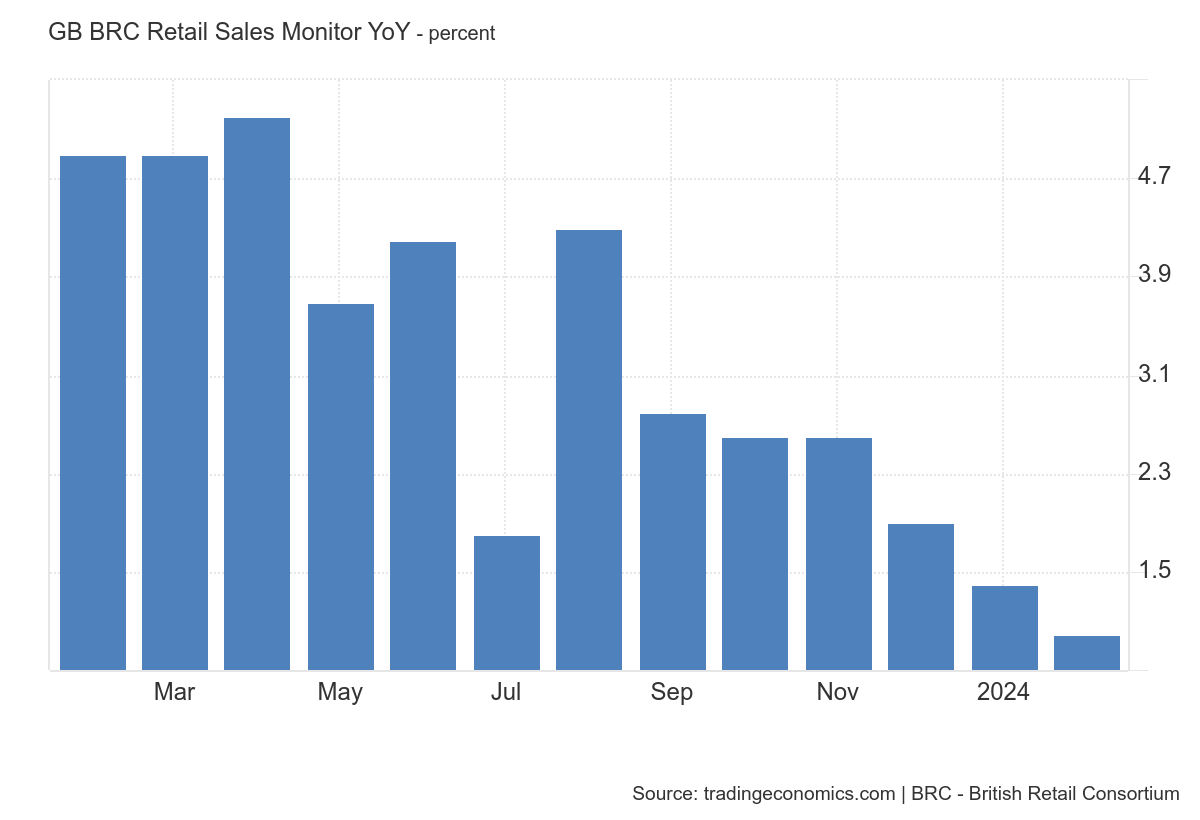
Helen Dickinson, chief executive at the BRC, commented: “Consumer demand was dampened by the wettest February on record, translating into a poor month of retail sales growth. Not even Valentine’s Day lifted customers out of the gloom.”
7.11am: Stocks to open lower
The FTSE 100 is expected to open around 24 points lower at 7,612 when markets open today, after closing 40 points lower on Monday.
Markets were weighed down by hefty losses from Ocado, St James’s Place and Entain, while tomorrow’s high-stakes Spring Budget appears to fraying nerves too.
Retail sales data released this morning hasn’t lifted the mood; the BRC Retail Sales Monitor rose a flat 1%, coming in far below the 1.5% forecasted growth.
Elsewhere on the macroeconomic calendar, new car sales figures are expected later this morning.
In company news, sausage roll kingpin Gregg plc has full-year results out shortly, with Hargreaves Lansdown pinning hopes on £168 million of pre-tax profits.
Builders' merchant Travis Perkins (LSE:TPK) also has results due, with nervous shareholders fully expecting a dividend cut.
Results from IWG, Reach plc and a trading update from Ashtead Group PLC (LSE:AHT) are also due.