
Ionic Rare Earths Ltd (ASX:IXR, OTC:IXRRF) has revised and increased its conceptual exploration target for the Makuutu Heavy Rare Earths Project in Uganda by 40% to 285-766 million tonnes grading 400-700 ppm total rare earth oxides (TREO).

The increase in the exploration target from the 2022 target follows successful maiden rotary air blast (RAB) drilling on exploration licences EL00147 and EL00257 last year.
Of the 76 RAB drill holes completed, 69 holes reported assays with clay-hosted rare earth intersections above the current resource cut-off.
The revised exploration target is separated into target areas within the sedimentary basin and those outside the basin in a mixture of weathered rock types including granite, granodiorite and some mafic rocks.
Drilling in 2023 on EL0147 was designed to infill the initial 1-kilometre spaced 2021 RAB program drilling to an approximate spacing of 500 metres. This returned results consistent with the 2021 RAB drilling and the exploration target ranges have been maintained for targets A6, B4 and B5.
The broad-spaced maiden RAB drilling program in 2023 on EL00257 aimed to identify the presence and tenor of rare earth mineralisation in the regolith above underlying fresh rock in laterite plateau areas.
Following assessment of the material type and multi-element analytical data, an exploration target was estimated and included in the overall Makuutu project exploration target of 285-766 million tonnes at 400-700 ppm TREO.
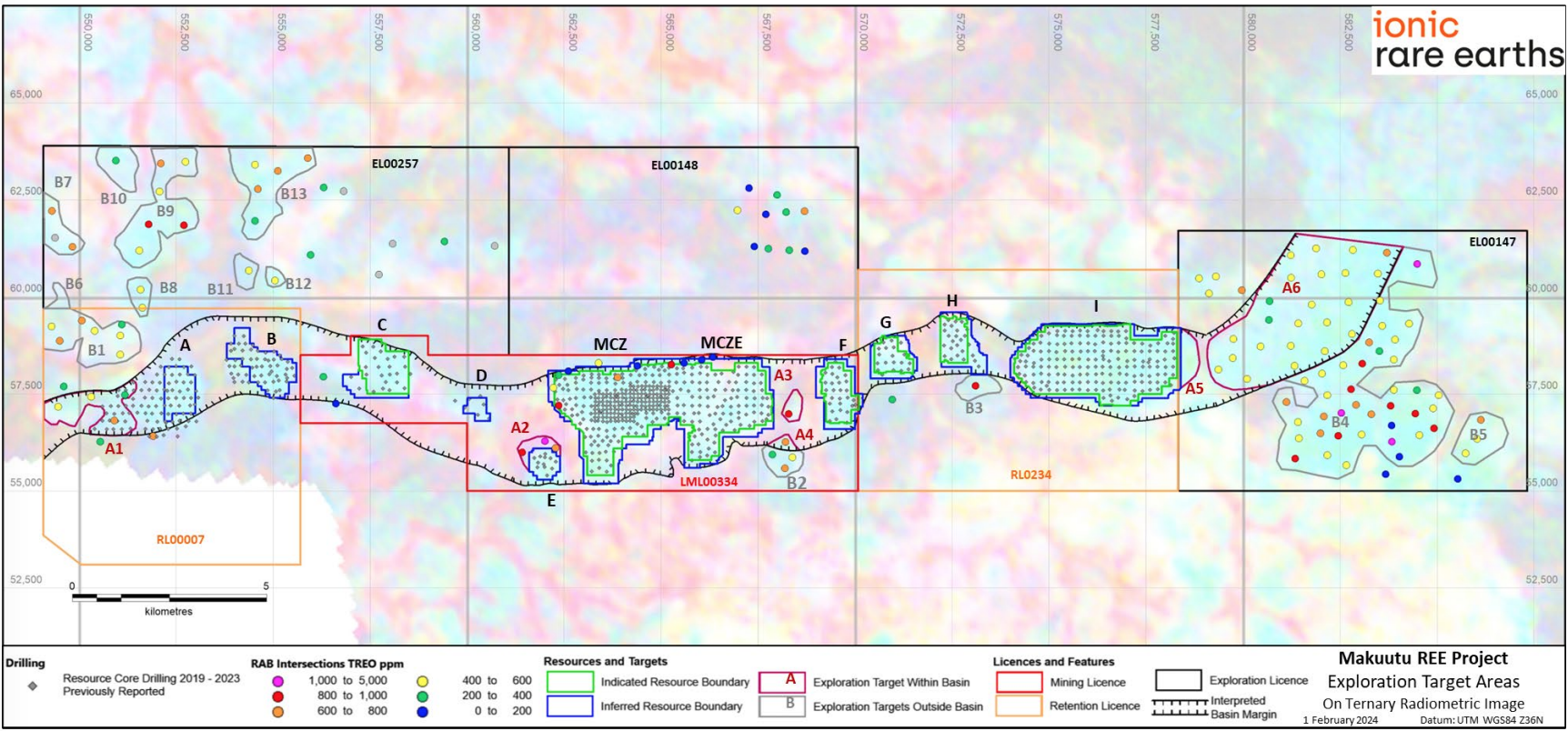
Makuutu project exploration target and mineral resource areas.
The company is progressing development at Makuutu through local Ugandan operating entity Rwenzori Rare Metals Ltd (RRM). The parties have agreed on terms that will see IonicRE move to 94% ownership, which is expected to occur in the first half of 2024.
IonicRE highlights that Makuutu remains the most advanced Ionic adsorption clay project in development today with product not committed to China and available to supply new supply chains looking to decouple from existing sources.