
In terms of mining stories, Meryllion Resources Corporation (CSE:MYR, OTC:MYRLF) has a straightforward tale.
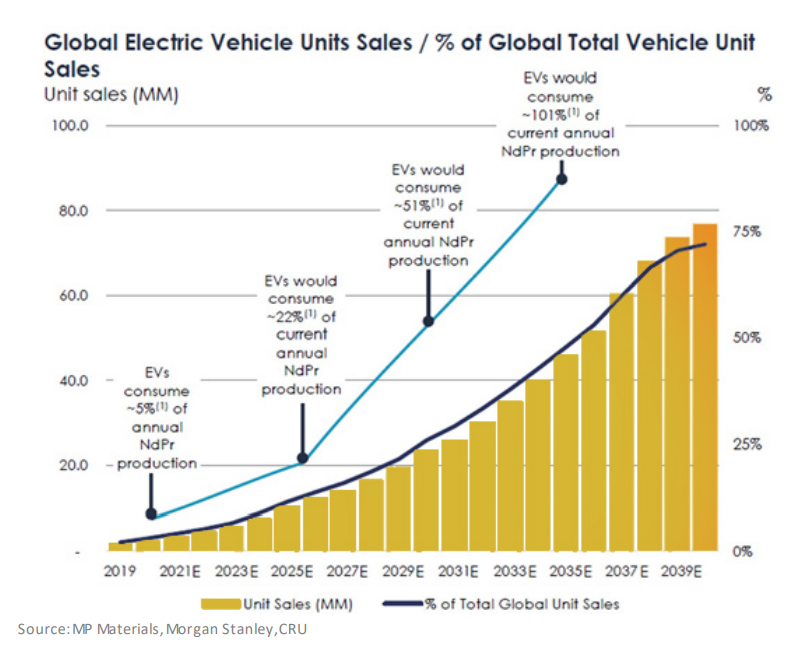
The Canadian-listed company is exploring in Tasmania, Australia’s southern island state, for rare earth elements to meet the growing demand for these critical minerals in electric vehicles (EVs), permanent magnets, wind turbines and various other applications across the automotive, aerospace, defence, healthcare, electronics, agriculture, and power generation sectors.
One thing that makes Meryllion’s Tasmania project particularly exciting is the fact that it is an ionic adsorption clay (IAC) hosted rare earth elements deposit. IAC rare earths deposits are common in China but to date, none have entered production in other countries.
As Meryllion CEO Richard Revelins explains: “IAC hosted rare earths are relatively new outside of southern China, but appear far more cost-effective to explore, establish defined resources and ultimately bring into production than traditional hard rock deposits. Hard rock deposits are also typically low in the most valuable rare earth elements, being terbium and dysprosium, which are in high demand for the permanent magnets used in wind turbines and for electric motors.”
In IAC deposits, mineralization typically exists close to the surface and can be extracted from the clay via a simple leaching process.
“Mother Nature liberated a lot of these rare earths over time through geochemical reactions and water flows and concentrated them in what might be regarded as paleochannels, so they tend to exist at, or very close to, surface and extend down to about 10 to 12 meters,” Revelins told Proactive.
He highlighted that the most important factor in rare earths projects is metallurgy.
“Whilst Meryllion has not conducted any detailed metallurgical testing itself, we know that to operate profitably we need to be looking at a less than a 4 pH level,” he said.
“Processing costs increase substantially as pH decreases due to increased acid consumption and impurities. We have reviewed the work done by other explorers in the area of our project, in particular ABx Group Ltd (ASX:ABX, OTC:AUSBF), and they have announced average recoveries of 40% using a relatively benign ammonium sulphate leach.”
Based on these factors, Revelins believes that Meryllion can develop its Tasmania project rapidly and cost-effectively.
“As with all mining operations, you want to position yourself at the low end of the cost curve to guard against the challenges changes in commodity prices can create,” he said.
He noted that “rare earth elements are not really rare” but what is rare is finding them in the grade, the concentration, and the ideal pH level that allows them to be economically exploited.
“About 80% of the world’s rare earths are concentrated in and around China and for Western governments, that’s a risky situation to be in,” Revelins said.
The development of new sources of rare earth elements outside of China is considered critical as demand for these minerals ramps up and is projected to outstrip supply, with a 26,000-ton deficit expected by 2030.
The Tasmania project
Meryllion in January 2024 exercised its option to earn up to a 100% interest in highly prospective rare earth exploration leases held by Tasmania Strategic Green Meals (TSGM) and Westbury Resources located in northern Tasmania.
Once it has earned its initial 50% stake, Meryllion can acquire additional interests in the project in 10% increments up to 80%, with the right to acquire the residual 20% at an independent valuation.
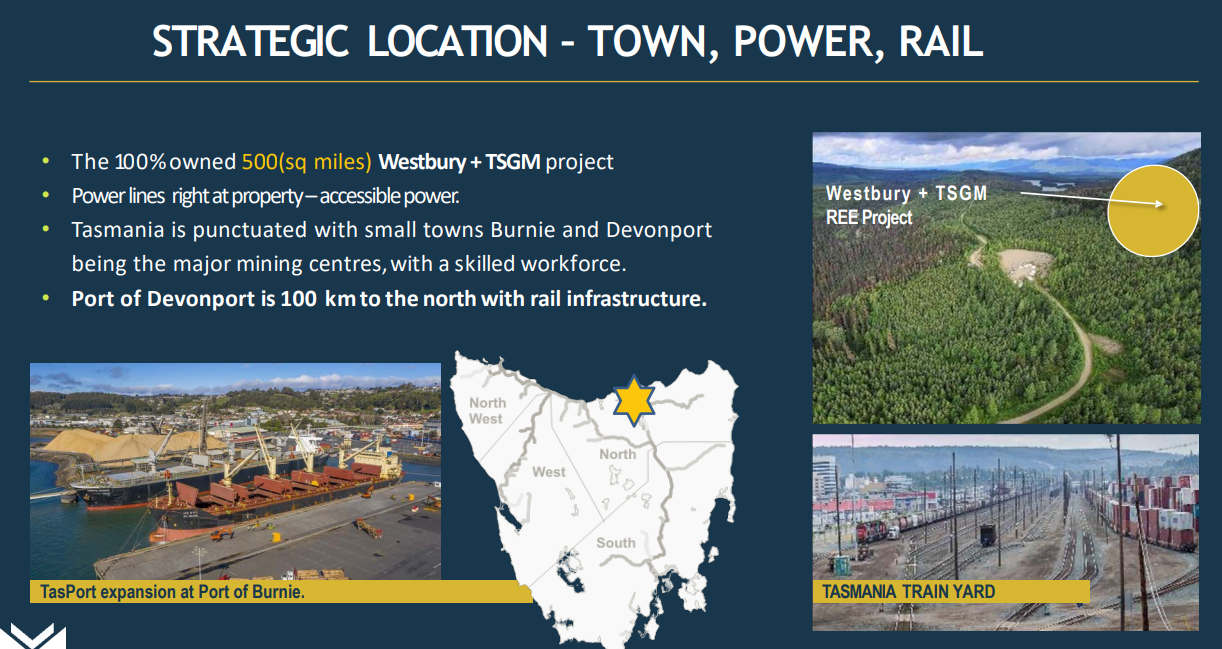
The leases cover 500 square miles and are located in proximity to the port city of Devonport. It also benefits from existing power grids, easy rail and highway access and weather conditions that permit year-round exploration.
“The infrastructure is absolutely everything you’d want for a mining project,” Revelins said. “It’s ideally located.”
In terms of its mineralization potential, initial sampling at the Tasmania project returned grades of up to 4,000 parts per million (ppm) total rare earth oxides (TREO).
Revelins highlighted that the project is located along strike from ABx Group’s Deep Leads-Rubble Mound rare earths deposit. In November 2023, ABx upgraded its resource estimate for the project from 27 million tons at an average of 803 ppm TREO to 52 million tons at an average of 817 ppm TREO.
Exploration highlights at ABx’s project include an interval of 8 meters at 6,406 ppm TREO, including 1 meter at 17,333 ppm TREO and 1 meter at 12,894 ppm TREO.
“An intersection of 17,333 parts per million is a mind-blowing intersection. The average grade of the deposit is understandably much lower than this, but it does demonstrate some exciting high-grade potential,” Revelins told Proactive.
He noted that this specific drill hole is located immediately to the southern boundary of Meryllion’s leases, so this is where the company plans to initially target its upcoming drill program.
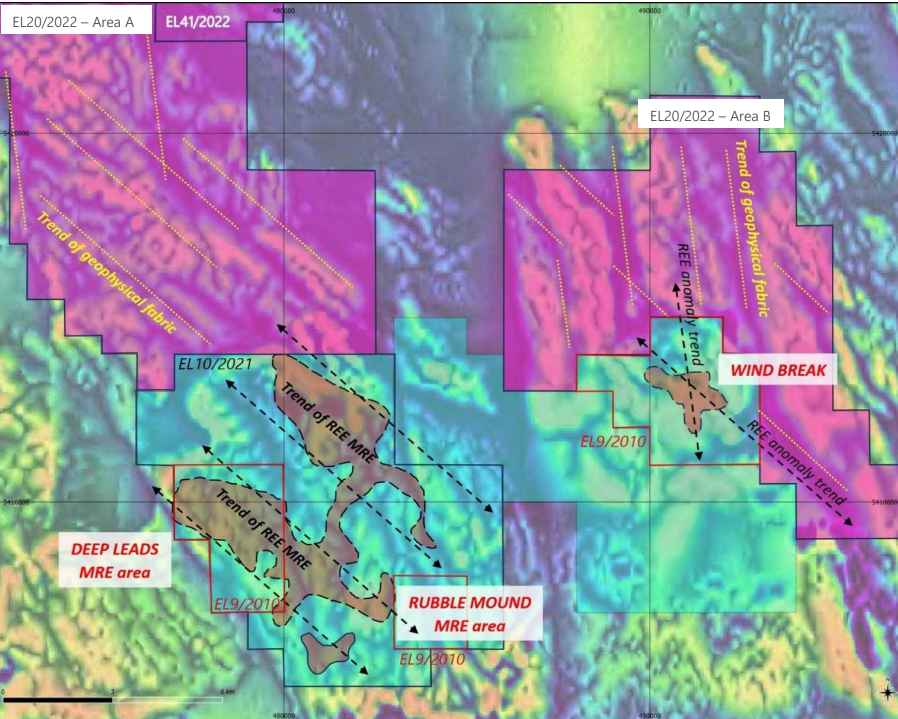
Figure 1: Overlay of regional magnetics data and interpreted geophysical feature that may control the trend of ABx Group’s Mineral Resource Estimate (MRE) and mineralization at Wind Break
Exploration plan
Meryllion intends to kick off a 500-meter drill program at its Tasmania project in April 2024, depending upon the granting of the required permits.
“That doesn’t sound like a lot, 500 meters, but because of the nature of the mineralization, we can drill a number of widely spaced and shallow 5- to 10-meter holes, which should provide 60 to 70 drill holes,” Revelins explained.
The drill program is expected to take a week or two to complete with results to follow shortly after, depending on the assay processing time.
“We believe we can get these programs done very efficiently and cheaply,” the CEO said. “Then we can quickly determine whether we’ve got something of potential economic interest or not.”
In January 2024, Meryllion released a National Instrument 43-101 compliant technical report for the project authored by independent geologists which confirmed the leases were favourable for the formation of IAC-hosted rare earth mineralization similar to that which contributes to the majority of the world’s rare earth elements sourced in China.
“It was a really strong report and supported everything our geological team had previously assessed,” Revelins said.
Protecting Tasmania’s environment
Revelins told Proactive that Meryllion does not see its project as potentially having significant negative environmental consequences that larger hard rock rare earths operations may encounter.
“Tasmania is such a pristine environment, and everyone wants it to be protected,” he said.
“Because of the recovery methodology, we don’t expect there’ll be any substantial environmental impact.”
Experienced leadership team
Meryllion’s leadership team has extensive experience and a track record of success in mining, project financing and development.
The company’s technical advisor, structural geologist Ian Neilson, has expertise ranging from project generation to discovery. He has consulted for clients including Newmont, First Quantum Minerals, BHP, Newcrest Mining, and others.
CEO Revelins has a background in investment banking and mining, including being the founding chairman of Atlas Iron and Gold Road Resources, co-founder of Peregrine Corporate in Melbourne, Australia, and a managing director at Cappello Group in Los Angeles, the United States.
The company’s non-executive chairman David Steinepreis also brings more than four decades of experience in international investment banking, having served as a director on numerous public companies in the mining sector.
With corporate finance lawyers Guy Charette as a non-executive director and Michael Kozub as company secretary, Revelins noted that the company has a strong board in terms of mining, finance, and corporate governance.
“As a team, we’ve been involved in companies that have generated billions of dollars in terms of market capitalization,” Revelins said. “If you’ve done it once, you know what's required to do it again.”