
Australia’s Mid Year Economic and Fiscal Outlook (MYEFO) for 2023–24 has revealed an improved fiscal position with lower deficits and reduced gross debt projections compared to the previous budget.
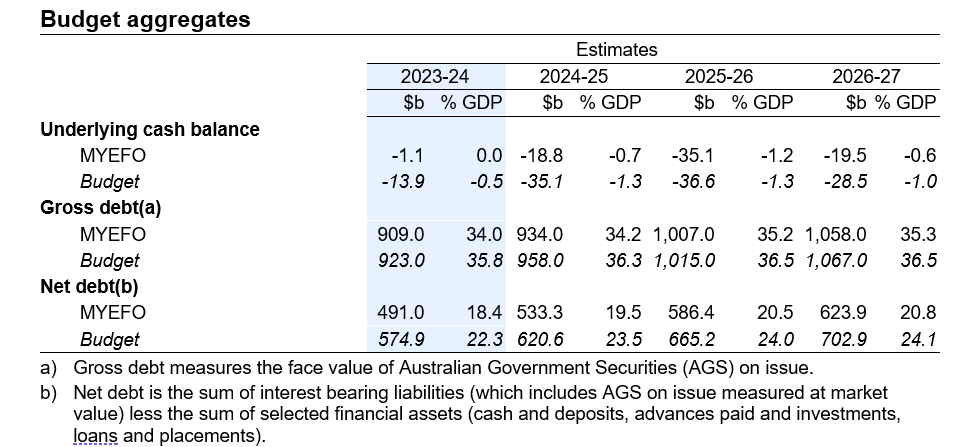
A deficit of $1.1 billion is forecast in 2023–24 (0.0% of GDP), an improvement of $12.8 billion since the 2023–24 budget. Gross debt as a share of GDP is now expected to peak 1.1% lower than forecast at the 2023–24 budget at 35.4% of GDP in 2027–28.
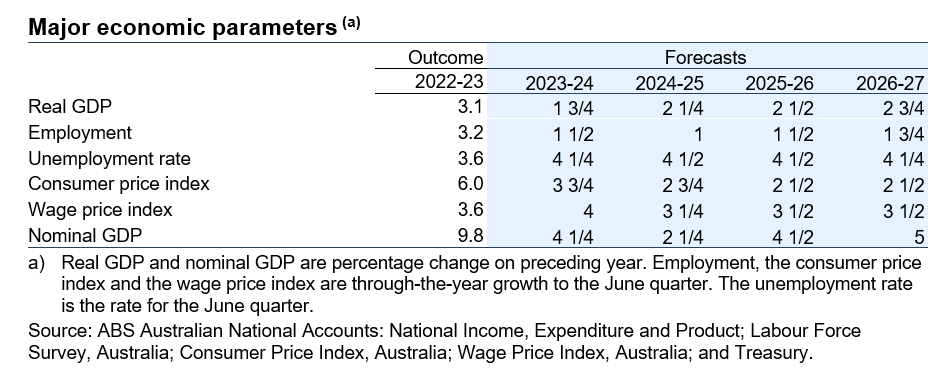
The 2022–23 period saw a robust economic growth rate of 3.1%, with wage growth reaching its highest annual rate since 2009. Real wage growth is showing positive trends and is expected to continue improving into 2024. The labour market remains strong, evidenced by the lowest unemployment rates in recent history and significant employment growth, surpassing major advanced economies.
Looking ahead, the Australian economy is expected to slow down in 2023–24 due to ongoing global pressures and domestic factors such as higher interest rates and moderating inflation. Despite these challenges, the economy's fundamentals remain solid, with projections indicating a return to the target inflation rate and sustained economic expansion into 2024–25. This anticipated growth will likely be supported by improved real incomes and a rebound in household consumption.
In summary, while the Australian economy navigates through a period of moderation, its underlying strength and proactive fiscal management position it well for future growth and stability.
However, the global economic landscape remains fraught with uncertainty. Factors such as the ongoing Russia-Ukraine conflict, tensions in the Middle East, China's property sector adjustments, and the ripple effects of global monetary tightening contribute to this uncertainty. Despite these challenges, the Australian economy is poised to outperform major advanced economies in the coming years.