
As the world races towards carbon-free and sustainable energy solutions, the spotlight is often on electric vehicles, solar panels, and wind farms. While these are integral components of our clean energy future, there's a quiet but powerful force that often gets overlooked - uranium.
Pegasus Resources Inc. (TSX-V:PEGA), a company with a strategic presence in the uranium-rich Athabasca Basin, is helping to shape the future of this essential element. Led by CEO Chris Timmins – an experienced entrepreneur and investor with a track record of over two decades in the resource industry – the company is poised to make a significant impact amid a surge in market interest in the yellow metal.
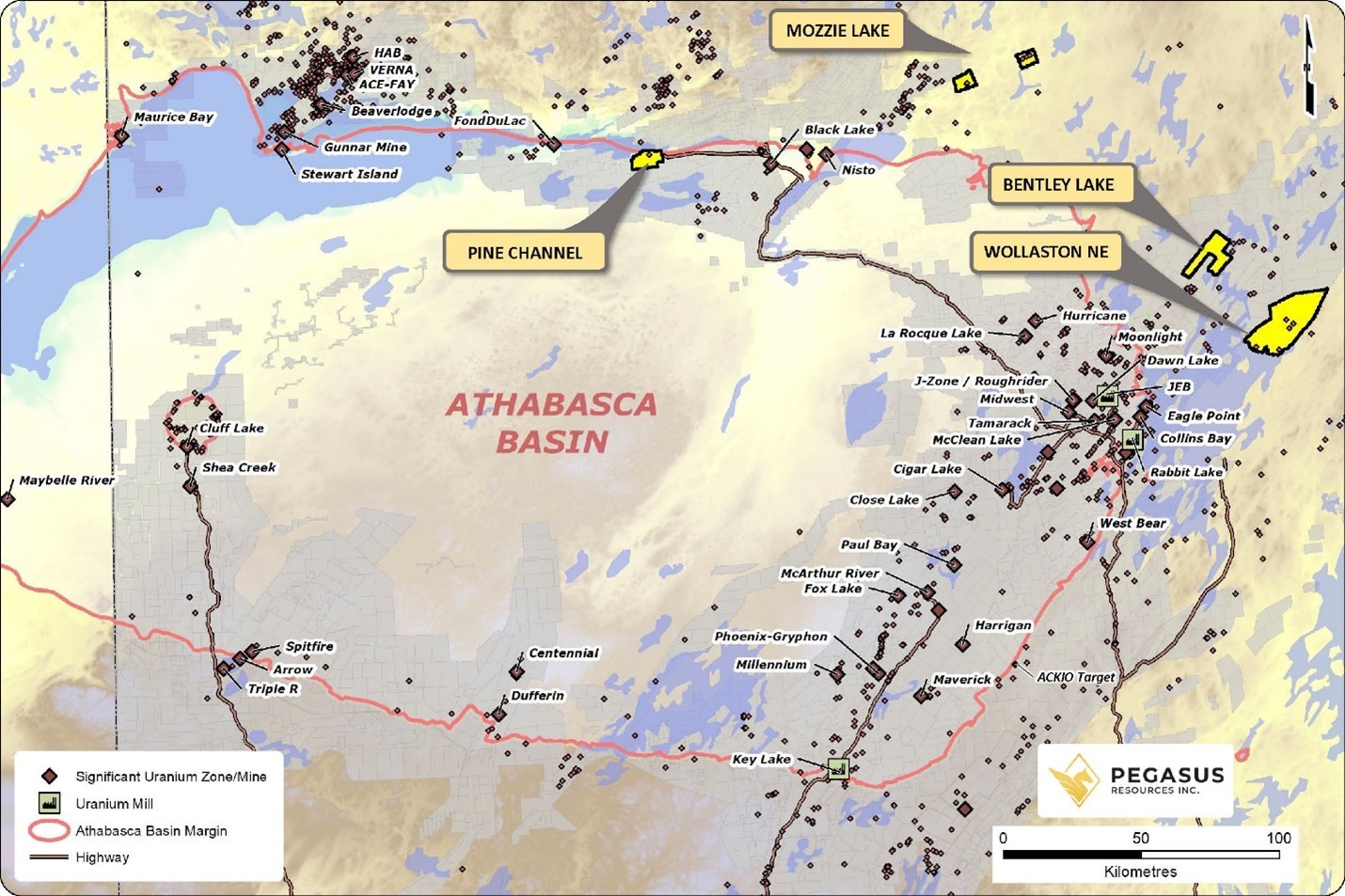
Pegasus holds four uranium properties nestled in the Athabasca Basin in northern Saskatchewan, the heart of North America’s uranium industry and home to some of the highest-grade uranium deposits on the planet. Canada's uranium reserves are substantial, standing at 606,600 tonnes of U3O8. What sets Canada apart is its wealth of high-grade deposits within the Athabasca Basin that are approximately a hundred times richer than the global average.
“Interestingly, despite the extensive exploration and production activities in the Athabasca Basin, there is still much to understand about the geological formations and the deposits themselves,” Timmins told Proactive.
“The Athabasca Basin in Canada is like a geological treasure chest, holding some of the world's richest uranium deposits. But despite our best efforts, we still don't fully grasp how these valuable deposits formed. Think of it as solving a complex puzzle that spans billions of years. Through exploration and drilling, Pegasus strives to help unlock this mystery while finding the next uranium deposit in the Basin.”

Pine Channel: an advanced uranium project
Of the company’s four properties in the Basin, Pine Channel is the most advanced, with significant historical work conducted by Denison Mines. Comprised of six mineral claims, Pine Channel is situated at the northernmost edge of the Basin, which allows for easy access via trails and winter roads. It holds significant potential for unconformity-related uranium mineralization, with historical drilling identifying anomalous uranium in fracture zones within Athabasca sandstone rocks.
Uranium production in Canada is driven primarily by the McArthur River and Cigar Lake mines owned by Cameco. These mines, characterized by their immense ore reserves and high grades, lead the global uranium production sector.
While Pine Channel shares some geological formations with the mega mines, Timmins acknowledged that there hasn't been much uranium drilling in the area.
“Our primary data is from the historical exploration and drilling on the Pine Channel property itself. Pine Channel is in the Manitou Falls formation, which hosts deposits like Cigar Lake, McArthur River, and Rabbit Lake,” he explained. “We have similar rock formations beneath the surface, but we need to conduct drilling into the basement rock to gain an understanding.”
Nevertheless, Pegasus has identified seven drill holes on the property that hit uranium, which is a promising indicator. Upcoming work will focus on a two-and-a-half-kilometer-long trend delineated through geophysical work.
“While it's challenging to make direct comparisons due to the limited drilling in our area, there's an air of excitement, especially considering the presence of anomalous uranium defined through historic drilling,” Timmins added.
Athabasca's uranium riches
Drilling will focus on relatively shallow depths compared to other areas in the Basin, providing an initial plan for the project's scope. Pegasus is looking at drilling anywhere from six to ten holes, depending on the depth requirements.
“In the Pine Channel area, the distance from the surface to the basement is typically 60 to 100 meters, so it's relatively shallow compared to the rest of the Basin, where depths can range from 100 to 700 meters before reaching the basement,” Timmins said. “Drilling should be relatively concise, with estimated depths of around 100 to 200 meters.”
Two other projects in the Basin give Pegasus unique access to uranium opportunities. The Wollaston Northeast property is situated in an area known for recent uranium discoveries, and the Bentley Lake property is strategically located at the transition zone of geological domains hosting renowned deposits. Additionally, the Mozzie Lake property boasts impressive historical resource estimates, reflecting the untapped potential of the region. Pegasus also holds a promising energy sands project in Utah.
Uranium's resurgence
With the uranium market showing signs of resurgence, Pegasus Resources' strategic presence in the Athabasca Basin takes on added significance.
Uranium has experienced a notable resurgence in recent years, thanks to its vital role in achieving clean and sustainable energy. As a reliable source of energy, nuclear power plants are capable of operating 24/7, making them suitable for baseload power. They are also incredibly efficient at converting fuel into energy, outperforming traditional fossil fuels by nearly 8,000 times. Moreover, nuclear power plants do not emit direct greenhouse gases, making them a cleaner alternative to fossil fuels.
The supply-demand dynamics in the uranium market are becoming increasingly favourable. The market faces a 26% production deficit, and approximately 30 countries, including the UK, US, Canada, Japan, and France, are considering or planning nuclear power programs.
Timmins believes that uranium supply is still significantly underestimated because current analysis does not factor in small modular reactors on the demand side.
Small modular reactors and the future of uranium
“Many projects are in the pipeline, and there's growing talk about small modular reactor demand,” Timmins said. “I believe that in the coming months, this demand will start to be factored into forecasts, causing the supply-demand gap to widen even further.”
Current estimates forecast a deficit of 40 to 50 million pounds, but with small modular reactors, that could easily increase to 100 or more million pounds each year. This potential surge in demand could drive uranium prices significantly higher over the next five years, Timmins believes.
For Timmins, his belief is not just lip service for shareholders. He has brought his passion for results and personal commitment to Pegasus, investing over $300,000 of his own money in the exploration company and aiming to drive its success through his expertise in organizing and managing complex projects.
This is one of the reasons shareholders chose Timmins to helm Pegasus. "I'm an individual who's eager to dive into the work, effect change, and propel Pegasus to prominence."
"I thrive on achieving tangible outcomes. Whether in my professional or personal life, I relish setting goals. One of my foremost objectives is to contribute to Pegasus' success,” he added.
“Advancing an exploration company demands unwavering determination.”