
NickelX Ltd (ASX:NKL) is setting the stage for a 1,700-metre reverse circulation (RC) drilling campaign next month at the Dalwallinu Nickel-Copper-PGE Project in the West Yilgarn region of Western Australia as it seeks Julimar-style mineralisation.
Assays from a recent infill auger drilling soil sampling program at Dalwallinu defined multiple high-priority geochemical anomalies over a combined strike length of about 12 kilometres of folded strata.
Priority targets
The highest priority target assays represent some of the highest West Yilgarn platinum group element (PGE) assays of up to 73.7 parts per billion platinum plus palladium.
These assays also returned significant and coincident anomalous values for nickel, up to 466ppm, and copper, up to 843ppm.
The company has received notice from the Department of Mines, Industry Regulation and Safety (DMIRS) of the proposed Program of Works (POW) for the drill program, for which Strike Drilling has been contracted.
“Significant prospectivity”
NickelX managing director Matt Gauci said: “The Nickel X team is very excited by the combined 12 kilometres of strike of geochemical anomalies recently defined, which confirms the significant prospectivity of the Dalwallinu project for nickel-copper-PGE mineralisation.
"This, combined with the recent Drone Magnetic Survey and MLEM and FLEM Survey results, has now identified numerous high-priority targets, prospective for Julimar-type nickel-copper-PGE mineralisation.
"A 1,700-metre reverse circulation campaign is now approved by the Department of Mines, Industry Regulation and Safety and drilling contractors have been contracted to test these very significant nickel-copper-PGE targets.”
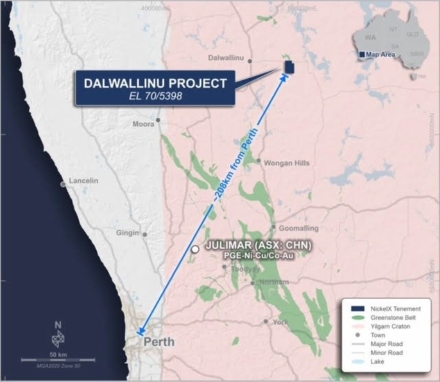
Dalwallinu Nickel Project is in the West Yilgarn, 150 kilometres northeast of Julimar and 208 kilometres northeast of Perth.
The project (E70/5398) covers 86 square kilometres of the entire Barra Barra Greenstone Belt, on accessible private farmland, containing sealed road frontage and where Native Title is extinguished.
Complements conductors
The high-priority geochemical targets complement the modelled Moving Loop Electromagnetic (MLEM) and Fixed Loop Electromagnetic (FLEM) bedrock conductors at DEM1 and DEM2, prospective for massive sulphides.
These auger soil geochemical and FLEM targets align and are consistently offset outboard of prominent magnetic strata thought to represent banded iron formation (BIF).
This is consistent with an interpretation of a folded sill complex, sitting stratigraphically below and folded with the BIF.
The DEM2 high-priority geophysical target represents some of the strongest FLEM responses in the West Yilgarn over 65 x 65 metres, with high conductance (16,850 S) sub-vertical plate at a shallow depth of about 30 metres from surface.