
Data sourced from Beaconchain shows that Ethereum validators are bringing in just 3.5% annually for contributing to Ethereum’s proof-of-stake consensus protocol, down from more than 8% in May.
Falling ETH yields give mixed messages for the health of the Ethereum blockchain network.
On the one hand, they suggest sustained high competition among validators, though they could also be a symptom of diminishing transaction fees from where staking rewards are generated.
The active validator count indeed remains at a record high of more than 970,000 members.
However, recent analysis from Coinbase and shared by CoinDesk suggests that staking demand may be levelling off.
According to Coinbase, the ‘validator queue’ is currently empty, suggesting a lack of interest from new validators not currently on the network.
Ether’s lagging performance on the spot market suggests that Ethereum’s gradual transition from proof of work (PoW) to proof of stake (PoS) over the past year has been met with a tepid reaction among crypto investors, who have instead concentrated their portfolios to bitcoin.
Though the ETH/USDT has gained 30% year to date, this is vastly below bitcoin’s 66% year-to-date rally.
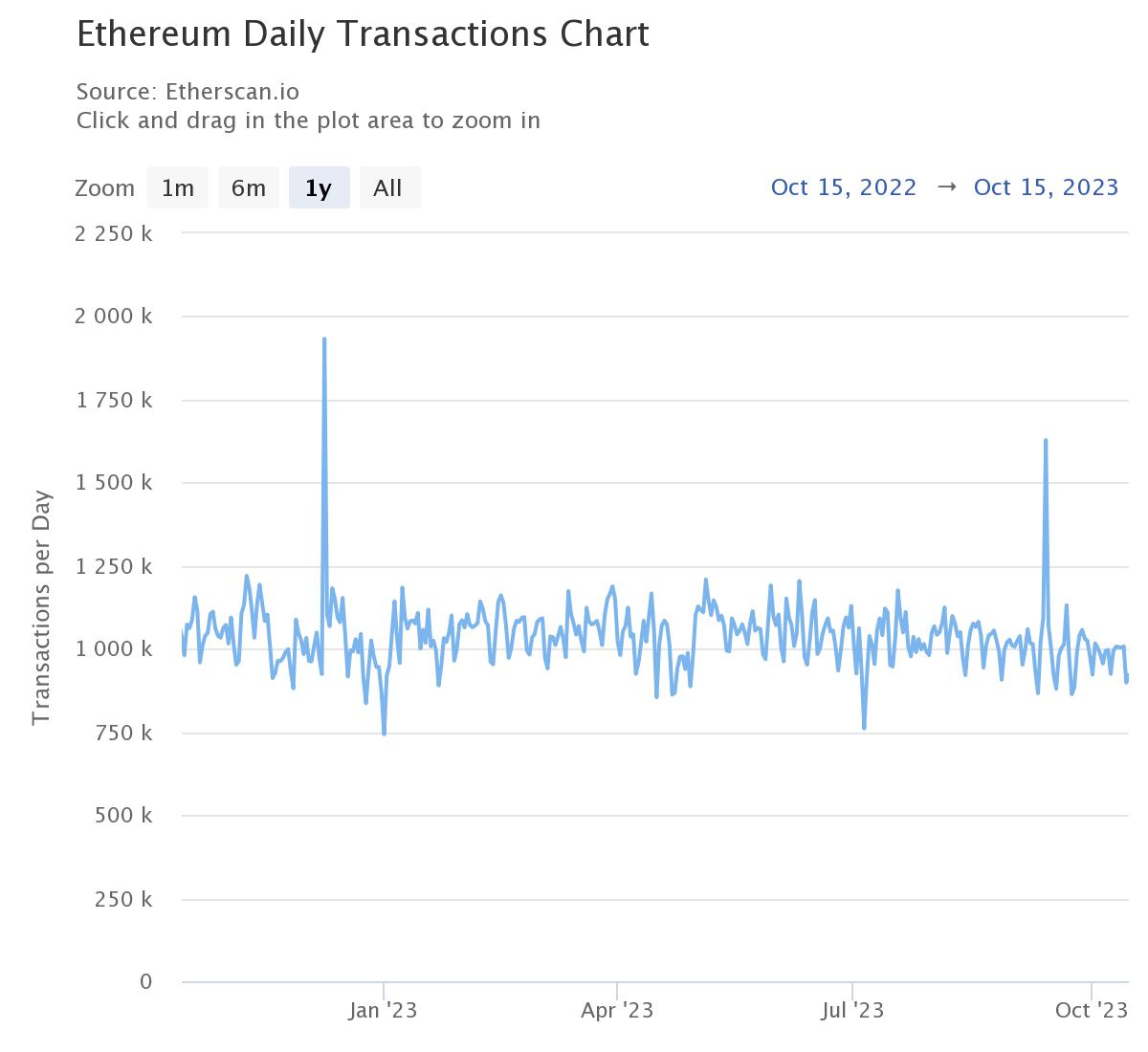
Average Ethereum transactions have remained around one million per day mark for the past 12 months, suggesting neither growth nor a notable decline in network adoption.
Proof of work versus proof of stake: An overview
For those unfamiliar with the concepts, proof of work (PoW) and proof of stake (PoS) are two distinct approaches to establishing consensus within the blockchain.
Although the technicalities of both methods are quite intricate, their fundamental distinctions can be readily discerned from their names.
In a decentralised blockchain network, the validation of transactions is carried out by a network of interconnected nodes, which receive financial incentives for accurately validating these transactions.
Technically anyone with a computer can be one of these nodes, but under PoW and PoS, significant roadblocks are put in the way to make sure they act responsibly.
In the case of PoW, of which Bitcoin is the benchmark example, nodes engage in a competitive process to solve intricate mathematical problems.
The first node to successfully complete this task is rewarded with newly minted cryptocurrency coins.
Consequently, individuals with greater computational power tend to have a better chance of receiving these rewards.
PoS, on the other hand, eliminates the necessity for solving complex equations, thus reducing the extremely high computational power and energy demands that are typical in PoW.
However, PoS introduces a different set of barriers: Rather than favouring computational power, it favours wealth.
The larger the stake an individual holds and the longer they are willing to lock it up, the higher their likelihood of receiving rewards.
For example, Ethereum requires an initial stake of 32 ETH to be a validator, making an entry price of more than $50,000 as of 16 October 2023.
In terms of security and decentralisation, PoW is generally considered more robust, whereas PoS offers greater scalability and transactional throughput.
The latter is why Ethereum decided to switch protocols. Other popular proof-of-stake cryptocurrencies include Cardano (ADA), Polygon (MATIC) and Solana (SOL).