
- FTSE 100 up 31 points at 7,631
- Shell's share price hits all-time high
- Ocado falls as Barclays downgrades
4:40pm: FTSE closes higher amid hopes of diplomatic push in Middle East
The FTSE 100 closed in positive territory amid diplomatic efforts aimed at ensuring the conflict in the Middle East does not spread.
At the close, London's lead index was up 31.03 points, 0.4%, at 7,630.63 while the FTSE 250 climbed 65.17 points, 0.4%, at 17,519.39.
Reports suggested US President Joe Biden is considering a trip to Israel as part of a global diplomatic push to prevent the war from spreading in the Middle East.
Meanwhile, US Secretary of State Antony Blinken also returned to Israel to meet Prime Minister Benjamin Netanyahu, after talks with Arab officials, and German Chancellor Olaf Scholz is preparing for a visit Tuesday.
Back in London, and a downgrade by Barclays hit Ocado which fell 5.25% but positive words from Jefferies lifted Pennon, up 2.2%, Severn Trent, up 2.8%, and United Utilities, up 2.5%.
The warning of lower sales at Pfizer kept GSK and AstraXeneca on the back foot while the ongoing conflict in the Middle East saw Shell touch an all-time high, up 1.8%.
St James's Place PLC bounced back 4.5% after tumbling more than 20% on Friday, pulling Hargreaves Landown with it.
3:52pm: Lloyds to push ahead with Telegraph auction despite new bid
Lloyds Banking Group is set to push ahead with the auction of the Telegraph newspaper and Spectator magazine as early as this week, despite a fresh attempt to derail the process by the Barclay family with an increased offer of £1 billion, according to reports.
The Barclays have made repeated attempts through the summer to regain control of the TelegraLloyds to push ahead with ph Media Group, which was seized by Lloyds after the family failed to repay debts of more than £1.2 billion that had built up behind the business over decades.
The Financial Times says the latest bid to be lodged is worth about £1 billion, according to two people familiar with the matter.
The FT said this is more than what the Telegraph is likely to be valued at auction, citing analysts.
3:15pm: FTSE 250 attractive but wait until 2024, says Goldman
Goldman Sachs (NYSE:GS) has taken a look at the FTSE 250, which is down 5% year-to-date, underperforming the FTSE 100 as well as indices across Europe.
It points out that for many years FTSE 250 was a persistent outperformer – especially versus the comparatively lacklustre/old economy FTSE 100.
Goldman noted the FTSE 250 gave more than a 400% total return between 2009-21 compared with a paltry 170% for the FTSE 100.
But in the last two years FTSE 250 this has stalled.
Goldman explains this is because of the weak economy – the FTSE 250 has around 50% UK sales compared to less than a quarter for the FTSE 100.
The UK economy has been hit by a combination of higher inflation cutting household real incomes and higher interest rates and the FTSE 250’s performance is closely correlated with PMIs, which have been weak.
Furthermore, EPS revisions have been sharply down for FTSE 250 while FTSE 100 has benefited more recently from the stronger dollar.
The rise in bond yields have also hurt. Goldman notes the FTSE 250 has higher expected medium-term growth and as such is longer duration than FTSE 100.
It also has a much higher weighting in rate sensitive sectors such as real estate (8% of FTSE 250).
The investment bank also noted a lack of M&A as higher bond yields plus economic weakness have weighed on corporate buying.
Can this change? Not until 2024, Goldman thinks.
“We believe the prerequisite is BYs stabilizing - for investors to gain confidence in a new level of yields - and economic growth bottoming,” it said.
These things are likely some time in 2024, but we are not there yet.
Goldman continues to prefer the FTSE 100 – “we think rates will stay higher for longer (benefiting the UK banks and hindering sectors like real estate) and we think energy prices have scope to move higher; especially given the conflict in the Middle East.”
The potential for more easing in fiscal policy in China is also something that benefits FTSE 100 with its exposure via miners and the banks, it added.
In addition, the UK economy remains vulnerable, with unemployment now picking up.
But in the medium term, FTSE 250 looks attractive, given its relatively low valuation.
Moreover, medium term expected growth remains high; the consensus expects sales and EPS growth in 2025 of 7% and 15%, respectively, vs. 1% and 7% for FTSE 100.
The upcoming general election (likely in 2024) adds to uncertainty for domestic-exposed assets, but evidence from the recent party conferences suggests both main parties are constrained by the challenging fiscal environment.
2:45pm: Bright start on Wall Street
US stocks pushed ahead in early exchanges ahead of a busy week of US earnings.
Shortly after the opening bell, the Dow Jones Industrial Average was up 229.40 points, 0.7%, at 33,899.69, the S&P 500 was up 24.15 points, 0.6%, at 4,351.93 and the Nasdaq Composite was up 85.66 points, 0.6%, at 13,492.89.
Investors were closely monitoring diplomatic efforts in the Middle East in the hope that a further escalation of the crisis could be avoided.
US President Joe Biden is considering a trip to Israel as part of a global diplomatic push to prevent the war from spreading in the Middle East.
Efforts also saw US Secretary of State Antony Blinken return to Israel Monday, following talks with Arab officials, and German Chancellor Olaf Scholz prepare for a visit Tuesday.
1.37pm: Here’s a quick recap of the top risers and fallers on the market today
Surface Transforms (AIM:SCE) jumped 15% as it announced a £100 million contract for its carbon ceramic brake discs.
Cerillion PLC (AIM:CER) shares jumped 8.7% after the company said it expects full-year profit to be “meaningfully” ahead of consensus forecasts after trading remained strong in the second half of the year.
Shares in Corcel PLC (LSE:CRCL) climbed 8.5% after the mining company announced the sale of its interest in the Mambare nickel-cobalt project following a revised offer.
Orosur Mining Inc (AIM:OMI, TSX-V:OMI) jumped almost 6% after announcing an entry into Nigeria for lithium exploration.
Tertiary Minerals PLC (AIM:TYM) got a handy leg-up following soil sampling results from the C1 target area at its Mushima North copper project in Zambia.Shares rose 7% to 0.15p.
Shares in Wildcat Petroleum (LSE:WCAT) plc fell by 54% after the company announced it is selling 375 million new shares at a heavily discounted price of 0.12p, raising £450,000. After expenses, the company will receive £393,750.
Shares in Hipgnosis Songs Fund Limited (LSE:SONG), the music investment company, sank over 11% after management confirmed parts of its royalties are set to be materially lower than expected, causing the group to cut its interim dividend.
1:01pm: UK to avoid recession but growth sluggish
The UK should still avoid a recession, although GDP growth is set to remain sluggish for the remainder of 2023 and into 2024, according to the EY ITEM Club’s new autumn forecast.
It expects the UK economy to grow 0.6% in 2023, up from the 0.4% growth projected in July’s Summer Forecast.
However, GDP growth expectations for 2024 have been downgraded slightly from 0.8% to 0.7%, as the impact of the recent interest rate rising cycle continues to feed through.
Subdued growth for the UK economy as 2023 closes, led by a stronger start to the year than expected.
➡️ 0.6% UK GDP growth forecast for 2023, with 2024 forecast growth reduced to 0.7%
➡️ Interest rates likely to have peaked
➡️ Inflation to fall to 4.5%#EYITEMClub
— EY UKI (@EY_UKI) October 16, 2023
Inflation is expected to fall to around 4.5% by the end of 2023, before declining to the Bank of England’s 2% target in the second half of 2024.
Oil prices, frozen income tax thresholds, inflation, and a deteriorating labour market are all expected to put pressure on consumer spending.
But business investment growth prospects for 2023 have been significantly upgraded, despite the higher cost of debt.
The economy is still forecast to grow 1.7% in 2025 as lower inflation lifts real incomes and interest rates are cut.
12:28am: Abrdn sells private equity unit to Patria Investments
Abrdn has risen 3.1% after it announced the sale of its European-headquartered private equity business to Nasdaq-listed Patria Investments.
The business sold has funds under management of £7.5 billion and follows a strategic review of its alternatives business.
Abrdn concluded that the capital generated from the sale of certain of its private equity businesses would be better deployed within our core investment businesses.
Abrdn will net a maximum £100 million from the sale.
Chief executive Stephen Bird said: “This latest sale marks further progress in the reshaping of our Investments business in line with previous guidance.”
“We are continuing to reduce complexity and are focusing on areas where we are confident we can drive growth in the future."
The sale is expected to complete in the first half of 2024.
12:02pm: Big earnings week coming up in the US
Across to the US and stocks are expected to open broadly higher on Monday as investors look ahead to a bumper week of earnings updates.
In pre-market trading, futures for the Dow Jones Industrial Average were 0.3% higher, while those for the S&P 500 rose 0.2%, and contracts for the Nasdaq 100 futures were down 0.1%.
The earnings season heats up this week with 11% of the S&P 500 slated to report results, including Johnson & Johnson (NYSE:JNJ), Bank of America, Tesla and Netflix.
Today, Charles Schwab (NYSE:SCHW) will report results before the opening bell.
Trading will take place against a backdrop of ongoing uncertainty in the Middle East as the conflict shows signs of escalating.
Elsewhere, a top Federal Reserve official said it is “undeniable” that the slowdown in US inflation is a trend rather than a momentary blip, despite a recent string of economic data showing persistent pressure on some prices.
Speaking to the Financial Times, Austan Goolsbee, president of the Chicago Fed, denied that progress was stalling on getting inflation back to the US central bank’s 2%.
He cautioned against tying forthcoming monetary policy decisions to a narrow set of data.
“There is a lot saying that inflation is trending down compared with what it has been and that’s what we want,” he said.
“It’s undeniable this is a trend. It wasn’t a one-month blip . . . we have to hope and keep an eye out to make sure that continues.”
11:28am: Water companies offer unprecedented opportunity
Pennon, United Utilities and Severn Trent’s business plans present an “unprecedented opportunity for multi-year growth,” according to Jefferies.
“This, alongside a potential for reasonable investment returns, outweighs our previous concerns about political/regulatory risk,” the broker said in a note to clients today.
In addition, the substantial step-up in investment is likely to improve sector performance on environmental issues, all the while bills appear to be manageable, it added.
The broker has double upgraded Pennon and Severn Trent to buy from underperform and moved United Utilities to buy from hold.
Shares in Pennon rose 1.7%, United Utilities rose 1.2% and Severn Trent rose 1.7%.
On Severn Trent, Jefferies has increased its price target to 2,960p from 2,100p.
“Our view is that the recent £1 billion equity raise has bolstered their balance sheet significantly, making them well-placed to deliver their PR24 business plans,” it said, wile it thinks it can maintain its current dividend policy too.
On United Utilities, the broker increased its price target to 1,200p from 960p.
“We see UU's business plan as offering sector-leading nominal RCV growth, with projected CAGR of 8% across the next regulatory period,” Jefferies said.
It thinks UU can maintain healthy levels of gearing and its current dividend policy.
The broker doesn’t see a need to raise equity funding even though it is a scenario that is presented in their business plan.
On Pennon, the price target is lifted to 850p from 700p.
“We believe Pennon’s 2025-30 business plan offers an attractive 7% p.a. nominal growth in regulatory capital value,” it said.
It thinks the proposed plan, if accepted by Ofwat, as financeable without the need to raise new equity or a dividend cut.
Jefferies said regulatory risks still remain, including the looming UK elections where poll-leading Labour has been vocal in its criticism of the water sector.
The business plans also still have to undergo Ofwat's regulatory and won't be finalised until December 2024, it added.
10:55am: Bank's Pill says more to do to bring inflation down
Bank of England deputy governor Huw Pill has said there is still “work to do” to bring inflation back down to Bank’s 2% target.
Speaking at an event organised by the thinktank OMFIF (the Official Monetary and Financial Institutions Forum), Pill said that the BoE would bring inflation down to 2% “in a way that is sustainable through time.”
The fact headline inflation is now falling, is “certainly not sufficient” for us to be able to say that the job is done, Pill added.
Pill said the “persistent components” of inflation were the main focus of policymakers.
He said: “If we have a persistent component of inflation, it seems natural to me that we have a persistent monetary response to it.”
“It is important that we do not declare victory prematurely, just because movements which are relatively mechanical in headline inflation are working their way through,” Pill added.
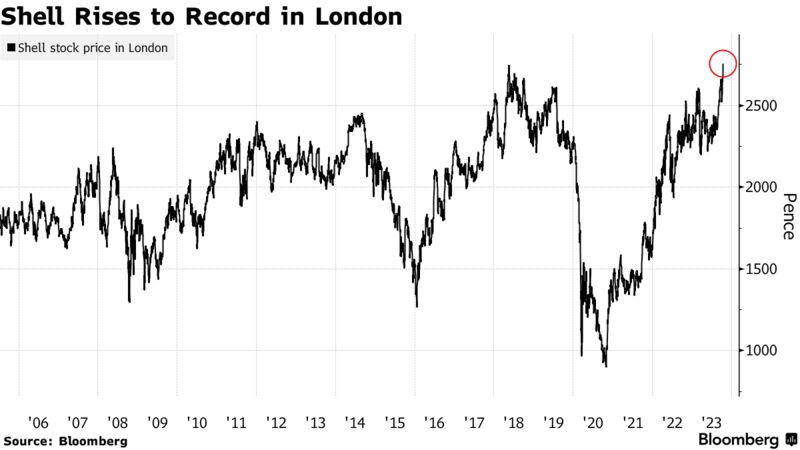
10:26am: Shell's share price hits all-time high
Keeping the FTSE in the green are the oil majors and mining companies, and Shell PLC (LSE:SHEL, NYSE:SHEL)'s share price has touched all all-time high in London.
Courtesy: Bloomberg
The firm has benefited from rising energy prices as its new CEO Wael Sawan has continued to pump investment into oil and gas.
Shell shares hit a record high as rising energy prices and a shift in strategy to focus on core oil and gas business attract investors https://t.co/BCSKW3PHTn
— Bloomberg Markets (@markets) October 16, 2023
Shares are up 17% year-to-date and 22% in the last 12 months, trading at 2,759.50p today.
9:44am: UK house prices rise at slowest post-summer rate since 2008 crash
UK house prices are rising at the slowest rate for this time of year since the 2008 financial crash, according to new data that highlights the impact on the housing market of higher interest rates.
The average new asking price rose by 0.5% in the month to 7 October to £368,231, but it was the smallest post-summer bump since the 2008 crisis, according to property website Rightmove.
House prices dropped by 0.8% in the 12 months to early October as the lower activity fed through, Rightmove said, while the number of agreed house sales fell by 17% compared with a year earlier.
Instant Info – Rightmove House Price Index pic.twitter.com/WfmLghu7Fu
— BuiltPlace (@BuiltPlace) October 16, 2023
Tim Bannister at Rightmove, said asking prices usually rise after the end of the summer holidays, but that the increase this year was “much more subdued” as sellers adjusted to the weaker market.
He said that estate agents were describing the market as “the most price-sensitive ever”.
The number of people enquiring about each property advertised on its website was still up by 8% on 2019, before the Covid-19 pandemic.
9:13am: Ocado slips as Barclays downgrades
Ocado Group PLC (LSE:OCDO) tops the FTSE 100 fallers, down 4.1%, after Barclays downgraded the stock to underperform from equal weight.
It also slashed its price target to 430p from 680p.
The broker said it follows a deep-dive into Tech Solutions, which is around 80% of its enterprise value, based on expert conversation and differentiated customer fulfilment centre (CFC) contract modelling, which points to Ocado missing medium-term guidance.
Barclays sees more downside risk in the next 12 months.
While it does not dispute Ocado's grocery technology is market-leading it thinks Ocado's medium-term guidance is at risk from existing customer CFC/module roll-out delays.
It also highlighted competitive pressures from Autostore while it is sceptical how much the company can scale non-grocery deals.
At the same time, Ocado's impending debt maturity wall means that its operating trends in the next 12 months will have an amplified effect on valuation, while the current Amazon/Autostore trial in the US presents a significant negative tail-risk that is not well understood, Barclays said.
8:43am: Hipgnosis tumbles as pulls dividend
The FTSE 100 has pared its gains but remains in positive territory. up 9 points, at 7,609.
Mining and energy stocks continues to lead the way, after the oil price rose above $90/barrel while the downgrade by Barclays continues to weigh on Ocado, down 4.1%.
Over in the FTSE 250, the big mover is Hipgnosis Songs Fund Ltd.
Sshares have plunged 16% after it pulled payment of its interim dividend after warning that debt covenants would have been at risk because of a change in royalty payments made to songwriters in the US.
The UK-listed music rights owner said the company’s independent portfolio valuer, Citrin Cooperman, had “materially reduced” expectations of industry-wide payments following a decision last year to recalculate the rate by the US Copyright Royalty Board, it said.
The decision covered royalties payable to songwriters between 2018 and 2022, and would mean that the company will receive “significantly lower” payments.
As a result, Hipgnosis said it would withdraw the interim dividend proposed last month, to ensure compliance with the terms of its revolving credit facility.
The fund manages music from the likes of Justin Bieber, Neil Young and Shakira.
8:15am: FTSE 100 higher, energy and mining stocks rise
The FTSE 100 opened higher supported by rising energy and commodity stocks amid concerns the crisis in the Middle East could spread.
At 8:15am, London’s blue-chip index was up 23.48 points, 0.3%, at 7,623.08 while the FTSE 250 rose 37.63 points, 0.2%, at 17,491.85.
Susannah Streeter, head of money and markets, Hargreaves Lansdown said: “As risk-off sentiment has been spreading, investors have been seeking more defensive positions amid fears of conflict escalating in the Middle East.”
“The FTSE 100 looks set to benefit from higher energy prices with oil and gas prices dipping back but remaining at elevated levels, having jumped sharply over supply concerns.”
BP PLC (LSE:BP.) and Shell PLC (LSE:SHEL, NYSE:SHEL) rose around 0.8%, while miners Anglo American rose 1.4% and Glencore 1.3%.
Ocado fell 2.6% as Barclays downgraded the stock to underweight from equal weight and slashed its price target to 430p from 680p.
Heading the other way was Severn Trent, up 1.6%, as Jefferies upgraded to buy from underperform.
The broker also upgraded Pennon, up 1.2%, to buy from underperform and United Utilities, up 1.3%, to buy from hold.
THG jumped 4.7% on reports it could spin off its Myprotein nutrition arm in the US, while boohoo Group PLC rose 1.8% after Mike Ashley’s Frasers Group PLC (LSE:FRAS) upped its stake once more.
Cerillion was another stock on the move, up 9.5%, after it said profits would be ahead of expectations in an upbeat trading statement.
7:45am: GSK's Jerperli one step closer to European approval
GSK PLC (LSE:GSK, NYSE:GSK) is a step closer to gaining European approval of its Jerperli drug for the treatment of a specific type of endometrial cancer.
The Committee for Medicinal Products for Human Use (CHMP) of the European Medicines Agency has adopted a "positive opinion recommending approval" of Jerperli, otherwise known as dostarlimab, when used alongside chemotherapy for patients who have endometrial cancer.
The CHMP opinion is one of the final steps prior to a marketing authorisation decision by the European Commission.
Hesham Abdullah, senior vice president and head of oncology within R&D at GSK, said: "If approved, dostarlimab plus chemotherapy will be the first new treatment option in decades for these patients in the European Union, offering long-awaited new hope for improved long-term outcomes.
"This opinion further reinforces our confidence in dostarlimab's important role in the immuno-oncology treatment landscape."
GSK said it is expecting a decision from the European Commission by the end off this year.
Jemperli remains under review in Australia, Canada, Switzerland and Singapore, but was approved this summer already in the US and UK.
7:33am: Cerillion sees profits "meaningully" ahead of guidance
Good news from Cerillion PLC (AIM:CER) which expects pre-tax profit to be “meaningfully” ahead of consensus forecasts after trading remained strong in the second half of the year.
The billing, charging and customer relationship management software solutions provider said the positive trading picture of the first half had continued through the second, including signing a £15.1 million new contract with an existing customer and completion of a major initial installation for Telesur.
As a result, adjusted pre-tax profit is expected ahead of the consensus market forecast of £14.3 million.
Revenue is expected to be around £39.0 million, with sales to existing customers significantly greater than any previous year, reflecting the growing value of the installed base.
Net cash at September 30 rose to £24.7 million from £20.2 million before.
Cerillion said the new customer sales pipeline grew again in the second half and it therefore expects to make further encouraging progress over the course of the new financial year.
7:23am: Frasers increases stake in boohoo again
We start the week with news Mike Ashley’s Frasers Group PLC (LSE:FRAS) have made another swoop for shares in boohoo Group PLC.
The retailer, which owns Sports Direct and House of Fraser now owns 15.1% of the online retailer, increasing its stake from 13.4%.
Only last week, Frasers lifted its holding from 10.4% to 13.4%, while in September, Frasers said it had raised its holding to 9.1%.
It continues Frasers’ acquisition spree which has seen it pick up stakes in electricals giant Curry’s, its online counterpart AO World and boohoo’s rival Asos.
It adds to other investments in German fashion designer Hugo Boss, Manchester-based clothing label N Brown, luxury handbag brand Mulberry and even a sliver of Next.
7:00am: Modest gains expected in London
Good morning and the FTSE 100 looks set to open modestly higher after the oil price rose as fears grow of an escalation in the conflict in the Middle East.
Spread betting companies are calling London’s lead index up by around 16 points after closing down 45.18 points at 7,599.60 on Friday.
“As a result of this continuing uncertainty and the war of words being played out in plain sight it’s hard to see much in the way of upside for stock markets unless there is a dialling back in the tension which is currently convulsing the region, with markets in Europe set to open modestly higher, despite a weak Asia session,” said Michael Hewson at CMC Markets.
Brent oil rose back above $90/barrel as fighting escalated in the Middle East which is likely to provide support for equities in London.
In Asia on Monday, the Nikkei 225 index in Tokyo was down 1.9% while in China, the Shanghai Composite fell 0.4% and the Hang Seng index in Hong Kong declined 0.6%.
Back in London, and the corporate diary sees annual results from Seeing Machines and Tristel.