
Google parent Alphabet Inc (NASDAQ:GOOG) found itself on the backfoot this year following the tremendous success of Microsoft-backed OpenAI’s landmark ChatGPT large-language model.
Sensing a ChatGPT-powered Bing renaissance (Bing is Microsoft’s search engine, by the way), Google unveiled its ChatGPT killer 'Bard' this February.
Named for Shakespeare’s moniker the Bard of Avon, Google’s LLM was a bit of a comedy of errors, making embarrassing factual mistakes in its first public road test.
Bard, simply put, was rushed out the gates in order to capitalise on ChatGPT’s groundbreaking success.
It has since improved, but in a landscape where ChatGPT is increasingly improving and expanding its dominance, it’s only valid to ponder what Bard actually brings to the table.
For what it’s worth, Bard has implemented some impressive features, including advanced image analysis and generative responses in over 40 languages.
Bard is also in the process of being implemented into Gmail, Google Doc, Maps and other Google applications, echoing Microsoft’s implementation of ChartGPT into Microsoft Office.
It’s yet another example of Google copying Microsoft’s homework, but an enticing development nonetheless.
What’s less innovative is Bard’s addition of a Google Search function.
In a feat of overengineering, Bard lets you cross-reference its responses on Google Search, leading one to ask- why not just use Google Search in the first place?
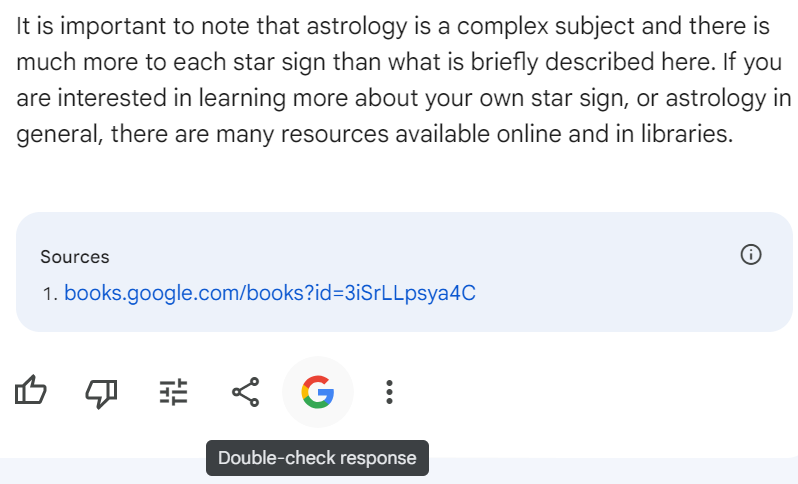
Bard’s Google Search function – Source: bard.google.com
The same question could be directed at ChatGPT, but at least it has the tenacity to stick by the responses it generates.
Now Bloomberg has reported that Google insiders themselves are questioning Bard’s utility
Senior product manager for Bard Dominik Rabiej was quoted on a private Google Discord channel stating: “My rule of thumb is not to trust LLM output unless I can independently verify it”.
Rabiej suggested limiting people’s use of Bard to “creative / brainstorming applications”, though was also useful for coding, said Rabiej, “ “since you inevitably verify if the code works”.
“The biggest challenge I’m still thinking of: what are LLMs truly useful for, in terms of helpfulness?” wrote Cathy Pearl, a user experience lead for Bard “Like really making a difference. TBD (to be determined)!”
Discord members seemed to have reservations about Bard’s true potential.
In fairness to Google, Bard is still in its beta stage; it may not be a total tragedy just yet. All’s well that ends well, after all.