
When the International Monetary Fund issues its biannual forecasts, such as today's that predict the UK will be overshadowed by other major economies next year and that interest will remain around their current level for the next five years, a lot of people ignore them.
And that's perfectly fine, especially on the basis that they, like many economic predictions, prove wide of the mark. Very few forecasts prove to be wholly correct, but if useful for anything it helps to establish a general sense of the future.
But if the IMF is correct in its prediction about interest rates remaining "high" - or more precisely the IMF expected them to rise to 6% from the current 5.25% - then what might be the outcome?
When I asked Russ Mould, investment director at AJ Bell, one of his first responses was to cite statistician George Box, who said "All models are wrong. Some are useful" - before cautioning that the number of people who IMF forecasts when it comes to picking stocks or sectors, or making strategic asset allocation decisions, is close to nil.
He also, like some others, takes issue with the IMF’s potentially false premise and its language and terminology "at best loose".
Indeed, while a 6% interest peak might have been on the card from the Bank of England earlier in the summer, the market does not see this as being on the cards any longer, with most viewing the current rate as a likely zenith with at most one hike to 5.5%.
If 5.25% does prove to be the peak, it might feel high to many homeowners who have only had a mortgage in the past decade, but on a historical basis it is not that high (house prices are the big issue, but anyway a separate discussion).
As Mould points out, a brief look at the history of UK and US interest rates since the 1970s reveals that interest rates "do not stay at a peak – wherever it is – for long".
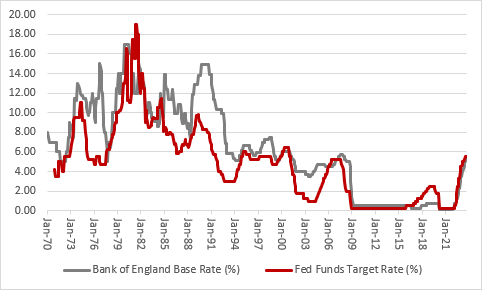
He suggests this goes back to the acerbic comment economist from Rudiger Dornbusch (I remember that name from my Begg, Dornbusch and Fisher economics textbook) that, “None of the post-war expansions died of old age. They were all murdered in their beds by the Federal Reserve.”
History seems very unlikely to repeat itself in that way, but as Mould says, the chart suggests the odds are against 'higher for longer', although this does leave the Bank of England and the US Federal Reserve in a tricky spot.
Also, it's worth noting another point from Mould, that, as the graph also shows, the long-term trend is for the peak in rate cycles to be progressively lower as growing levels of debt in the system make the economy much more sensitive to relatively minor changes in headline borrowing costs (see also the next chart).
In short, this means a return to the UK’s rate peaks of the 1970s oil shocks, up to 13% in 1973, 15% in 1976 and 17% in 1979, or the US equivalent highs will not be needed or even countenanced by the BoE or Fed.
The UK government's annual interest bill is not far off £115 billion a year (versus £160 billion spending on the NHS and a US Federal interest bill heading to US$1 trillion a year) adds to the pressure on higher rates.
There will be great pressure on the BoE and Fed if and when the economic pips squeak and the government and financial markets will send some loud signals to accompany the calls for rates to start being cut again.
This, potentially alongside quantitative easing, is a "logical way out", says Mould. "Governments cannot afford the current cost of money."
However, with the inflation genie still outside the bottle, central governments will be nervous about the timing of cuts.
Mould points to rates being cut too early on both sides of the Atlantic in the 1970s, with the current geopolitics around Russia and Middle East also keeping the oil price issue in mind and reminding of the 70s (oil price shock in 1973 after the Yom Kippur war and 1979 in the wake of the Iranian Revolution).
But, reminds Mould, governments "need inflation" - if nominal GDP growth can be kept above nominal interest rates them debt-to-GDP ratios come down as if by magic.
"But to achieve that, you need to follow the path of financial repression – keeping a cap on rates and returns on cash and bond yields to keep a cap on debt costs. Inflation is governments’ saviour here, even if savers might get stiffed (again) as a result," he tells me.
"It's almost as if the IMF is trying the old misdirection trick – move along, nothing to see here. But then who can blame them, as bond vigilantes are starting to shove around bond yields (and by implication central banks)."
If rates do stay higher for longer until something breaks, then Mould predicts the "shock and awe monetary policy" to stave off any threat of deflation as per 2007 and 2020 will be something to behold.
"Central banks know we cannot afford deflation at any price as the resulting debt bust will be crushing. Just look at this long-term chart of total US indebtedness – see the tiny dip in total debt in 2007-08. That’s the Great Financial Crisis. Economic cardiac arrest."
Another chart from Mould is an arresting one.
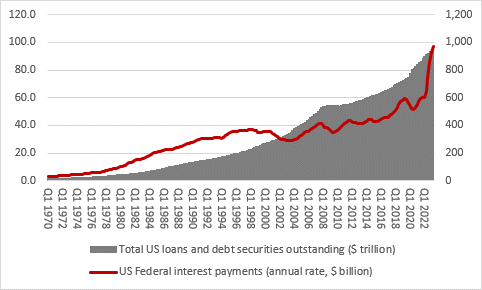
Debt "has to keep growing and for it to keep growing it has to be kept cheaper for longer, not more expensive for longer", says Mould.
This may be why the UK Gilt and US Treasury markets have been caving in (until this week’s dash for safety) as they don’t like what they see, he says.
"Too much debt on one side, risk of too much inflation on the other."