
Maximus Resources Ltd (ASX:MXR, OTC:MXRRF) has completed its drill program and ongoing nickel-copper-gold-platinum group element (PGE) soil mapping at its Spargoville Project, 25 kilometres from Kambalda, Western Australia.
The reverse circulation (RC) drill program totalling 1,658 metres completed at the Hilditch Gold and Kandui Nickel prospects, provided encouraging geology at both targets along strike and below known mineralisation.
All samples have been submitted for multi-element analysis.
Further to this, targeted nickel-copper-gold-PGE soil mapping completed across several prospective ultramafic horizons has identified priority targets for follow-up drilling.
Encouraging drilling
MXR drilled a total of 15 holes, amounting to 1,658 metres, at the Hilditch Gold and Kandui Nickel prospects. The drilling at both sites intersected promising geological features, and all samples are undergoing multi-element analysis.
At the Hilditch Gold prospect, seven holes were drilled over 870 metres. The focus was on expanding known mineralisation across three established lodes and investigating the possibility of a fourth lode. The objective was to update the mineral resource estimate (MRE). A portable X-ray fluorescence (pXRF) device was used to map zones with elevated arsenic levels, guiding the determination of drilling depths. Arsenic is recognized as a pathfinder element for gold systems in the Eastern Goldfields.
At the Kandui Nickel prospect, eight holes were drilled, covering 788 metres. The drilling campaign completed five holes aimed at assessing the potential plunge of several higher-grade nickel zones, and an additional three scout holes were drilled to investigate a geochemical anomaly.
The drilling revealed several promising zones at targeted depths, confirming the geological interpretation of Kandui and potentially guiding any future drilling activities.
Soil mapping advances target generation
Maximus' tenements are situated at the northern extremity of a fertile ultramafic belt, which is home to numerous noteworthy nickel sulphide deposits such as Cassini, Miitel, Wannaway, Mt Edwards and Andrews Shaft. The company is progressing in generating gold and nickel targets through a proven, cost-effective methodology.
Historically, the Spargoville Project's nickel targeting heavily depended on electromagnetic (EM) surveys. However, due to the prevalence of conductive sediments in the project area, EM signals are more likely to be false indicators linked to the sediments, rather than genuine markers for nickel sulphides. Consequently, the company has shifted its focus to using geology and geochemistry for nickel sulphide target generation.
This validated approach primarily involves pinpointing the basal contact's location and employing geochemical analyses to highlight the most promising areas. Key pathfinder elements like nickel, copper, and PGEs are used to identify these areas.
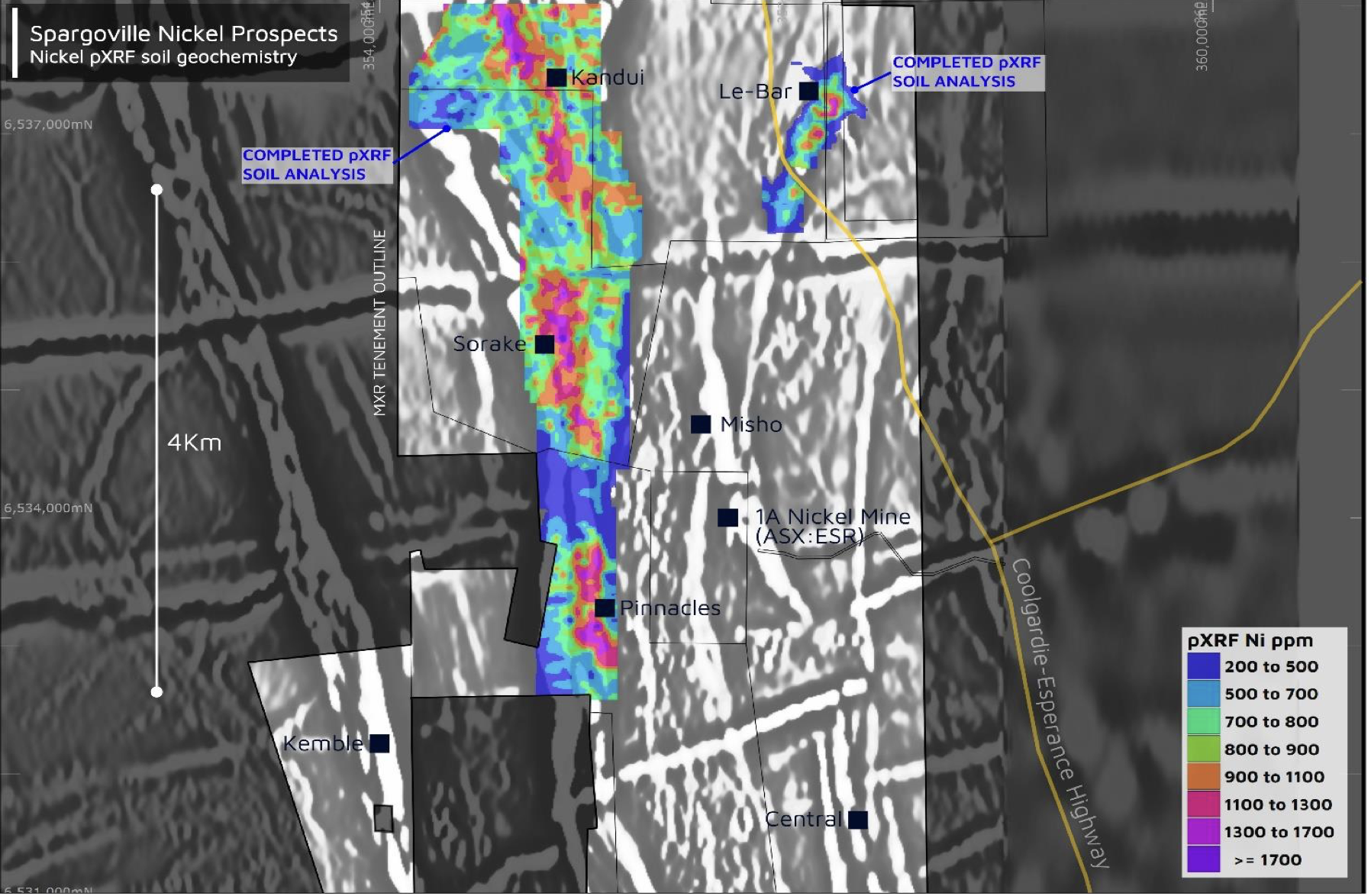
Spargoville Nickel Prospects location plan displaying Nickel pXRF soil geochemistry grid over greyscale aero-magnetics.
MXR is conducting close-spaced soil analysis using an in-field portable X-ray fluorescence (pXRF) to refine potential nickel sulphide targets, accompanied by follow-up gold and PGE assaying. This strategy is yielding encouraging results, identifying several favourable ultramafic layers at the Kandui, Sorake, Pinnacles and Le-Bar Prospects.
The use of portable X-ray fluorescence (pXRF) for acquiring near real-time multielement data offers a cost-efficient alternative that considerably lessens the dependency on extensive laboratory assays during large-scale, closely spaced soil sampling initiatives.
The pXRF technique has shown high effectiveness in parts of the project characterised by residual soil and minimal transported overburden. However, for precise detection of gold and PGEs in soils, laboratory analysis via fire assay remains indispensable due to the extremely low concentrations of these elements. Elevated levels of PGEs in soils strongly suggest the potential presence of magmatic nickel sulphide deposits at greater depths.
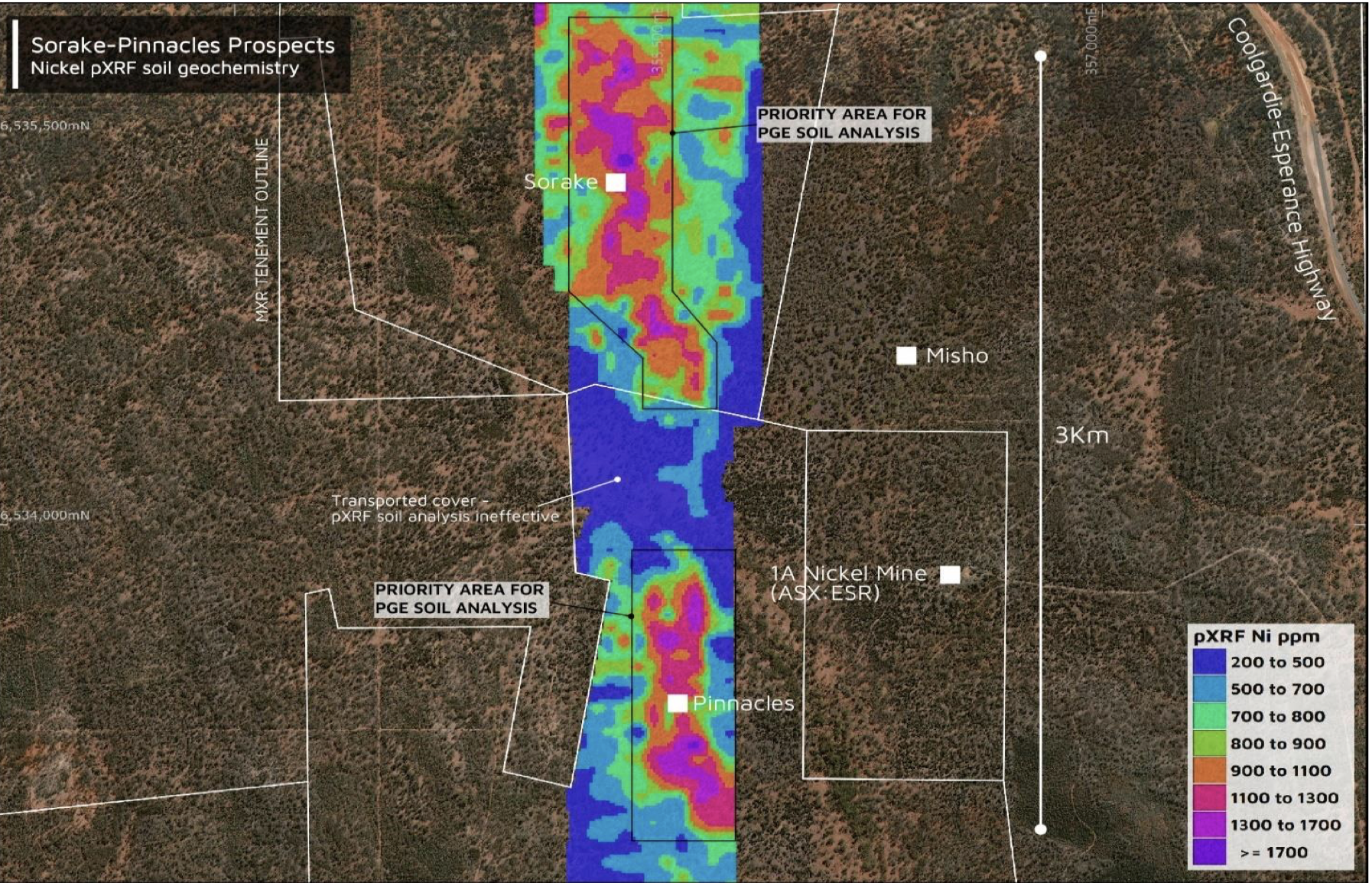
Pinnacles - Sorake Prospects location plan displaying Nickel pXRF soil geochemistry grid.
Historically, the Spargoville Project has seen limited geochemical sampling employing modern low-detection analytical methods, particularly PGE analysis, owing to the high costs traditionally associated with such techniques. The company recently conducted PGE soil sampling over areas that displayed anomalous nickel and copper concentrations, as identified by pXRF. This supplemental analysis aims to ascertain whether the nickel anomalies in the soil are sulphidic or lateritic in origin, thereby refining targets for future drilling.
Exploring for nickel sulphides at Kandui
Kandui features Kambalda-style nickel sulphide mineralisation situated within a sub-vertical ultramafic sequence. Recent field mapping has uncovered a series of stacked sub-parallel pegmatite intrusive bodies that penetrate the greenstone belt. These bodies are oriented in a northeast-southwest direction, with inclinations ranging from 20° to 30° towards the east.
Portable X-ray fluorescence (pXRF) analysis in the Kandui region identified a significant nickel-in-soil anomaly extending over a 2-kilometre distance. Following this, supplementary soil samples were collected along grid lines measuring 40 metres by 40 metres in the northernmost area of the prospect, where the anomaly is most intense. Assay outcomes showed pronounced PGE anomalism, with values reaching up to 65 parts per billion (ppb) of platinum and palladium.
The completed reverse circulation (RC) drilling program is designed to explore the existence of nickel sulphides beneath this PGE anomaly.
Follow up at the Central Nickel prospect
MXR intends to conduct additional reverse circulation (RC) drilling at the Central Nickel Prospect, building on earlier air-core drilling results announced on April 24, 2023. This prospect spans around 5 kilometres of high-potential ultramafic stratigraphy, positioned between Estrella Resources Limited's 1A nickel mine to the north and the Andrews Shaft / 5A / 5B nickel mines to the south.
The initial air-core drilling yielded anomalous PGEs at a stratigraphic level comparable to ground electromagnetic (EM) conductors situated along strike from the Andrews Shaft nickel mine.
This raises the possibility that unexplored legacy EM conductors might be linked to underlying nickel sulphides, particularly given the abundant PGEs discovered in the area. The forthcoming phase of RC drilling aims to probe the coinciding geochemical/EM target along the Andrews Shaft horizon at greater depths.
In addition to this, the company executed a preliminary PGE soil sampling program at the Central Nickel site. Soil specimens were gathered at 50 metres intervals along east-west grid lines, spaced 200 metres apart. This supplementary exploration has enhanced the understanding of the distribution of regolith pathfinder elements, thus fine-tuning the nickel sulphide targets for upcoming RC drilling.
What’s next?
MXR plans to broaden its close-spaced soil multi-element analysis to include several other promising ultramafic layers. This expansion encompasses additional soil sampling for PGEs at designated areas within the Kandui, Sorake, Pinnacles and Le-Bar Prospects.
The objective of the PGE sampling is to fine-tune the identification of fertile basal contact locations and prospective nickel targets across a wider region, thus facilitating more focused follow-up drilling.
Assay outcomes from the reverse circulation (RC) drilling initiatives at both the Hilditch Gold and Kandui Nickel prospects are expected within the forthcoming four to six weeks.