
Back to the Future Part II may have promised us a world of robot waiters and automated Pepsi dispensers from as early as 2015, but in the real world, numerous startups have tried unsuccessfully to integrate robotic technology into the modern-day hospitality sector.
It seems unreasonable, given that robots can already do everything from building cutting-edge electric vehicles to writing bogus articles saying fake tans are racist and ending up in the Irish Times.
But when it comes to flipping burgers and making milkshakes, automation has yet to take off.
In fact, despite the name and a promising trailer, Miso Robotics’ Flippy device gave up its dream of flipping burgers, settling for cooking French fries instead.
As one of the more recognisable names in robotic automation for quick-service restaurants (QSRs), Miso Robotics launched a European roadshow earlier this year, but little has been heard from the group since.
An April shareholder presentation was less than enthusiastic, with chief executive Mike Bell sounding apprehensive over Miso’s fundraising capabilities.
In August, Ocado-backed Karakuri, another robotic French fryer that once had ambitions of being a Japanese food dispenser, hung up its chef’s uniform and headed into administration, a bit like Gordon Ramsey tossing another head chef wannabe into the Hell’s Kitchen parking lot.
Let’s be real: Automated QSR technology hasn’t quite panned out the way Robert Zemeckis thought it would.
What’s the hold up?
While automated car factories and even Ocado’s high-tech grocery warehouses benefit from ample space, the logistics of retrofitting a bulky mechanical arm and associated electronic and computer equipment into a small kitchen have proved challenging at best, and infeasible at worst.
Furthermore, the value proposition does not seem to be there yet; operational and maintenance costs have yet to prove disruptive to underpaid hospitality staff.
In some ways, Flippy et al, without wanting to offend them, feel like a solution in search of a problem.
Yet that has not stopped another startup from throwing its hat in the automated QSR ring.
Incorporated this April, Kaikaku is the latest UK-based company attempting to realise the potential of automated QSRs.
Cracking the hospitality code
Kaikaku was co-founded by chief executive Josef Chen and chief technology officer David Sharp (who was formerly head of Ocado’s autonomous mobility team), who reckon they can succeed where others have failed.
Recent history is certainly against them, although Chen and Sharp are taking a different approach to automated QRS technology.
Kaikaku has designed an entire store prototype with a view to go live in Central London next year.
Herein lies Kaikaku’s pitch: Instead of clumsily retrofitting bulky robots into existing food chains, the group is aiming to grow its own chain of QSRs from scratch, the advantage being that the QSRs will be designed around robotics, not the other way around.
Barring flowchart designs, Kaikakau’s restaurant design and branding remain under lock and key, though Chen told Proactive that its QSRs will be focused on healthy bowls, juices and coffees (i.e., things robots can easily make en masse).
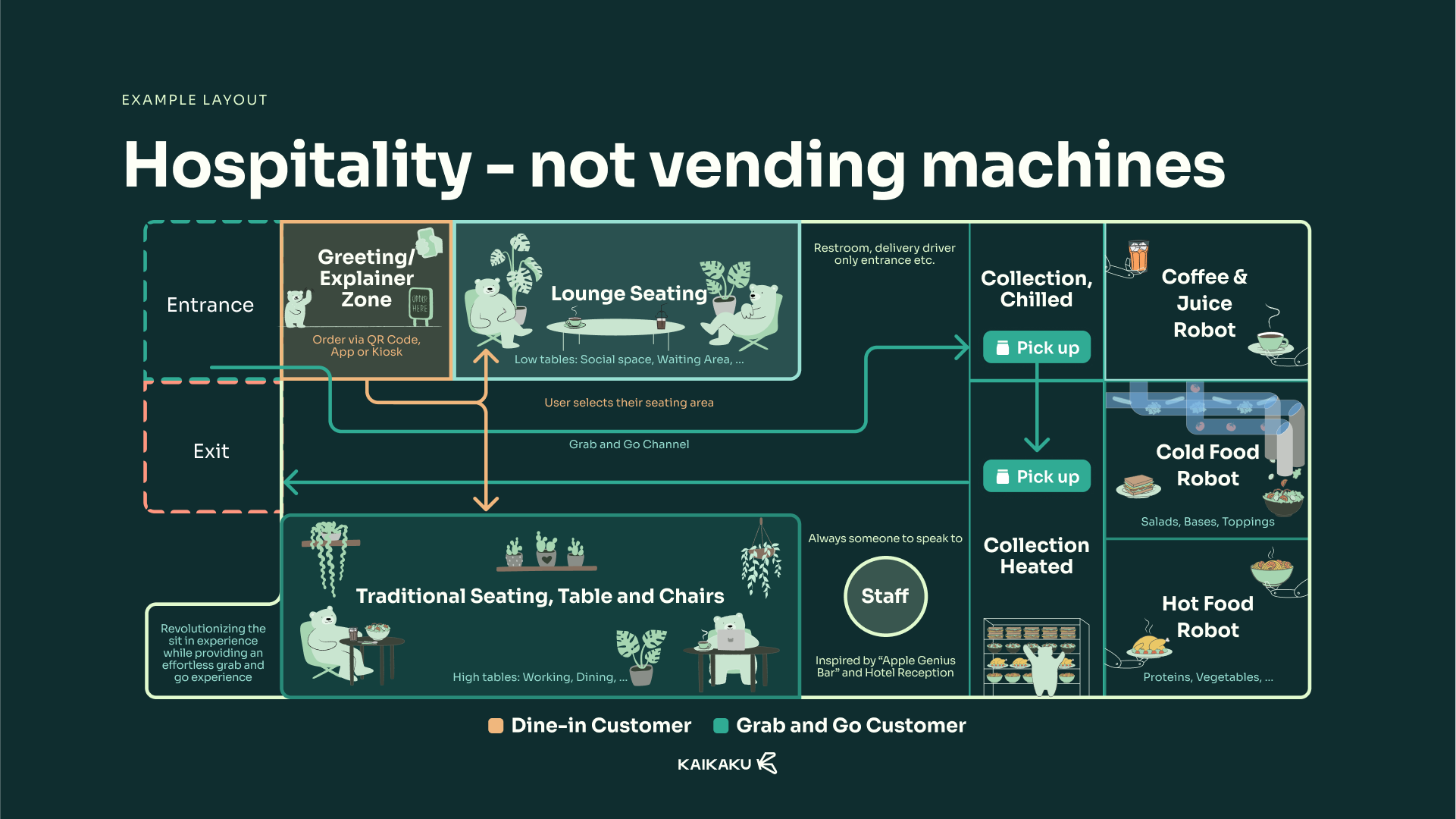
The restaurant of the future, a la Kaikaku – Credit: Kaikaku
It sounds cool, yet also quite clinical. The human element is all part of the eating-out experience after all, right?
Chen agreed. “We don't want to create a vending machine. We want to create a hospitality experience,” he stated, while noting that other startups in this field have “over-engineered the process”.
None of these startups, whether that be Miso or the admittedly cool Cafe X coffee bar in San Francisco, have cracked the hospitality code, reckoned Chen, “and none of them has created a genuinely good experience where you go there and want to go back”.
Chen envisions Kaikaku’s QSRs to be something like the Apple Genius Bar- hi-tech yet people-led, stating: “You will see you will see the robots but they will not be the centre of it.”
How very hierarchical. Regardless, could Kaikaku finally discover the problem to the automated QSR solution?
Hopefully, we’ll find out if and when the concept goes live somewhere in Central London, at some point next year.