
- FTSE 100, up 27 points at 7,466
- House prices fall at fastest pace since 2009
- US markets rise after mixed employment report
4:40pm: FTSE finishes on front foot
London’s blue-chip benchmark closed the 4-day trading week with a 25 point gain, up 0.34%, at 7,464.
3:50pm: US manufacturing sector contracts less than feared
The US manufacturing sector contracted significantly in August, but came in better than anticipated, according to the latest figures from S&P Global.
The headline manufacturing purchasing managers' index remained below the 50.0 no-change mark in August at 47.9 points, indicating a contraction and accelerating from 49.0 in July.
The August figure however outperformed FXStreet-cited consensus, which expected a contraction to 47.0 points.
This deterioration was driven by a further decline in new orders, S&P Global said.
"US manufacturers reported another tough month of trading in August. Output has fallen back into decline after a brief respite in July amid an increasingly steep deterioration in order books. Orders are in fact falling faster than factories are cutting output, suggesting firms will need to continue scaling back their production volumes into the near future," said Chris Williamson, chief business economist at S&P Global Market Intelligence.
3:10pm: Bank of America fears UK inflation could become entrenched
Bank of America believes the UK has an entrenched inflation problem which it thinks will lead to interest rates staying higher though 2024.
In a research note, economist Robert Wood pointed the UK has faced four supply shocks - energy prices, supply chains, Brexit, workforce sickness – which have caused weak UK potential growth.
This is how no growth since 2019 has resulted in strong domestic inflation pressure, he said.
“In our view that inflation pressure is now entrenched to a degree, as the structural economic changes combined with high inflation have modestly deanchored inflation expectations,” he continued.
To fight entrenched inflation the Bank of England will have to keep growth weak with restrictive interest rates, Wood thinks.
“With headline and core inflation now falling we expect only one more rate 25bp rate hike in September,” he said, adding, “but we expect the BoE to hold rates at that 5.5% terminal through end-2024.”
“We see risks to that terminal rate skewed up,” he added.
Wood pointed out that even with unemployment rising, recruitment difficulties easing, and growth weak, inflation persistence has worsened.
Services inflation continues to annualise close to 8%, private wage growth has again far exceeded BoE forecasts and runs at 8.2% excluding bonuses, he pointed out.
The BoE argues a variety of structural changes can help explain this, and those changes do not necessarily imply risks of higher inflation ahead.
But Wood noted the argument the BoE doesn't consider in view is that inflation expectations may have somewhat deanchored.
“We see evidence in favour of that as part of the explanation for inflation/wage surprises.”
“This suggests risks to BoE interest rates remain skewed up,” he concluded.
2:45pm: Bright start across the pond
US stocks have opened higher after employment data supported hopes that US interest rates have peaked.
Shortly after the opening bell the Dow Jones Industrial Average was up 0.5% at 34,893.62, the S&P 500 was up 0.4% at 4,527.44 and the Nasdaq Composite was up 0.1% at 14,040.14.
Non-farm payrolls for August came in above expectations, but July's figure was revsied downwards, while the unemployment rate jumped.
Average hourly earnings surprised on the downside in further good news for the US central bank.
Ian Shepherdson at Panrheon Macroeconomics described the payrolls figure as "trivially above the consensus."
He said: "The big surprise here is the jump in the unemployment rate, which is - unusually - statistically significant."
"The hourly earnings numbers also surprised in the right direction for the Fed, with the 0.2% increase following back-to-back 0.4% gains."
"These hefty increases are out of step with surveys and other indicators pointing to slower wage gains, so we think it likely that the August print marks the start of a renewed softening," he added.
"More immediately, this report clearly increases the pressure on the Fed not to hike this month, and it would now take horrific PPI and CPI data to trigger action. We remain of the view that the Fed is done, and that the next move will be an easing, as soon as next March."
1:48pm: August non-farm payrolls strong, but July revised down
The non-farm payrolls figures are out and it is a mixed bag.
The US economy added 187,000 jobs in August, ahead of forecasts of 170,000, although July's number was revised down to 157,000 from an original reading of 187,000.
The rate of unemployment rose unexpectedly in August to 3.8%, surprising economists who had predicted it would remain unchanged at 3.5% but growth in average hourly earnings surprised on the downside.
Average hourly earnings rose 0.2% in August compared to July, below the 0.3% expected, although annual growth of 4.3% was in line with expectations.
The figures from the US Bureau of Labour Statistics showed employment continued to trend up in health care, leisure and hospitality, social assistance, and construction. Employment in transportation and warehousing declined.
In August, the labor force participation rate rose by 0.2 percentage point to 62.8 percent, after being flat since March.
1:45pm: August payrolls strong but July revised down; unemployment rate jumps
The non-farm payrolls figures are out and it is a mixed bag.
The US economy added 187,000 jobs in August, ahead of forecasts of 170,000, although July's number was revised down to 157,000 from an original reading of 187,000.
The rate of unemployment rose unexpectedly in August to 3.8%, surprising economists who had predicted it would remain unchanged at 3.5% but growth in average hourly earnings surprised on the downside.
Average hourly earnings rose 0.2% in August compared to July, below the 0.3% expected, although annual growth of 4.3% was in line with expectations.
The figures from the US Bureau of Labour Statistics showed employment continued to trend up in health care, leisure and hospitality, social assistance, and construction. Employment in transportation and warehousing declined.
In August, the labor force participation rate rose by 0.2 percentage point to 62.8 percent, after being flat since March.
1:00pm: ONS revisions mean UK no longer the G7 laggard
Some reaction to the ONS revisions which seem to have altered the narrative of how the UK was perceived to have performed during the pandemic.
Simon French at Panmure Gordon commented: said "the entire UK economic narrative - post pandemic - has just been revised away."
I am a big fan of @ONS & recent improvements but as @ChrisGiles_ has flagged this AM the entire UK economic narrative - post pandemic - has just been revised away. Every "UK not back at pre-CV-19 level" headline now obsolete. "UK bottom of the G7" no longer true. Extraordinary pic.twitter.com/hThbgvnJSo
— Simon French (@shjfrench) September 1, 2023
He said every "UK not back at pre-CV-19 level" headline was now obsolete and "UK bottom of the G7" was no longer true.
"Extraordinary," he said.
Chris Giles at the Financial Times has helpfully shown how the revisions impact the UK's place in the economic leaderboard.
Quite the UK GDP revision today - hugely higher level - almost 2% up
- ONS found stockbuilding down the back of the sofa in 2020
- and foud wholesale and health services much stronger than expected in 2021
Means the UK is not a global outlier any more.... pic.twitter.com/Sc621UWPrn
— Chris Giles (@ChrisGiles_) September 1, 2023
12:15pm: Octopus Energy agrees purchase of Shell Energy UK and Germany
Octopus Energy Group has bought Shell's household energy supply business in the UK and Germany, taking on two million new home energy and broadband customers, it said in a statement.
The deal takes Octopus to nearly 6.5 million household customers in the UK, while its customer base in Germany will grow to almost 300,000.
The move comes after a competitive process run by Shell and includes 1.4 million household energy customers and 500,000 broadband customers, a statement said.
As part of the agreement, Shell and Octopus Energy have also signed a memorandum of understanding to explore a potential international partnership.
The companies are planning to bring the best possible experience to their EV charging customers, including for Shell Recharge and Octopus Electroverse subscribers.
Options will be explored for possible joint promotions, brand activations and other activities across the EV value chain.
No financial details were disclosed.
12:00pm: US futures rise ahead of non-farm payrolls
It's midday amd time to look ahead to events across the pond where it is Jobs Report day.
US stock futures are pointing to a bright start on Wall Street although much will depend on the non-farm payrolls released before the opening bell.
In pre-market trading, futures for the Dow Jones Industrial Average were 0.4% higher, while those for the S&P 500 rose 0.3%, and contracts for the Nasdaq 100 futures were up 0.2%.
The pace of job creation in the US is expected to have slowed in August’s non-farm payrolls report.
Economists forecast that the economy added 170,000 jobs, down from 187,000 in July. The unemployment rate is expected to have remained flat at 3.5%.
Ipek Ozkardeskaya at Swissquote Bank said a “softer than expected NFP figure, a slight deterioration in the unemployment rate, or softer-than-expected wages data could further cement the idea that the Fed will skip a pause at the September meeting, and maybe at the November as well.”
Data this week on the jobs markets has mostly showed that interest rates rises are feeding through to a weaker labour market.
Job vacancy and ADP private payroll figures were below expectations although the weekly jobless claims data proved resilient once more.
Elsewhere, the health of the manufacturing sector will be in the spotlight with The Institute for Supply Management’s manufacturing purchasing managers’ index expected to record a reading of 47 in August, up from 46.4 in July.
11:25am: UK economy performed better during Covid than thought, says ONS
The UK economy performed better than was previously thought during the Covid pandemic, according to the Office for National Statistics.
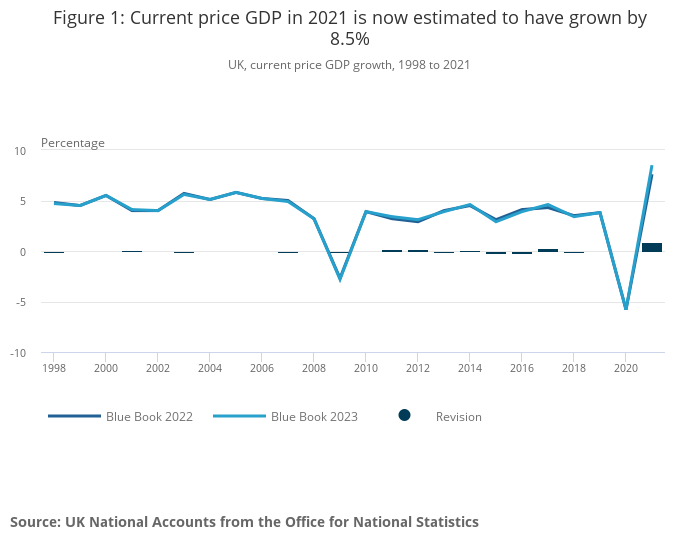
The ONS said its annual examination of previously published data, the Blue Book, showed that by the end of 2021, the UK economy was 0.6% larger than pre-pandemic levels versus the 1.2% contraction shown in the original data.
It revised gross domestic product (GDP) growth in 2021 0.9 percentage points to an 8.5% increase which follows an unrevised fall of 5.8% in 2020.
10:41am: Manufacturing downturn becoming more marked
Martin Beck, chief economic advisor to the EY ITEM Club says the S&P manufacturing survey "signalled that the sector's downturn is becoming increasingly marked."
He pointed out the forward-looking balances of August’s survey "remained largely downbeat," with respondents reporting "a steeper fall in new business, with demand falling both at home and from abroad."
"This suggests that the manufacturing output balance could yet fall further in the near-term," he thinks.
He did note some grounds for optimism on the inflationf front with input costs down for the fourth consecutive month on the back of lower energy and raw material prices. Output price inflation also cooled slightly, he added.
While he believes the MPC will focus on persistent inflation at its next meeting, "growing evidence of a weakening economy and disinflationary pressure mean the possibility that the MPC will choose to keep rates unchanged is looking more plausible.”
10:23am: Manufacturing sector hits 39-month low - S&P
The UK manufacturing sector hit a 39-monh low with rates of contraction in output and new orders among the steepest registered outside of events such as the global financial crisis or COVID-19 pandemic, according to new figures.
The seasonally adjusted S&P Globa CIPS UK manufacturing purchasing managers' index stood at 43.0 in August, down from 45.3 in July but above an earlier flash estimate of 42.5.
August saw the #UK manufacturing sector sink into a deeper downturn (#PMI at 43.0; Jul: 45.3), with rates of contraction in output and new orders among the steepest registered outside of the global financial crisis and pandemic. Read more: https://t.co/qMn1MLURm6
— S&P Global PMI™ (@SPGlobalPMI) September 1, 2023
Falling further below the 50.0 no-change mark, it shows the contraction in the UK manufacturing sector worsened last month, reaching its lowest level since May 2020.
Companies mentioned slower market conditions, declining new order intakes and efforts to reduce inventories of finished goods as factors underlying the latest contraction.
"Another substantial fall in manufacturing activity, contracting for the sixth month in a row and the fastest rate since May 2020, showed that these are tough times for manufacturers," said John Glen, chief economist at the Chartered Institute of Procurement & Supply.
9:54am: Next picks up Warburg Pincus' stake in Reiss for £128 million
Next PLC (LSE:NXT) and the Reiss family have agreed to buy Warburg Pincus' 34% interest in Reiss for £128 million.
The deal, which is expected to complete in mid-October, will see Next's holding in the Reiss business increase from 51% to 72%.
The acquisition will not materially impact Next's underlying pre-tax profit or EPS in the current year, the retailer said, although there will be a non-recurring, non-cash, exceptional gain reflecting the increased value of its investment in Reiss.
Next said it would proide further details alongside half year results in September.
Following completion of this transaction, Reiss's results will be consolidated into the Next accounts.
In the year to 28 January 2023, Reiss achieved total sales of £324.6 million, an increase of 26.4% on the prior year. Profit before tax in the same period was £51.6million, an increase of 50.5% on the prior year.
9:24am: A further leg down in house prices ahead - Capital Economics
Andrew Wishart, senior property economist at Capital Economics, thinks the large monthly fall in house prices in August confirmed “that the further leg down in house prices that we have been forecasting has begun to materialise.”
“With mortgage rates likely to remain around current levels for another 12 months, we expect prices to continue to fall until mid-2024, taking the total drop in house prices since their August 2022 peak from 5.3% now to 10.5%,” he said.
“With mortgage rates set to remain between 5.5% and 6.0% for the next 12 months, and second-hand supply on the market becoming less tight, we think the August data marks the start of a significant further drop in house prices,” Wishart believes.
Indeed the RICS survey, which is the best leading indicator of house prices, is consistent with house prices falling by a similar amount month-on-month for the next five months at least, he pointed out.
9:10am: Johnson Matthey jumps as Standard Investments doubles stake
Leading the risers in the FTSE 100 is specialty chemicals maker Johnson Matthey PLC, which had its exit from the FTSE 100 confirmed this week.
But today it is up by around 13% after Standard Investments nearly doubled its stake in the business to 10.1% from 5.2%.
It is the investment arm of industrial group Standard Industries.
Melrose Industries is up 1.8% as Swiss bank UBS reiterates a buy rating and lifts its price target to 665p from 640p.
Barclays PLC (LSE:BARC) is also on the rise, up 0.9%, following reports on Bloomberg that the lender is looking at pushing more heavily into the private credit markets.
Admiral PLC is down 0.9%, possibly following the news Direct Line expects a £30 million charge from over charging customers while the house price fall has hit Persimmon PLC (LSE:PSN), down 0.9%.
Over in the FTSE 250, and Mobico PLC is down 1.6% after RBC lowered its price target to 145p from 180p although it has stuck with its outperform rating.
8:40am: Mike Ashley's picks up more Boohoo stock
The FTSE 100 has extended its early gains, now up 28 points at 7,467.
Away from the blue-chips and shares in Boohoo Group PLC (AIM:BOO) have risen a further 7.1%, following gains on Thursday, after Frasers Group, the Mike Ashley-controlled owner of Sports Direct, increased its stake in the online fast-fashion retailer to more than 10%.
Frasers now owns 10.4% of Boohoo, with the news coming a day after the retailer disclosed it had raised its stake 9.1% from 7.8% before.
Frasers has been picking up shares in a number of other UK retail names this year, including Asos and electronics retailers Currys and AO World.
Russ Mould at AJ Bell on Thursday said: "Mike Ashley-founded Frasers has developed a reputation for being a vulture – picking at the bones of businesses when they are down."
Asos is also on the move with shares 3.0%. Frasers holds a stake of around 19% in them as well.
8:15am: Bright start for blue chips despite housing data
The FTSE 100 has opened higher shrugging off the latest downbeat assessment of the UK housing market.
At 8:15am, London's lead index was up 14.64 points, 0.2%, at 7,453.77 while the FTSE 250 fell 38.59 points, 0.2%, at 18,567.11.
Building society Nationwide reported house prices contracted at the fastest annual pace since 2009 as the impact of higher interest rates hit the property market.
The average house price fell 5.3% in August compared with the same month last year, down from a 3.8% contraction in July and the sharpest fall since July 2009, the lender’s monthly house price index showed.
Robert Gardner, Nationwide’s chief economist, said the “softening is not surprising, given the extent of the rise in borrowing costs in recent months.”
The EY ITEM Club said the “unexpectedly large” fall in prices showed “the impact of rising interest rates is building.”
But it thinks the decline “should prove more of a slow puncture than a serious correction.”
Nonetheless, the economic thinktank “expects house prices to continue to deflate over the rest of this year and into 2024.”
Direct Line Insurance Group PLC (LSE:DLG) fell 1.9% after it estimated the cost from over charging customers for insurance products would be £30 million.
Under rules introduced last year, insurers have to charge existing customers the same as they would charge new customers.
But today, the insurer said it had failed to comply with the rules.
7:50am: Direct Line faces £30 million bill from over charging
Direct Line Insurance Group PLC (LSE:DLG) expects to pay around £30 million as it continues to carry out a review of past business after admitting charging some customers too much for their home and motor cover.
The insurer said the review follows the implementation of the FCA pricing practices regulation from January 1, 2022.
Direct Line said an error in its implementation of these rules meant its calculation of the equivalent new business price for some customers failed to comply with the regulation.
As a result, those customers have paid a renewal price higher than they should have.
Redress will be paid to any affected policyholder, the firm said, with the current estimate of these payments in the region of £30 million of which half was provided for within the group's 2022 full year results.
7:37am: House prices fall at fastest rate since 2009
UK house prices contracted at the fastest annual pace since 2009 as the impact of higher interest rates hit the property market, according to data from building society Nationwide.
The average house price fell 5.3% in August compared with the same month last year, down from a 3.8% contraction in July and the sharpest fall since July 2009, the lender’s monthly house price index showed.
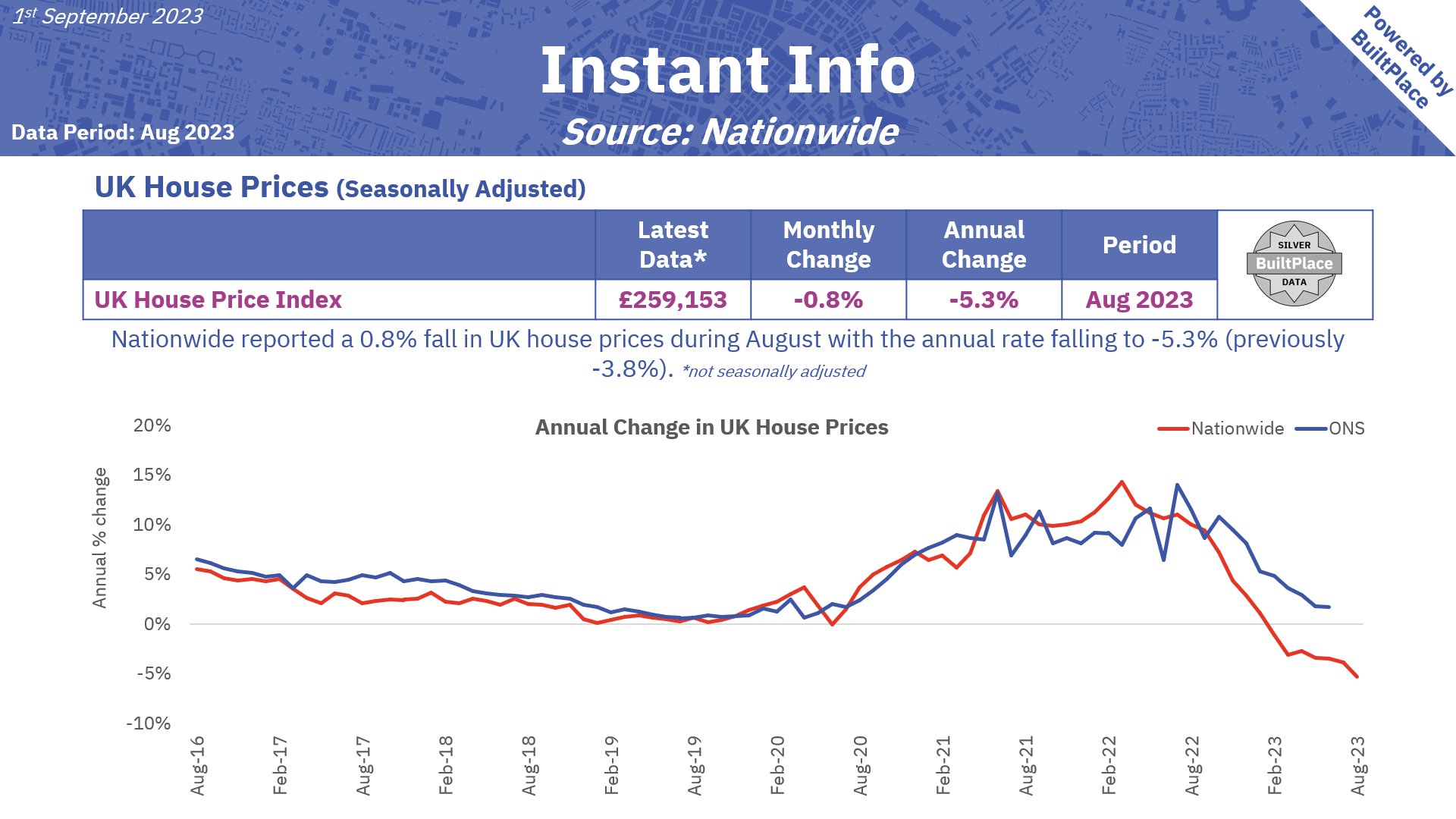
House prices were down 0.8% between July and August, taking the average property cost to £259,153, down from a recent peak of £274,000 in August last year.
Robert Gardner, Nationwide’s chief economist, said the “softening is not surprising, given the extent of the rise in borrowing costs in recent months, which has resulted in activity in the housing market running well below pre-pandemic levels.”
He pointed out “mortgage approvals have been around 20% below the 2019 average in recent months and mortgage application data suggests the weakness has been maintained more recently.”
But he thinks a “relatively soft landing is still achievable, providing broader economic conditions evolve in line with our (and most other forecasters’) expectations.”
Gabriella Dickens at Pantheon Macroeconomics thinks house prices “will have further to fall a little bit further to bring demand back in line with supply.”
“Admittedly, mortgage rates have started to tick down, but we doubt they will fall as far as they did this spring, given bank Rate looks set to top out at 5.5%,” she said.
7:25am: GSK's new drug application for Nucala accepted for review in Japan
Kicking off Friday with news from pharmaceutical giant, GSK.
The FTSE 100-listed firm said Japanese authorities have accepted for review a supplementary new drug application (sNDA) for Nucala, a treatment for chronic rhinosinusitis with nasal polyps in adult patients.
If approved, Nucala would be the first anti-interleukin-5 biologic available in Japan for the treatment of adults with inadequately controlled chronic rhinosinusitis with nasal polyps, the firm said.
This would be the third indication for mepolizumab in Japan for an IL-5 mediated condition, it said.
The sNDA is based on results of the pivotal phase III Merit trial which studied the efficacy and safety of mepolizumab over a 52-week period in a population of Japanese, Chinese and Russian patients.
In the trial, the co-primary endpoints were met, and the efficacy and safety of mepolizumab in the Japanese population were consistent with results from global trials.
7:05am: FTSE seen higher ahead of non-farm payrolls
Good morning from the Proactive team. The FTSE 100 is set to open higher on Friday after fading into the close on Thursday and as investors eye non-farm payrolls figures as well as a batch of manufacturing PMI releases.
Spread betting firms are calling the lead index up by around 20 points after closing down 34.54 points at 7,439.13 on Thursday.
In New York on Thursday, stocks ended mixed, with the Nasdaq extending its winning run to five days but the S&P 500 and DJIA fell back.
Ipek Ozkardeskaya at Swissquote Bank notes the US economy is expected to have added around 170,000 new nonfarm jobs in August.
“Today, a softer than expected NFP figure, a slight deterioration in the unemployment rate, or softer-than-expected wages data could further cement the idea that the Fed will skip a pause at the September meeting, and maybe at the November as well,” she believes.