
Is it as grim as it seems for the City of London right now?
Perhaps not, according to the London Stock Exchange’s recent capital markets update for the first half of 2023.
Despite a desperate six months for IPOs, £11bn in funds was raised through public offerings on the LSE.
This is only 24% lower than 2022 volumes in their entirety, with six months still to go.
This is also a significantly better figure than global capital markets volumes, which are down 49% year to date against 2022 total volumes.
London has also outpaced New York, which is down 34% in year-to-date volumes against 2022 total volumes across the New York Stock Exchange and Nasdaq.
As you would hope, London was the most active equity market in Europe, with 1.6 times more transactions completed compared to Stockholm, which was the next most active market.
In total, the LSE saw 179 transactions, yet only a handful of these were IPOs, with the vast majority of 161, or 90% of all transactions, comprising follow-on transactions.
In terms of raw sterling value, follow-on transactions constituted £10.4 billion, or 94%, of the total transaction value.
Shareholders cash out
Though a surprisingly strong figure, the £11bn in equity capital markets deals was flattered by at least £4.7 billion worth of cross trades between investors in the London Stock Exchange Group PLC (LSE:LSEG) itself, interestingly.
Blackstone and Thompson Reuters (TSX:TRIL) disposed of their £4.7 billion worth of LSEG stock following an end to their lock-up period starting in 2021 when they sold financial data firm Refinitiv to LSEG.
Since LSEG itself was not responsible for, nor did it net any rewards from, these cross trades, some may raise their eyebrows at them being included in total equity capital markets volumes.
It is also worth noting that New York’s volumes are expected to be heavily weighted to the second half, for a reason that will provide a sober reality check to the Square Mile.
SoftBank-owned Arm Holdings Inc, Britain’s prized semiconductor giant, is gearing up for what will likely be one of the biggest IPOs of the year, and potentially the largest of all time for a British tech company.
Sadly for the Square Mile, SoftBank has chosen New York over London to IPO Arm. This deal alone could add as much as US$70 billion (£55.3 billion) in volumes for the US capital markets in just one transaction.
Is London really less liquid than New York?
Apparently not, according to Tom Stenhouse, head of securities trading at LSEG.
Liquidity is essential for a healthy, low-spread, low-volatility equities market, something the London Stock Exchange has historically lacked, at least per common wisdom.
However, “the misconception of a liquidity differential between the UK and US can sometimes be driven by comparisons across different market structures and incomplete analysis when comparing trading volumes, despite easily available data”, stated Stenhouse.
Raw trading volumes are naturally significantly higher in the US- not surprising given the US stock market comprises nearly 60% of global equities.
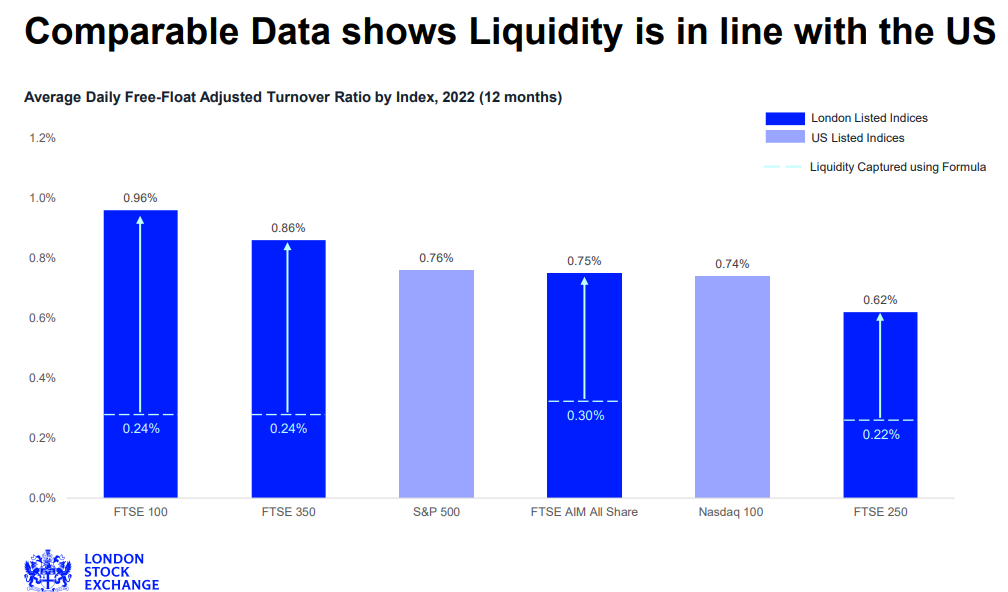
But when using like-for-like liquidity comparatives, as Stenhouse did, the relative liquidity between New York and London is broadly on par.
As part of his analysis, Stenhouse considered the depth of liquidity across all execution venues including over-the-counter (OTC), not just the primary exchanges used to determine ‘on-screen’ liquidity values on a Bloomberg or Refinitiv terminal.
The data presented here suggest that the FTSE 100 blue-chip index is actually more liquid than the Nasdaq 100, while liquidity across the gamut of small, mid and large-cap equities is broadly equal on both sides of the pond.
This analysis comes with a caveat, potentially quite a significant one.
Those OTC trades included in Stenhouse’s analysis, by their nature, do not necessarily contribute to price discovery, nor are they open to all market participants.
Proactive has reached out to LSEG to contribute to this article.