
- FTSE 100 adds 58 points
- Nasdaq weak after tech earnings, but Dow holds firm
- easyJet posts record quarterly profit
4.45pm: FTSE closes near its high
London's FTSE 100 closed near the day's high point, adding 0.8% to 7,646 as it shrugged off disappointing earnings in the US from the likes of Netflix and Tesla.
“Yesterday the leaderboard in London was dominated by the housebuilders. Today it is the turn of the mining sector, along with Burberry, with something of a China theme emerging during the session," commented IG senior market analyst Axel Rudolph.
"While the rebound in that economy has slowed, the general improvement in global economic data has investors hoping that China’s numbers will pick up too, and miners are likely to be prime beneficiary of such a development.”
By the London close, US markets were mixed. The Dow Jones Industrial Average had gained 0.8% to 35,343, but the S&P 500 slipped 0.2% to 4,556 and the tech-heavy Nasdaq Composite shed 1.1% to 14,202.
4.00pm: Further data drop
With half an hour of trading to go in London, the FTSE 100 index remained buoyant, albeit off session highs, extending Wednesday’s gains which followed the bigger-than-expected fall in UK inflation in June.
The gains came in spite of a mixed performance across the Atlantic. with the tech-laden Nasdaq Composite dropping back after earnings disappointments from Netflix and Tesla, although the Dow Jones Industrials Average pushed higher having posted eight consecutive sessions of gains since weaker US inflation data last week.
The latest US data came in much as expected, with June existing home sales down 3.3% to 4.16mln, just below the consensus forecast of 4.20mln.
Kieran Clancy, senior US economist at Pantheon Macroeconomics commented: “Existing home sales continue to bounce around the cycle low, and mortgage applications signal no improvement over the next couple months. The fundamental issue in the existing home market is that most homeowners are financed at extremely low interest rates—the average rate on outstanding mortgages stood at 3.9% in the first quarter—but the prevailing mortgage rate currently is a little under 7%. Anyone wishing to move, therefore, faces a huge jump in their monthly mortgage payment, unless they trade down considerably, so most people are staying put unless they are forced to move for family or work reasons. The discretionary market is dead, and nothing will change until mortgage rates fall sharply.”
He added: “The number of existing homes for sale remained at 2.8 months of sales for the fourth straight month, significantly below the pre-Covid trend of a little over four months. The lack of homes coming to market is preventing any downward adjustment in prices, despite the collapse in demand since the Fed started raising rates last year. The monthly existing home price numbers are extremely noisy, but the sideways trend over the past year or so is clear.”
3.45pm: Crude moves
Oil prices pushed higher on Thursday afternoon on hopes for improved future demand, though a lower-than-expected drop in US crude inventories squeezed the supply picture.
UK Brent was 0.7% higher at $79.37 a barrel, while US West Texas Intermediate (WTI) crude added 0.5% to $75.81 a barrel.
The Organization of the Petroleum Exporting Countries and the International Energy Agency have both said that demand from China is expected to continue to rise in the second half of this year and remain the main driver of global growth in spite of recent weak growth data from the Communist country.
China's imports of crude oil from Russia hit an all-time high in June, Chinese government data showed on Thursday, even as discounts against international benchmarks narrowed.
However, analysts at Citi believe crude prices may struggle to find a clear direction in the near term given the current global demand outlook is "a mixed picture with stronger gasoline and jet fuel demand, but weaker petchems and diesel”.
Brent crude prices have broken through to a higher range this month, after being stuck around $72-$78 in May and June, the Citi analysts added, as Saudi output cuts and geopolitical risks supported demand.
3.25pm: Investors bullish on gold
New research out today from BullionVault says half of private investors (49.5%) forecast the price of gold will increase by 10% by the end of the year, to around $2,125 per troy ounce.
Some are even more bullish; 15% believe the price will increase by 20%, while one in five (21%) predict no change. That gives a consensus outlook for gold to end 2023 at $2,110.
BullionVault currently cares for £3.1 billion of precious metals for more than 100,000 users worldwide, almost 90% of them living in the UK, Europe or North America. Its latest customer survey – now run twice a year since 2014 – polled over 1,440 responses from private investors saying, on average, that they currently hold four-fifths of their investable wealth in other assets besides precious metals.
Adrian Ash, director of Research at BullionVault, commented: "Gold tends do well when other assets perform poorly. With the precious metal continuing to outpace the FTSE and global stock markets since the eve of the terrible shocks from Covid and then inflation, private investors remain confident in gold's role as portfolio insurance.
"Because gold pays no income, rising interest rates could present a headwind to the bullion market. But gold shrugged off rising interest rates in the first half of 2023 to reach new all-time highs in terms of all major currencies, including the Pound.”
3.05pm: European IPOs stirring
Bankers at Bank of America Corp. (BofA) have highlighted a slow revival in the European IPO market, Bloomberg has reported, although a deal rush is some way off,
BofA noted that European transactions have accelerated in the past month, with low market volatility having contributed to a gradual reopening.
Nearly 40% of the roughly $9.5 billion in IPO proceeds that European exchanges have clocked so far this year was raised in the last month alone, according to data compiled by Bloomberg.
2.45pm: Wall Street wobbles
The FTSE 100 index held firm just off session highs in afternoon trading as US stocks started mixed, with the Nasdaq giving back some of its recent gains after mixed tech earnings overnight from Netflix and Tesla, but the Dow Jones Industrials Average (DJIA) pushing higher once more.
Around 15 minutes after the New York open, the DJIA had added 151 points, or 0.4% to 35,212, while the S&P 500 rose 0.1%, but the Nasdaq Composite dropped 0.4%.
The day’s US data saw the Philly Fed index rise only slightly to -13.5 from -13.7 in June, while initial weekly jobless claims dipped unexpectedly to 228,000 from 237,000.
Ian Shepherdson, chief economist at Pantheon Macroeconomics commented: “The stability of the headline Philly Fed hides bigger moves in some of the components. New orders fell 5.9 points to -15.9, the lowest since April, while shipments plunged 22.4 points to -12.5, the lowest since March. Capex plans for the next six months dipped slightly but this follows a 15.3-point gain over the previous two months, so it looks like the trend has bottomed, albeit at a low level. Finally, prices paid dipped slightly but prices received rebounded to 23.0 from 0.1, hitting its highest level since January.
“This is hard to explain in the context of the continued softness in prices paid, and it likely won’t last. All the subindexes are volatile and its best to look at the five regional Fed manufacturing surveys - Philly Fed, Empire State, Dallas, Kansas City, and Richmond - as a group rather than individually. The big picture here is that manufacturing is still struggling under the weight of higher rates and tighter credit conditions, and has seen no benefit from the weak recovery in China.”
He added: “The dip in initial jobless claims to a two-month low is a surprise but we have repeatedly argued in recent weeks that the data have to be viewed with extreme skepticism in July and early August because shifts in the timing and extent of the automakers’ annual shutdowns play havoc with the seasonal adjustments. At this point it is just not possible to know whether the dip in claims in the past couple weeks marks a real change or is just noise.
“Our guess is the latter, given the upward trend in Google searches for ‘unemployment benefits’ and other indicators, shown in our chart. It seems reasonable also to think that the impact of the shutdowns on unadjusted claims is smaller than usual this year as the automakers run production hot in order to rebuild inventories, but we won’t know for sure for another month or so.”
2.30pm: Hedge funds hedged
The European Union has reached a deal on revising its rules for managers of hedge funds and other alternative investments, Reuters has reported, easing industry fears of a post-Brexit crackdown on managers in London.
Representatives of EU states and the European Parliament reached the deal overnight to update the bloc's Alternative Investment Fund Managers Directive (AIFMD) rules that cover investments in hedge funds, private equity, private debt funds and real estate funds.
The agreement, which seeks to make it easier to invest in a broader range of assets to boost the EU economy, needs formal rubber-stamping by parliament and member states.
The European Commission proposed changes to AIFMD and to the Directive on Undertaking for Collective Investment in Transferable Securities (UCITS) - traditional funds that invest in stocks and bonds - in November 2021.
Under the agreement, European asset managers will have to disclose more details to regulators about their investments with private funds in the United States, Britain and other non-EU countries.
But it stops short of toughening up "delegation" rules for managers outside the EU that pick assets for funds listed in the bloc. London-based managers run many funds listed in Luxembourg and Dublin, and had been worried this could become harder after Brexit, Reuters noted.
2.15pm: US claims beat
The latest US initial weekly jobless claims have come in at 228,000, beating consensus expectations of 242,000. That is the lowest number since mid-May and has bought down the 4-week average from 246.75K to 237.5K.
Commenting on the claims which reflect the country's stubbornly tight labour market, Tom Hopkins, Portfolio Manager at BRI Wealth Management, said: "Today’s data is yet another example of the US economy's stubbornly tight labour market. Whilst the Fed decided to hold interest rates at the last meeting, Jerome Powell and many other FOMC members have reiterated that they expect that it will be appropriate to raise interest rates somewhat further by the end of the year.
"We believe the Fed will raise another 25-basis point rate at least over the coming months. It takes time for interest rate hikes to filter down into the real economy with many economists predicting layoffs to pick up in the second half of this year."
1.30pm: A quick glance at some of the movers in London
Fallers
Lookers - down 5.4% to 112.7p: Shares plunged as the London-listed car dealer announced shareholder Cinch intended to block its proposed sale. Having withdrawn a letter of intent to back Global Auto Holdings Limited's takeover of Lookers, 19.2%-stakeholder Cinch will now vote against the takeover. “Lookers is re-engaging with other shareholders to understand whether [resolutions] to implement the acquisition are capable of being passed,” Lookers said.
Lansdown Oil & Gas - down 30% to 0.12p: Shares were down as the micro-cap Irish oil firm announced up to £200,000 of equity funding. It intends to sell two tranches of new shares with an initial £60,000 raise, 60mln shares at 0.1p, alongside a conditional £140,000 to be raised at the same price, subject to shareholder approval at an EGM slated for 9 August.
Risers
GSTechnologies - up 76% to 0.86p: Fintech group GSTechnologies crushed it on the London Stock Exchange today following news of its acquisition of PAYPT Finance, a Canadian company holding a Canadian Money Services Business (MSB) licence, clearly impressed investors.
Babcock - up 11% to 350p: Babcock topped the FTSE 250 leaderboard on what seemed a mixed full-year results. Top-line numbers from the defence contractor were in line with expectations, said analysts at Liberum, though there was a £100mln hit on a Type 31 frigates contract with the Ministry of Defence, at the top of the previous guided range. The Type 31 contract is being delivered amidst a dispute with the MoD due to cost overruns.
1.11pm: FTSE hits intraday high
The Footsie has just notched a new intraday high, up 64 points at 7652 as Wall Street traders wake up and prepare for the opening bell in New York.
London's blue-chip benchmark has retreated slightly from that level but is still up 56 points or 0.7% at almost 7,645.
Looking to the US, the futures indications are mixed, with the Dow Jones heading for a 0.1% improvement that would mark its ninth positive session in a row if it can be maintained, while S&P 500 futures are pointing to a 0.1% dip and the tech-powered Nasdaq a 0.6% reverse.
As a reminder, the Nasdaq is up almost 40% so far this year, the S&P 20% and the Dow 6%.
Disappointment about earnings from Tesla and Netflix, among others, is behind the Nasdaq's expected retreat today.
More earnings are flowing on Thursday, with IBM mixed, Johnson & Johnson positive and United Airlines also impressing, Travellers, American Airlines and Blackstone are also among those reporting before the opening bell.
Three-quarters of the S&P 500 companies that have announced earnings so far have topped estimates, according to FactSet data, which has created optimism about a soft landing for the US economy.
With that in mind, investors will also be keeping an eye on the latest US weekly jobless claims numbers and existing home sales data due out today.
Market analyst Craig Erlam at Oanda says: "Equities have performed extremely well recently as economic data has been more promising and the banks kicked off earnings season positively. Perhaps that's just lifted expectations a little too much and we're seeing some profit-taking going into the end of the week."
12.40pm: CMA tells supermarkets to be clearer on prices
The UK competition regulator says high food price inflation is not down to "weak retail competition" but has demanded that supermarkets comply with its guidance on 'unit pricing', ie how much individual items cost, to allow shoppers to compare between different chains.
Further probing from the Competition & Markets Authority (CMA) will examine competition and prices across the supply chain for the product categories identified, with it adding that rules on unit pricing "should be tightened and retailers must comply".
Investigating for the past two months, the CMA said its assessment is that "retail competition is working in the UK grocery sector", particularly between big supermarkets such as Asda, Morrisons, Sainsbury’s and Tesco as well as discounters, including Aldi and Lidl.
"Although food price inflation is at historically high levels, evidence collected to date by the CMA indicates that competition issues have not been driving this," it said.
This was based on operating profits in the grocery sector falling 41.5% compared to last year, it said, while average operating margins fell from 3.2% to 1.8%.
"This is due to retailers’ costs increasing faster than their revenues, indicating that rising costs have not been passed on in full to consumers."
Now that some input costs are starting to fall (though global food prices have been falling for many months), the CMA said "there are some signs that grocery retailers are planning to start rebuilding their profit margins" and it promised to monitor this in the months ahead.
11.45am: Good news on mortgage rates
A crumb of better news for homeowners looking to remortgage, as the average two-year fixed rate fell for the first time in two months.
Rates fell to 6.79%, the first drop since late May, according to financial data provider Moneyfacts.
But this comes off Tuesday’s 15-year peak of 6.81%.
The fall in mortgage rates was sparked better UK inflation data, with the consumer price index softening to 7.9% in June from 8.7% in May.
This led to the market pricing a lower peak rate of BoE base rate, from 6.5% earlier in the week to 5.88%, which in turn, led to 2yr gilts yields ending the day 20bps lower (4.91%) while 10y rates declined 11.6bps (4.22%).
Consensus on the Bank of England rate peaks continues to shift.
Checking on the FTSE, the index is giving up some gains, up 43 points or 0.6% at 7631, with the FTSE 250 also up 0.6%.
Bank stocks are mixed, with Lloyds Banking Group PLC and NatWest Group PLC (LSE:NWG) both down 0.7%, Barclays PLC up 0.7%, HSBC Holdings PLC (LSE:HSBA) up 1.2% and challengers OSB Group PLC and Paragon Banking Group PLC (LSE:PAG) both up 1.6%, while Virgin Money UK PLC is down 0.2%.
11.20am: London tech bellwether leads fallers
Retail investor favourite Scottish Mortgage Investment Trust PLC (LSE:SMT) is one of the big fallers on the FTSE 100.
This is likely due to the fund's status as a tech bellwether and reflects a downbeat start to US tech earnings season, with numbers from Tesla, TSMC, ABB and Netflix providing things for the market to worry about.
Chip giant TSMC reported its first decline in profit in four years as demand for consumer electronics weakened, while Swiss-Swedish automation specialist ABB also warned of slowing Chinese demand.
Shares in Tesla and Netflix were also seen heading lower in pre-market trading, following disappointment on margins and revenues respectively.
IBM also reported mixed results, with software and services slowdown.
10.54am: Both FTSE indices strong, US earnings disappoint
Mid-morning and the FTSE 100 and 250 indices are roughly neck and neck, as the mid-cap index catches up.
The blue chips are up 54 at 7,642 and the mid-caps are now up 117 points at 19,440.
Babcock is topping the 250 leaderboard, up 10% after its results.
The defence contractor's full-year results were in line with expectations, though there was a £100mln hit on Type 31 frigates contract with the MoD, top of the previous guided range.
Chief executive David Lockwood said: "We've made excellent progress this year, with better-than-expected cash generation, margin expansion and double-digit revenue growth."
Broker Liberum, which fired a warning shot earlier in the week, noted that management has given first medium-term guidance, with sales growth of mid-single digits, margins of at least 8% and cash conversion of at least 80%.
"We will update our thoughts on valuation once we have had more time to digest the complex results. We note that the share price is ahead of where it was prior to the Type 31 news."
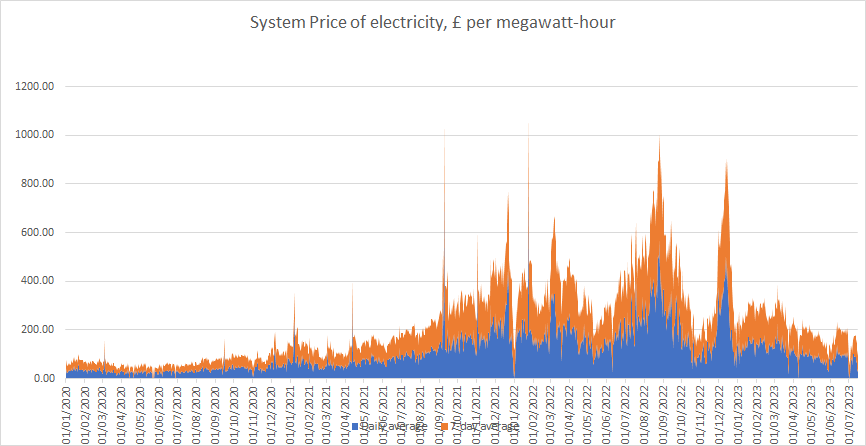
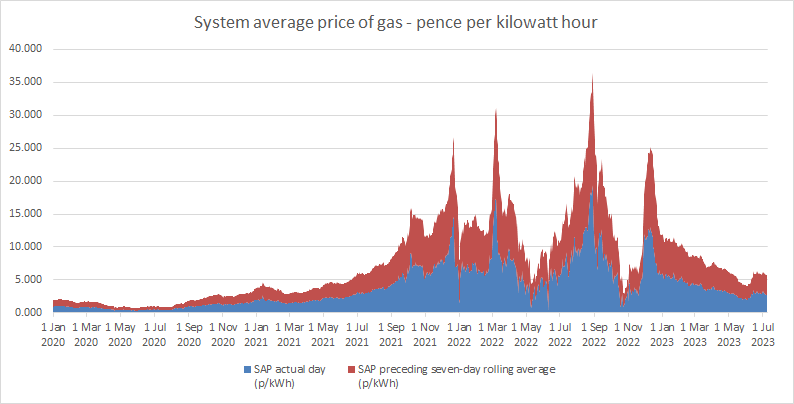
10.30am: Gas and electric prices still coming down
The Office for National Statistics has released another batch of timely "experimental data" and analysis on economic activity and social change.
These faster indicators are created using rapid response surveys, novel data sources and experimental methods, the ONS says.
One of them is the system average price (SAP) of gas and electricity, which fell when compared to the previous week, by 18% and 11% respectively.
Both are around 70% lower than the equivalent week of 2022, having trended downwards since the beginning of this year, according to data from the National Gas Transmission and Elexon.
Among the other data, there was an 8% decline in credit and debit card purchases, while retail footfall from Springboard also decreased, to 98% of the previous week. Revolut has also contributed to this scheme, and it revealed card spending from its customers increased by two percentage points.
Online job ads were down 6% compared to a year ago but up 1% from the previous week (via Adzuna), while the average number of daily UK flights was, at 6,160, the highest number since mid-October 2019 and 7% higher than the level seen in the equivalent week of 2022.
10.06am: Miners top the leaderboard
After yesterday’s spectacular session for UK stocks, Danni Hewson, head of financial analysis at AJ Bell, feels it is "refreshing" to see further gains today.
With the FTSE 100 having added 54 points or 0.7% to 7,642 and its mid-cap sibling putting on 0.3% to 19,384, London's heavy weighting of big miners are paving the way, with Anglo American top of the leaderboard, followed by Antofagasta, Glencore and Rio Tinto.
As well as Anglo reporting a surge in copper production, former Footsie constituent BHP also posted record full-year iron ore output and flagged rising costs.
More importantly for the wider sector, prices of most base metals were up, with Reuters reporting that this is on short covering following a report that the Chinese government is looking at supportive measures for the real estate market.
Investors are also continuing to shop for bargains among the housebuilders, says Hewson, with Persimmon PLC (LSE:PSN) and Barratt Developments PLC (LSE:BDEV) also near the top of the risers table.
"However, market sentiment can turn quickly and investors have a habit of finding things to worry about,” she says.
"The corporate reporting season went into overdrive with updates from a multitude of players large and small across the UK, mainland Europe and the US.
"So far, there have been mixed messages, particularly from the tech sector, and pre-market indicative prices suggest the US market will open in the red later today."
Shares in Tesla and Netflix are heading lower in pre-market trading, while chip giant TSMC reported its first decline in profit in four years as demand for consumer electronics weakened.
"You can see the effects in one of the big European names as shares in home appliances giant Electrolux sank 14% after swinging to a second quarter loss thanks to a shift in customer habits."
9.35am: London and Madrid stock markets leading the way
Looking around European markets, London's FTSE and Spain's IBEX are leading the way this morning.
The Footsie is up 55 points or 0.7% now, while the IBEX has risen 0.6%. Germany's DAX and Italy's FTSE MIB are both up 0.2% while France's CAC has added 0.4% so far.
Earlier, most of the continental indices were in the red.
"European markets are diverging," says Neil Wilson at Markets.com, noting that miners, utilities and real estate are leading London moves this morning.
For easyJet he says the fall in the shares of 1.6% "is tiny versus the +47% return YTD – looks like profit taking as strikes create some near-term uncertainty".
9.06am: Shell gains boost London
Elsewhere in commodities, moves higher in the shares in oil heavyweight Shell and BP are helping London's progress this morning.
Brent crude oil front-month futures have battled to a roughly flat position this morning at US$79.46 a barrel, with WTI up slightly at US$75.31.
"Oil prices have steadied after a volatile week following the breakout from its two-month range," says Craig Erlam, market analyst at Oanda.
"The break came on the back of output curbs from Saudi Arabia and Russia, initially, but then better inflation data from the US, eurozone and UK which could boost economic prospects.
"Since then, the price has been volatile but importantly held above previous range highs."
Inventory data from EIA yesterday triggered some choppiness but it was "no game-changer", says Erlam, while promises from China's top economic planner to restore and expand consumption "fell on deaf ears a little as they lacked significant detail".
He sees chances for more of a rebound in the second half of the year. "A stronger rebound in China and softer landings elsewhere could be bullish for crude depending on what producers do."
8.56am: Alarm bells ring for wheat and food prices
An important story in the wider context of what's going to drive future inflation was what is happening to wheat prices, affected by drought in the US and Russian aggression.
This has been flagged by Deutsche Bank and others, who note a surge of 8.50% after Russia’s defence ministry said that ships heading to Ukrainian ports from today would be considered as potentially carrying military cargo.
Other agricultural goods were also affected, with corn (+3.46%) and soybeans (+0.97%) rising on the day as well.
"That follows the news earlier in the week that Russia was pulling out of the Black Sea grain deal, which had enabled the continued export of millions of tonnes of food from Ukraine. This morning wheat futures are up a further +2.27%, on track for their 6th consecutive daily advance," notes Deutsche.
Susannah Streeter, head of money and markets at Hargreaves Lansdown, adds: "Just as painful food inflation was beginning to ease, Russian attacks on grain storage facilities in Ukraine risk causing another spike in costs of staple ingredients."
With missiles having been fired at infrastructure after Moscow’s deal pull-out, she says: "Although its highly disappointing for Western shoppers, dealing with prices increases at the tills, this move is treacherous for countries grappling with severe drought, particularly in the horn of Africa, where millions of people are at risk of acute food insecurity and famine."
The escalating crisis in Europe is coinciding with a severe dry spell in key growing regions in the US as well, leading to expectations for US wheat stocks to come in at a 16 year low.
8.44am: Dunelm also among gainers
Dunelm Group PLC (LSE:DNLM), the homewares retailer, is another FTSE 250 name in positive territory, up more than 3% after raising profit expectations for its just-completed financial year.
This followed a “robust” final quarter, where sales grew 6%, taking sales for the year to 1 July to £1.6bn, also up 6%.
Profit before tax is therefore expected to be slightly ahead of the current market consensus of £188mln.
Among others reporting results or trading statements, ventilation specialist Volution Group PLC (LSE:FAN) is impressing investors, rising 4.5% for similar reasons.
Management expects full-year adjusted EPS to be “toward the top end” of forecasts.
Elsewhere, builder Vistry Group PLC (LSE:VTY) is up 0.4% as its half-year update sees full-year guidance held, as Partnerships proves resilient and housebuilding compensates for some slowing in private sales with more bulk sales.
Howden Joinery is up 0.2% after reporting first-half PBT down 23% but 43% ahead of 2019, in line with City forecasts.
"Outlook notes macro-economic uncertainty but momentum in market share gains gives management confidence that it can deliver FY23 in line with guidance. Market will be relieved that there are no estimate cuts today," said broker Liberum.
Together these reactions are helping the FTSE 250 back into positive territory, up 14 points now.
Big brother FTSE 100 meanwhile is adding to its gains, rising 38 points or 0.5% to 7,627.
8.25am: FTSE 100 starts on front foot
The FTSE 100 has extended its gains but not quite in the same rip-roaring form as yesterday, with a 19-point improvement in early deals, a rise of 0.25% to 7607.
Leading the pack is Anglo American PLC (LSE:AAL), up 3.3% after reporting a 42% ramp up in copper production in the first half, a key metal for the era, with demand from renewable energy to electric cars. Glencore PLC is also higher.
After gangbusters gains for both the big-caps and the mid-caps, the more domestically focused FTSE 250 has started in the red today.
Despite reporting record third-quarter results, easyJet shares are down 0.5%.
The budget airline said it also expects to deliver a record fourth-quarter profit, but warned guidance is subject to the operational environment, with constrained air space and air traffic control disruption increasing the number of strike days by 40% compared to pre-pandemic 2019.
Royal Mail owner International Distributions Services PLC (LSE:IDS) is up 1% after announcing a new German CEO, Martin Seidenberg, and revenues that were just above flat for the first quarter.
Matt Britzman, equity analyst at Hargreaves Lansdown, says: “When you consider the turmoil that’s plagued Royal Mail over the past year or so, with persistent strikes and lacklustre performance, it’s still a little surprising to see updates with no major issues.”
Elsewhere, IG Group Holdings PLC and Babcock International PLC (LSE:BAB) both climbed 5% on the back of their full-year results.
Revenues for IG were up 6% despite overall active client numbers falling 6% - though as analysts at broker Shore Capital note, this is still more than twice the pre-pandemic number, while earnings fell 2%.
Babcock reported earnings up 10% on revenues that rose 8%, with its outlook statement confirming expectations of delivering continuing cash-backed profitable growth and reintroducing a dividend.
7.47am: easyJet could take off
Third-quarter numbers from easyJet have also landed, with the budget airline saying it delivered a “record” profit for the period, with good booking momentum heading into the winter.
A swing to a profit before tax of £203mln was reported for the three months to 30 June, compared to a loss last year, with a £317mln improvement on last year, according to a statement.
Additionally, easyJet said ticket yield per passenger improved by 22% year-on-year while ancillary yield per passenger grew by 20%, with a total revenue per seat (RPS) improvement of 23% to £81.80.
7.32am: IDS maintains outlook as Royal Mail decline expected
More details on those numbers from Royal Mail owner International Distributions Services PLC (LSE:IDS).
Group revenues inched 0.3% higher in the three months from April to June as parcel volumes declined 10% at Royal Mail and grew 4% at overseas arm GLS.
Following the pay deal agreed by Royal Mail with its major union, chairman Keith Williams said the appointment of new group CEO Martin Seidenberg is being made at a “critical juncture” as the UK arm enters “a new phase of its transformation”.
He said planning is underway for new attempts to improve productivity and service at Royal Mail, with other new work conditions coming in from 1 August.
Seidenberg, who has been leading the group’s Amsterdam-based international parcel arm, GLS, for the past two years, will set strategy as leader of the IDS Group as a whole, and will appoint new CEOs for GLS and Royal Mail "in due course".
The outlook for the full year was unchanged, targeting an adjusted operating profit at group level before voluntary redundancy costs in Royal Mail.
7.11am: FTSE may struggle
The FTSE 100 may struggle on Thursday to recreate the same positive vibes for a second day in a row, following its best trading session of the year so far.
London's stock benchmark is heading for a small decline at the open, according to spread-betting platform IG, of around two to three points.
Yesterday, off the back of improving inflation numbers, the index added 134.5 points or 1.8% to finish at 7,588.20, setting up the US for more gains, with the Dow Jones closing higher for the eighth session in a row, up 0.3%, followed by the S&P 500 gaining 0.24% and the Nasdaq closing just above flat.
Big earnings came overnight too from Tesla and Netflix, though both shares fell sharply in after-market trading. Netflix subs improved on the password sharing crackdown but revenues disappointed, while Tesla's revenue impressed but margins narrowed after Elon Musk's price cuts.
Focusing on today in London, we have a trading update from Royal Mail owner IDS, which has also announced a new group chief exec in the form of Martin Seidenberg, formerly boss of the company's international arm, GLS.
More on those results shortly, along with numbers from easyJet, defence contractor Babcock, spread-better IG Group, energy group SSE, housebuilder Vistry and retailer Dunelm.