
Critical minerals mining company Stelar Metals Ltd (ASX:SLB) has laid claim to a 90% stake in the Trident Lithium Project near Broken Hill in Far West New South Wales, adding to the Midas and Perseus projects the company already holds within the Euriowie Pegmatite Field.
Historical tin mining at Trident – as well as previous lithium exploration, including rock chip sampling – has already identified the presence of lithium-caesium-tantalum (LCT) pegmatite formations up to 100 metres wide and over 1 kilometre in length.
“Completion of the acquisition of our new Trident Lithium Project now enables Stelar to ramp up hard-rock exploration,” Stelar Metals CEO Colin Skidmore said.
“Planning of Stelar’s inaugural lithium drilling program is also underway and expected to commence late next quarter.
“It is looking to be a very exciting period ahead of Stelar.”
Stelar to hit the ground running
Earlier this year Stelar Metals entered into an agreement with SensOre Ltd (ASX:S3N) to apply new geochemical and geophysical techniques to identify lithium-bearing pegmatites on SLB’s projects.
SensOre was recently the recipient of NSW Government funding as part of the NSW Critical Minerals and High-Tech Metals Activation Fund, a $130 million fund designed to “accelerate investment and position NSW as a major global supplier and processor of critical minerals and high-tech metals”.
In May, SensOre acquired high-resolution geophysical data over the Euriowie Pegmatite Field which hosts Stelar’s Trident project and specifically the Trident, Lady Don and Triumph target areas.
The mining exploration technology company has subsequently completed positive ground-truthing over the known lithium-bearing pegmatites in those regions.
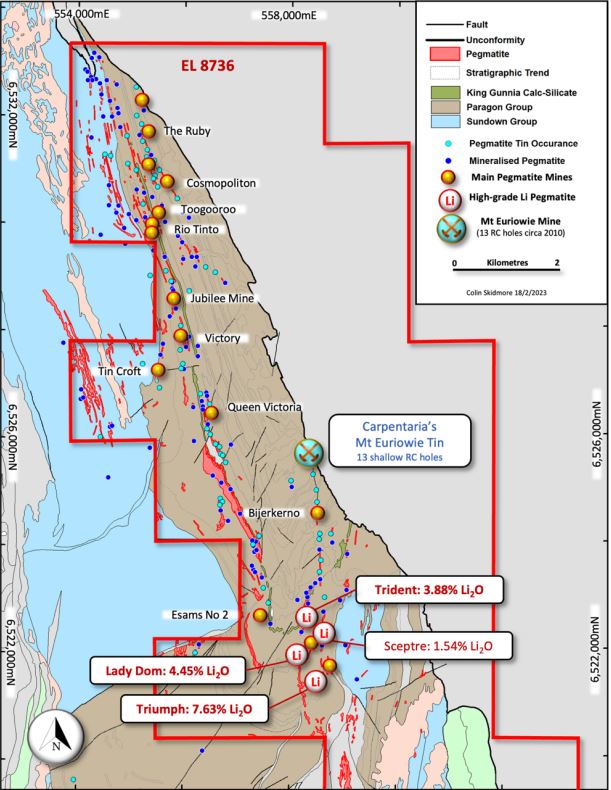
Trident Lithium Project showing the distribution of pegmatites and known mineral occurrences.
Stelar intends to begin surface sampling and mapping next month, while also advancing approvals with an aim to begin an initial drilling program late in the third quarter of 2023.
The program will be designed to confirm pegmatite orientation and lithium fertility before embarking on a deeper, more comprehensive drill program to test for lithium resource potential.