
Fine wine is emerging as a popular alternative asset class among wealth managers and high-net-worth individuals, having made strides to shake off its reputation as a passion asset.
In a recent survey commissioned by fine wine investment expert WineCap, 96% of respondents said they expect demand for investment-grade vino to increase, with 60% expecting it to increase “significantly”.
In comparison, 86% of respondents expect luxury watch demand to increase, 80% for luxury handbags, 68% for art and 62% for classic cars.
“Fine wine has long been seen as a ‘passion asset’ – a fun and exciting yet niche investment option for connoisseurs and hobbyists,” said Alexander Westgarth, WineCap’s founder and chief executive.
He continued: “But over the past few years, characterised by increased market and economic volatility that have destabilised traditional assets such as equities and bonds, perceptions of fine wine have evolved from a passion asset into a mainstream alternative asset.”
Westgarth believes that, due to its low correlation with other asset classes, fine wine investing deserves a wider audience than it currently has.
“Our research found that fine wine is already featuring prominently in many wealth managers’ client portfolios.
“Indeed, the UK wealth managers and advisers that took part in our study estimated that over 40% of their HNW client base invests in fine wine with an average portfolio allocation of
around 10%,” noted Westgarth.
Its growing prevalence among investment portfolios, “provides compelling evidence, if
any is needed, that it has graduated to a genuine alternative asset”.
In terms of market performance, the Liv-Ex 100 Index, which acts as a benchmark for monitoring fine wine prices, is currently down 3.3% year to date, though it has generated returns of 21% in the past 24 months.
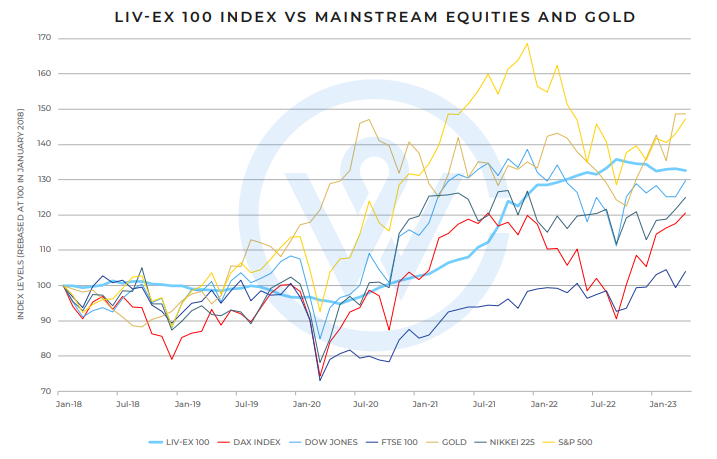
Live-Ex 100 Index performance compared to global commodities and equities indexes – Source: WinCap
Burgundy and Champagne wines were the top regional performers in the past 24 months, generating returns of 46.8% and 45.5% respectively.
Rhone was the worst regional performer tracked by Liv-Ex, generating returns of 1.6% in the past 24 months.
Col d'Orcia’s Poggio Vento Riserva label from the Brunello di Montalcino sub-region of Tuscany, Italy, has been the best individual wine investment in the past 12 months, with the average case price increasing 45% to £ 1,290.