
- FTSE 100 closes 40 points lower
- Wall Street lower as PMI data proves mixed
- UK retail sales and consumer confidence improve
4.45pm: FTSE finishes in the red
At the close, the UK's main index had fallen another 0.5% to finish the week at 7,462 points.
IG's Axel Rudolph struck a cautious tone.
"The FTSE 100 is trading back in negative territory year-to-date and is fast approaching its March banking crisis low as worries of a UK recession due to rapidly rising interest rates mount," Rudolph said.
3.55pm: Office enforcement
Citigroup Inc will start enforcing a rule for workers to be in the office at least three days a week, saying it will "hold colleagues accountable" for doing so, potentially by taking it into account in performance reviews, according to reports.
The bank said in a statement on Thursday that it will now check whether employees are coming into the office the required number of days, Bloomberg reported, and will consider office attendance when rating employees' performance and pay.
"We are committed to our hybrid work model and proud of the flexibility it provides our colleagues to work at least three days per week in the office and up to two days remotely," the bank said in a statement to media, shared by Reuters.
"We have firm expectations for office attendance and know that the majority of our employees are compliant with their requirements."
"As necessary, we hold colleagues accountable for adhering to their in-office days," it added.
3.40pm: Crude matters
Oil prices dropped on Friday as concerns over economic growth in the wake of interest rate hikes outweighed signs of tighter supplies and lower US crude stocks.
In afternoon trading, UK Brent crude was down 1.3% to $72.84 a barrel, while US West Texas Intermediate (WTI) crude was 1.3% lower at $68.24 a barrel.
Crude prices fell back on Thursday after the Bank of England raised interest rates by a bigger-than-expected 50 basis points, while central banks in Norway, Switzerland and Turkey also hiked rates. Higher interest rates could slow economic growth and cloud the oil demand outlook for the rest of the year.
This week's US inventory report showed crude stocks posted a surprise decline of 3.8 million barrels.
Saudi Arabia's production cut of 1 million barrels per day in July, announced along with an OPEC+ deal to limit supplies into 2024, is also set to tighten the market.
3.30pm: US composite PMI down
Activity at US factories and in the services sector slowed in June, meaning S&P Global's composite output index for both sectors fell to a reading of 53.0 in June, down from 54.3 in May.
While US manufacturers again saw production shrink, in services output remained "solid", S&P Global said, although it slowed as well.
The separate Purchasing Managers' Index (PMI) for services alone fell to 54.1 from 54.9, just above consensus of 54.0. The PMI for factory activity dropped to 46.3 from 48.4, against the consensus for a rise to 48.5.
"The overall rate of expansion of business activity in the US remained robust in June, consistent with GDP rising at a rate of 1.7% to put second quarter growth in the region of 2%," said Chris Williamson, chief business economist at S&P Global, said in a statement.
"Growth remains dependent on service sector spending, however, with manufacturing slipping back into decline after three months of growth. While improving supply conditions had helped boost manufacturing production in prior months, an increasingly severe downturn in new orders mean factories are running out of work,” he added.
3.15pm: Traveller’s joy
Security workers at Heathrow Airport have called off 31 days of strikes planned for this summer, Reuters has reported.
Over 2,000 staff accepted an improved pay offer for a rise of between 15.5% and 17.5% the Unite union said on Friday and industrial action at the airport has been cancelled as a result.
Workers had already staged 18 days of strikes in recent months, and while airport bosses had guided it would be able to keep operations running smoothly despite walkouts over the summer, passengers worried there could be a repeat of last year's chaos.
In 2022, a faster-than-expected rebound in air travel for the peak season coupled with labour shortages caused long delays at several airports across Europe.
Heathrow, which was used by 6.7 million passengers in May, said it was pleased the dispute was over.
"We can now move forward together and focus on delivering an excellent summer for our passengers," a spokesperson told Reuters.
2.45pm: Weakness worldwide
The FTSE 100 index stayed close to session lows mid-afternoon as US stocks started lower after a nervous week reflecting worries over the impact of interest rate rises by central banks globally in their efforts to contain inflation.
Around 15 minutes after the New York open, the Dow Jones Industrial was down 211 points, or 0.6% at 33,999, while the broader S&P 500 index shed 0.8%, and Nasdaq Composite dropped 1.1%.
US stocks are on track for a losing week as Federal Reserve chair Jerome Powell’s hawkish outlook and interest rate hikes from several central banks weighed on sentiment on Friday.
“[Powell’s] comments that the Fed would proceed with caution resulted in a small relief rally, but stocks are still set to book weekly losses after several weeks of gains,” noted FOREX.com market analyst Fiona Cincotta.
“While Fed Chair Powell pointed to another two rate hikes this year, the market is less convinced, pricing in another 25-basis point hike in July. Recent data has also raised concerns about a potential recession which is also hurting risk sentiment," she added.
2.30pm: Insurance reserved
Insurers must rigorously assess the impact on their solvency of the rising cost of settling car, property and other claims and ensure they have sufficient reserves, the Bank of England has told the sector, Reuters reported.
The BoE said that claims inflation due to factors such as rising wage, medical and raw materials costs is expected to affect all general insurers.
"There is a risk that persistently elevated claims inflation might result in a material deterioration of solvency coverage for some firms unless they take appropriate mitigating actions," the BoE said in a letter to chief actuaries of general insurers, Reuters said.
"Technical provisions must be calculated based on up-to-date, credible information, and realistic assumptions. Therefore, claims inflation should be robustly considered."
The BoE anticipates that 2023 year-end will be more challenging for reserving teams at insurers. Firms should be mindful of this when undertaking their mid-year reserving exercise, along with capital and business planning for 2024 later this year, BoE said, adding that it may check with firms how they have considered these issues.
2.15pm: What's the credit score
Chancellor Jeremy Hunt has said mortgage borrowers will not have their credit score affected if they struggle to meet repayments.
The move follows a meeting between Hunt and the heads of the UK’s leading mortgage lenders this morning. Banks have also agreed to give more flexibility in their mortgage terms allowing a temporary six-month change before returning to the original agreement.
Anyone at risk of repossession will also be able to delay any move by their lender for twelve months.
“The most significant thing is that they can pick up the phone to their bank or mortgage lender and talk about their situation without any worry that it will impact their credit score,” Hunt said.
Mortgage lenders have rushed to raise rates again after the Bank of England yesterday raised interest rates to 5% to curb inflation. Rates have jumped to more than 6% on a typical two-year fixed-rate mortgage, almost double the rate a year ago.
Attendees at the meeting included NatWest chief executive Alison Rose, Lloyds CEO Charlie Nunn, Virgin Money’s David Duffy, Nationwide’s Debbie Crosbie and Mike Regnier of Santander UK.
1.40pm: FTSE falling again
The FTSE 100 is retreating again, ahead of the New York stock market open, now down 43 points or 0.6% to 7460.
Most of London's biggest companies are in the red, with AstraZeneca, Shell, HSBC and Unilever all sliding lower in the past half-hour.
US stock index futures also indicated initial drops will be larger.
1.30pm: Top movers
GSK is the top riser on the FTSE today, up over 5% after agreeing a settlement to avoid a court case in July over its former Zantac drug.
Analysts said it was encouraging news but is not a full stop on the saga.
Among small caps, telco engagement app group Pelatro PLC was another big riser, up 9% on a bullish AGM statement that contained news that it has so far racked up 28 customer contracts.
Another gainer was Zenith Energy Ltd, which picked up 11% to 0.4p earlier on a Memorandum of Understanding signed with the Ministry of Petroleum in the Republic of South Sudan, though its shares have flattened off as the day wears on.
Biggest faller was podcast company Audioboom Group PLC, down 24% after warning on profits due to challenges in the ad market, even though it had notched a new company download record.
Hotel Chocolat Group PLC (AIM:HOTC) also warned on profits, its second in three months, sending its shares down 15%. It now expects a "minor loss" this year having said in April that it expected to break even in what is a "transitional year".
12.53pm: US stocks to join risk-off mood
Joining the FTSE and other European stocks in the red, Wall Street futures are indicating the Dow Jones, S&P 500 and Nasdaq will all fall at the open.
The Dow is seen dropping 0.30%, the S&P 0.42% and the Nasdaq 100 by 0.50%.
“It’s tech to the rescue once again as a strong showing from names such as Amazon and Apple helped Wall Street to record a positive session last night,” commented analyst Danni Hewson at AJ Bell.
“Federal Reserve chairman Jerome Powell gave the market the message it wanted to hear – while US rates have not hit the top of the current cycle, the central bank will proceed with caution. That was enough to convince investors to keep bidding up shares in the mega-cap tech names, which in turn gave a near-1% lift to the Nasdaq last night.”
Aside from Powell’s comments, US Treasury Secretary and former Fed chair Janet Yellen noted that she felt US recession risks had fallen recently.
Tesla is heading lower as another analyst downgrade lands, this time from DZ Bank, which double downgraded to 'sell' from 'buy'. This followed a downgrade from Barclays earlier in the week as analysts worried about near-term fundamentals for the car industry.
Another trading down in pre-market trading is Virgin Galactic Holdings Inc (NYSE:SPCE), where shares fell sharply in pre-market trading after it revealed plans to sell shares worth up to US$400mln on top of $300mln sold since March.
In terms of US macro data, the latest round of US factory and non-factory sector PMIs will give a fresh insight into the health of the US economy.
"While any upside might be welcomed in terms of endorsing Yellen’s view that a recession will be avoided, that same strength might also feed into expectations of further rate hikes, keeping stocks pressured near-term," Harte added.
Back in London, the Footsie is down 22 points or 0.29% at 7480.
12.27pm: Weather warning for soft commodities
There's another warning about the potential effects of the El Niño weather system, this time from Capital Economics commodities expert Bill Weatherburn.
Yesterday, Barclays warned of the potential inflation threat looming as the upcoming El Nino weather pattern is set to further push up prices across a range of commodities, hitting beer, soft drinks and many foodstuffs in particular.
Weatherburn, in a note to clients today, says: "If the weather forecasters are right, El Niño conditions have arrived in the Pacific and are set to build over the next few months.
"The negative impact on agricultural production will depend upon the strength and duration of these conditions but sugar, cocoa and coffee output is particularly vulnerable."
For now, he continues to expect that higher prices should incentivise planting, and that over the coming seasons supply should improve.
"But a key risk to our forecasts is that El Niño affects production this year and into next year," he says, adding that the extent to which El Niño conditions actually affect production will depend on the strength and duration of the weather system this year.
12.05pm: Bank talks held in Downing Street
Bosses of the UK’s largest lenders have met Chancellor Jeremy Hunt today, fresh from mortgage rates rising again on the back of yesterday’s shock base rate hike to 5.0% from the Bank of England.
The meeting is designed to encourage lenders to do more for households struggling to meet mortgage payments after both Hunt and UK prime minister Rishi Sunak ruled out direct help from the government.
NatWest chief executive Alison Rose, Lloyds boss Charlie Nunn, Virgin Money’s David Duffy, Nationwide’s Debbie Crosbie and Mike Regnier of Santander UK all were in attendance.
According to reports earlier in the week, Hunt will reportedly encourage the lenders provide some leeway for customers struggling to keep up with mortgage repayments, including for families in arrears.
As for savers, MPs are calling for the Chancellor to intervene there too, with suggestions that a bank windfall tax might work.
Shares in the FTSE 100 banks are all in the red, from 0.4%, 0.7% and 0.8% for NatWest, HSBC and Lloyds, to 1.2% for Barclays and 1.5% for Standard Chartered.
11.48am: Rate expectations rise, FTSE falls
The market has increased UK rate expectations, following the Bank of England's hike yesterday and comments from the monetary policy committee and governor Andrew Bailey.
A peak rate of 6.25% is now being priced in, up from 6% earlier in the week and compared to the current BoE base rate of 5.0%
Many economists only see one or two more hikes in the coming months.
*TRADERS BET BOE WILL RAISE RATE TO 6.25%, HIGHEST SINCE 1998
— IGSquawk (@IGSquawk) June 23, 2023
As we approach midday, the FTSE 100 remains underwater, down 23 points or 0.26% at 7479.
Like yesterday, it is being underperformed by the more UK-focused mid caps of the FTSE 250, which is down 155 points or 0.84% at 18,173.
Gilt yields, which fell after the disappointing PMI data earlier, have climbed.
The UK 2yr is up to 5.12%, while the 10yr has not perked back up from weekly lows and little moved at 4.29%.
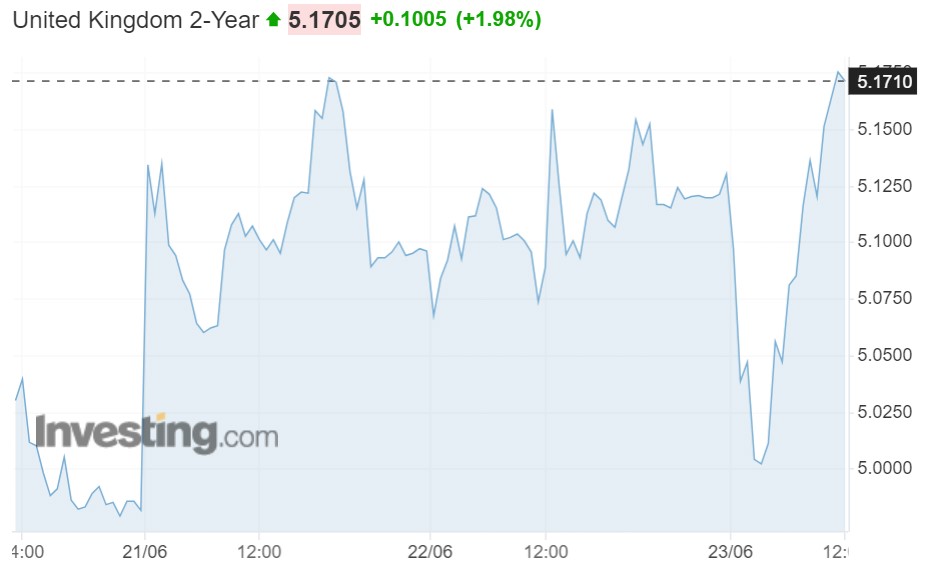
Ok - well that didn't last very long - UK 2-year yields now higher at 5.12% and highest since 2008
— Michael Hewson ???????? (@mhewson_CMC) June 23, 2023
11.37am: Top FTSE risers and fallers
Among the blue chips the main fallers, behind Ocado, are housebuilders, retailers, miners and cardboard boxmakers.
Ocado is down 8.1%, then other retailers JD Sports Fashion, Kingfisher, Burberry and Frasers are down between 4% and 2%.
Builders Persimmon, Berkeley, Barratt Developments and Taylor Wimpey have fallen either side of 3%, similar to miners Anglo American, Glencore and Antofagasta. Boxmakers DS Smith and Smurfit Kappa are also in there.
Concerns about demand has seen commodities take a hit, with oil prices down again and metals also struggling.
Fitch this week reduced short-term prices for copper, aluminium, zinc and thermal coal in a revision of its global metals and mining assumptions.
GSK is top of the leaderboard after its Zantac settlement, up almost 6%. Next is British American Tobacco, up 2%.
11.11am: Doom and gloom prediction
Some doom and gloom if you want it, from Clifford Bennett, chief economist at ACY Securities, an Aussie forex and CFD broker.
Bennett, author of 'Warrior Trading' and whose Twitter account boasts that he is the “world’s most accurate currency forecaster" according to Bloomberg News, says following the recent interest rate hikes, the UK, Europe, US and Australia face "inescapable" recessions and "lasting destruction".
"While the world has faced and continues to face many challenges, these major historic errors of largely western central banks in completely missing the rise of a new inflation animal, continue to wreak havoc around the globe," he began, in jolly style.
He says "the great historic error version 2" is that central banks have called "so far behind the recurve, as to need to aggressively raise rates belatedly in a way that only continues to trail the reality of the underlying challenge".
"It really has, and continues to be a case of the application of last century central bank thinking and playbooks, to an entirely different this century inflation animal. Let alone taking into account the very altered state of the global economy we now live in."
With side-swipes against economists having no imagination and unquestioningly falling into line behind "the absurdity of doubling up on the pain and anguish of consumers and businesses", Bennett goes on to say that the sequence of rate hikes are "arguably both un-necessary and indeed harmful in a non-productive way".
Is this the final battle between the crumbling economic fundamentals of the USA, and all that money printing and debt spinning through the system? In the wake of an exuberant rally witnessed last week, the stock market has taken a noticeable downturn. https://t.co/JyrkFnrkGH
— Clifford Bennett (@cliffordbennett) June 23, 2023
Once inflation does come down he says these policy decisions will be "trumpeted by their executioners" nonetheless even though inflation would have surrendered by its own accord "in most probably the same period of time, or sooner in any case".
Sooner, he says, because rate hikes have now reached "a tipping point where they themselves add fresh inflationary impetus", presumably alluding to the cost of living crisis leading workers to demand pay rises.
"All cycles come to an end. This will of now however be only after the amplified unnecessary destruction of much capital and community well-being," he adds noting that this is something central bankers are supposed to take into account.
"Rather than a short term economic correction to take the edge off inflation, we have now entered the realm of lasting destruction not easily remedied.
"Rate cuts are not coming, as we always forecast, but even if they did, they would at this point not be enough to save the West from one of the more severe and prolonged economic slow-downs we have perhaps ever experienced.
"The outlook for all asset classes remains somewhat vulnerable to say the least," he concludes.
10.32am: FTSE outperforming so far
Having disentangled itself from deeper losses earlier, London's blue-chip index is doing better than most of its continental European cousins.
Looking across the European scene, the Footsie is down 15 points or 0.20% at 7487, while over in Germany, the DAX is down 0.6%, Italy's FTSE MIB is down 0.5% and Spain's IBEX down 0.4%.
France's CAC 40 is the only one matching the UK index currently, also down 0.2%
On the forex market, the pound is up 0.6% against the euro at £0.8541 today, though it is down 0.3% versus the dollar.
The pound had a pretty "neutral" reaction to the Bank of England’s hike yesterday, economists at ING noted, with the attempt by the MPC "to get ahead of the curve with more aggressive tightening [...] being accompanied by rising speculation that this will trigger monetary easing starting in the summer of 2024".
After the Bank of England hiked rates to 5% yesterday, governor Andrew Bailey later calling for workers to stop demanding higher wages and businesses to refrain from lifting prices, otherwise he said inflation will not come down from current “absolutely unsustainable” levels.
Bailey also signalled that rate setters were prepared to push the country into a recession if necessary to curb soaring prices.
13th time lucky? ????https://t.co/xoXpk9WNMJ pic.twitter.com/QGJHmvSvWc
— Dario Perkins (@darioperkins) June 23, 2023
10.10am: PMI gives 'ambiguous steer' for Bank of England
The PMI survey "continues to give an ambiguous steer on whether the MPC already has done enough to cool the economy and curb CPI inflation", says economist Gabriella Dickens at Pantheon Macroeconomics.
She says the survey is consistent with quarter-on-quarter growth in GDP in the second quarter of about 0.2%, but excludes the construction and public sectors, where output is likely to have fallen sharply, so she expects the UK economy to be broadly unchanged in Q2 versus Q1.
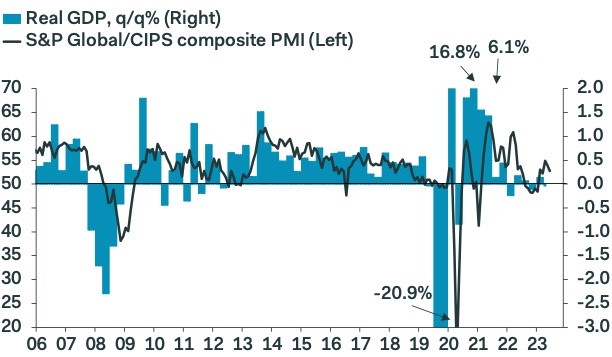
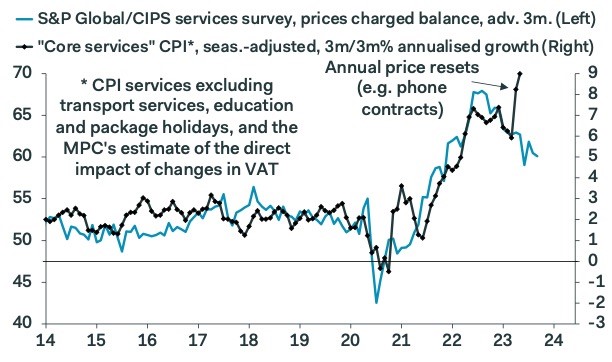
The output prices balance of the services survey points to three-month growth in the core services CPI, as defined by the Bank of England's MPC, slowing to about 5% "soon" from the 9.0% pace in May.
"We think that such a slowdown in the pace of services price rises, if it materialised, would persuade the MPC that it does not need to increase Bank Rate to the 6% level priced-in by markets, but the committee hasn’t been clear how much progress it needs to see before it takes a breather from raising rates.
"Our view is that the MPC will raise Bank Rate to 5.25% in August and to 5.50% in September before then standing pat in November."
9.49am: PMI suggests services inflation remains stubborn
Backing up the CPI data from earlier in the week, and with the Bank of England confirming services sector inflation is one of its main worries, the PMI survey also points to inflation persisting.
The June data also highlighted contrasting inflationary pressures in the manufacturing and service sectors, says S&P, which carries out the surveys.
Manufacturing companies signalled a reduction in factory gate charges for the first time in more than seven years, while service providers recorded more steep rises in average prices charged, though the rate of inflation was slightly softer than in May.
"Reports from survey respondents suggested that strong wage pressures remained by far the biggest factor leading to higher average prices charged across the service economy," the report said.
9.32am: FTSE pares losses despite PMI disappointment
UK PMI data indicated business activity increased for the fifth consecutive month in June, but was lower than expected and showed slight falls in inflation.
Both the services sector and manufacturing components of the S&P Global/CIPS UK PMI update for June came in below the consensus forecast.
The services PMI for June printed at 53.7, down from 55.2 the month before and below the 54.8 average economist estimate. A number above 50 indicates economic expansion, while those in the 40s and below point to recession.
The manufacturing PMI fell to 46.2 from 47.1, missing the expected 46.8.
Putting the two together, the composite PMI measure was 52.8, down from 54.0 and below the expected 53.6.
S&P said it showed a "solid upturn" in the service economy, whereas manufacturers "continued to underperform".
Chris Williamson, economist at S&P Global Market Intelligence, said: “June's flash PMI survey indicates that the UK economy has lost momentum again after a brief growth spurt in the spring, and looks set to weaken further in the months ahead.
"Most notably, consumer spending on services, which was a core growth driver in the spring, is now showing signs of faltering as the reality of higher interest rates, the increased cost of living and gloom about the outlook sets in and overrides the brief boost to spending enjoyed from the pandemic tailwind.
"The manufacturing sector meanwhile continues to report recessionary conditions."
Following the release the FTSE index continued to pare losses, now down just under 13 points. The FTSE 250 meanwhile, more of a domestically focused index, remained largely unmoved, down 69 points or 0.4% at just under 18,259.
9.19am: Cold water poured on Ocado
Some comment on Ocado from Shore Capital's head of consumer research Clive Black, after the online grocery group's shares rocketed yesterday on recycled reports about potential bid interest from Amazon or another tech giant.
"To be clear, we do not know if there is something going on in terms of a present bid for Ocado. However, in light of the quite notable share price movement, we would be amazed if the UK Takeover Panel had not been in-touch with both Amazon and Ocado to seek clarification as to the veracity of this story line," said Black in a note to clients this morning.
"That there was no announcement from either party on the 22 June or on the morning of the 23rd, suggests to us that there was nothing to report and as such other factors must be at play."
It is the biggest faller on the Footsie, down 8%.
8.32am: Savings rates going up, FTSE still down
Interest rates are in focus for markets, mortgage holders and savers after the Bank of England hiked again yesterday.
Investec has announced that after the Bank of the interest rate on its fixed rate saver account to 5.68%.
The FTSE 100 meanwhile has fallen to below 7450 but is trying to pare losses.
8.18am: Thoughts on retail data
Thoughts are pouring in from City commentators on the retail sales and consumer confidence data earlier.
Martin Beck, chief economic advisor to the EY ITEM Club, said he thinks that persistent inflationary pressures and rising mortgage costs mean "a sustained retail renaissance is unlikely in the near-term, with sales growth set to remain slow throughout this year".
Looking beyond temporary supports such as the weather, the retail sector does enjoy some tailwinds, he added.
"The labour market is proving resilient, with unemployment remaining low while growth in cash pay is strong. Furthermore, the latest GfK barometer of consumer confidence for June rose for the fifth successive month, and spending power should receive a boost in July, when average annual household energy bills will fall by almost 20%."
However, he says the EY ITEM Club thinks the retail recovery will struggle to gain momentum.
"Although today’s retail release showed growth in shop prices slowing to a 16-month low, overall inflation is proving uncomfortably sticky, suggesting that it will take longer for real household incomes to return to growth. Relatedly, the Bank of England raised interest rates by more than expected yesterday, and the rate rise cycle may have further to run. This will add to the debt service costs of the 2.5mn households exposed to higher mortgage rates during 2023.”
Matt Britzman, equity analyst at Hargreaves Lansdown, said the consumer confidence index rising to its best showing in 17 months "is perhaps a case of consumers simply accepting their fate and choosing to get on with things".
He added: "This renewed 'optimism' will surely be tested over the second half of the year, as things like rent and mortgage costs look set to tick higher – if consumers can pull off a miracle and hang on, it would pave the way for growth if and when inflation comes under control."
8.16am: FTSE 100 opens in red
The FTSE 100 has opened 22 points lower, down 0.3% at 7,480, falling to a new monthly low.
Ocado Group PLC (LSE:OCDO), after its rise yesterday, is leading the fallers, ahead of a group of housebuilders, including Berkeley Group Holdings PLC (LSE:BKG) and Persimmon PLC (LSE:PSN) as worries about the effect of rising interest rates continue.
GSK PLC (LSE:GSK, NYSE:GSK), after its update (see below) on Zantac, is up over 4%.
Richard Hunter, the head of markets at Interactive Investor, was sanguine, seeing markets as "flat to positive, underpinned by a tentative return to high growth momentum stocks".
"The main theme of the week has seen a guarded investor response to the latest central bank actions and outlook comments," he said, noting the Bank of England's rate hike and US Federal Reserve chair Jerome Powell confounding the interest rate speculators who believe that the hiking cycle has definitely ended.
"The position remains finely balanced, with some chinks beginning to appear in what has been a strong labour market, and with some warning signals emanating from the likes of the manufacturing and banking sectors. At the same time, the consumer remains active even though there is an increasing belief that pandemic savings are starting to evaporate, all of which is leading to a consensus for another rate rise in July following the pause this month."
He said the FTSE's moves have "mirrored investor concerns over the general state of inflationary and interest rate positions, drifting lower as investors chose to sit on the sidelines as events continue to unfold", with its gain reduced to 0.4% for the year to date.
7.56am: UK retail sales rise
UK retail sales volumes, including petrol, rose by 0.3% month-to-month in May, according to new figures from the Office for National Statistics.
This was higher than the consensus forecast, -0.2%.
Year-over-year retail sales were down but less than the previous month, moving to -2.1% in May from -3.4% in April, which was again better than the average forecast of -2.5%.
Sales rising on the month as saw weaker food sales around the bank holiday were offset by stronger online spending, which the ONS put down to the warmer weather.
ONS senior statistician Heather Bovill said online shops did particularly well selling outdoor goods and summer clothes, while May also saw a return to growth for fuel sales after a dip in April.
“Garden centres and DIY stores also saw growth, as the good weather encouraged people to start home and garden improvements," she said.
“These were offset by food sales, which fell back as prices in supermarkets continued to rise, exacerbated by many people ordering takeaways and drinking out more during the extra bank holidays, while jewellery and art also fell back after a strong April.”
Economists at ING said: "Weather seems to have been a key driver of recent month-on-month sales volumes, which otherwise have essentially flatlined in real terms for a number of months now."
7.34am: Revolution responds to Boohoo criticism
It's pretty quiet in terms of big company news, but in the intriguing battle between two AIM companies, Revolution Beauty has fired back at criticisms from major shareholder Boohoo with a show of strength.
First-quarter sales for the cosmetics brand were up 60% on the same time last year and underlying earnings (EBITDA) at constant currency rates flipped from a loss las year to a positive £3.5mln this time, it said in a statement.
Revolution chief executive Bob Holt said: "The excellent trading performance in the first quarter of the year is testament to the quality of our offer and the strength of our leadership team, and shows that we are delivering on our global retailer strategy.”
"This has been achieved at the same time as fixing the historical issues overseen by previous management and putting in place improved cost controls and processes across the business."
Shares in Revolution Beauty have been suspended since September after its auditor refused to sign off on its accounts, which has led to an independent investigation being carried out by a law firm and forensic accountants over various issues, including questionable historical sales and personal loans made by its former chief executive.
The company said it is "on the cusp" of having trading in its shares on AIM restored.
7.16am: UK consumer confidence improves
GfK’s composite index of consumers’ confidence improved for the fourth month in a row, but remains firmly negative.
It rose to -24 in June, from -27 in May, above the consensus, -26.
Joe Staton, client strategy director, said: "The cost-of-living crisis has been part of our daily financial reality for a long time, with double-digit inflation and record-high food prices. But despite those pressures, May sees an encouraging three-point uptick in consumer confidence."
He noted that the index has now increased from January’s score of -45 and noted that there had also been an improvement in how people view their personal finances in the next 12 months, despite worries about rising interest rates and the chance it will results in a recession.
The headline index score of -27 means we’re "still deep in negative territory and a long way from any ‘sunny uplands’", Staton said.
"However, the overall trajectory this year is positive and might reflect a stronger underlying financial picture across the UK than many would think. But everybody must hold on tight as it could still be a rocky ride out of these tough times."
7.13am: GSK settles Zantac litigation
Among the early company news, GSK PLC (LSE:GSK, NYSE:GSK) has told shareholders that it has reached a "confidential settlement" with the individual who brought a class action on behalf of users of heartburn drug Zantac.
It said the settlement had been made with James Goetz, and the case he filed in California state court, meaning the trial that was set to begin next month will be dismissed.
"The settlement reflects the company's desire to avoid distraction related to protracted litigation in this case. GSK does not admit any liability in this settlement and will continue to vigorously defend itself based on the facts and the science in all other Zantac cases," the FTSE 100-listed drug giant said in the statement.
7.04am: Further FTSE fall anticipated
Traders are betting that the FTSE 100 will extend its losses on Friday after the Bank of England surprised with a larger rate hike and with global markets mostly in the red.
London's blue-chip index is heading for at least a 22-point drop, according to the IG spread-betting platform, adding to the 57 points lost the day before and the 149 over the previous days this week.
Overnight, Wall Street had a mixed session, with the Dow Jones flat but the Nasdaq rising 0.95% and the S&P 500 adding 0.37% as eight of the top 10 big tech stocks gained ground.
Asia is a sea of red this morning, with Hong Kong's Hang Seng tumbling 1.9%, Tokyo's Nikkei sliding 1.4% and the Shanghai Composite retreating 1.3%, with only India's Sensex showing some sort of resistance, down 0.3%.
"Global markets have continued to struggle over the last 24 hours, with a fresh selloff for sovereign bonds and further equity declines across most regions," said Henry Allen at Deutsche Bank.
"Several factors have been behind this, but the biggest was the dawning realisation for investors that central banks are set to keep hiking rates into the second half of the year, particularly after a surprise 50bps move from the Bank of England."
He noted that the latest macro data "aggravated fears about a potential recession, which further dampened risk appetite".
While it's expected to be a quiet day in the company diary, there's various macroeconomic data out, including updates on UK retail sales and consumer confidence, with the purchasing managers index (PMI) releases for the UK among many other countries later in the morning.